Map reading skills Science Worksheets for Ages 6-9
1 filtered results
-
From - To
Enhance your child's understanding of geography with our engaging Map Reading Skills Science Worksheets, designed specifically for ages 6-9. These worksheets provide interactive and age-appropriate activities that help develop essential map-reading abilities, including understanding symbols, directions, and distance. Through fun exercises and colorful illustrations, children will learn to interpret maps confidently while boosting their spatial awareness. Perfect for both classroom and home use, these worksheets not only build foundational skills in geography and science but also spark a love for exploration. Equip your young learners with the tools they need to navigate the world around them with these entertaining worksheets!
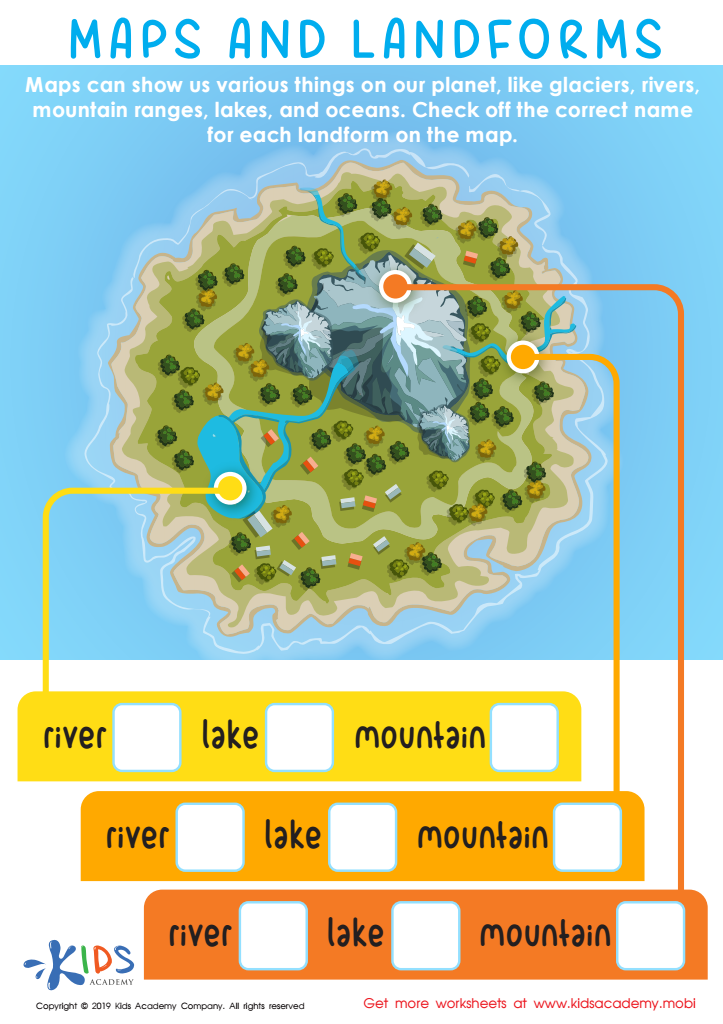
Maps and Landforms Worksheet
 Assign to My Students





Map reading skills are essential for children aged 6-9, as they lay the foundation for spatial awareness and cognitive development. Developing these skills encourages curiosity about the world, helping children understand their surroundings in a more profound way. When children learn to read maps, they enhance their abilities to process information, make sense of symbols, and follow directions—all of which are crucial for problem-solving in various subject areas, including science.
Additionally, engaging with maps can connect students to concepts such as geography, ecosystems, and environmental science. For example, when exploring different terrains or habitats in a map context, students gain insights into the interrelationships between nature and human activity. This understanding fosters a sense of responsibility toward the environment and can stimulate interest in scientific inquiry.
Moreover, map reading promotes teamwork and collaboration when children work on group projects or scavenger hunts. It creates an opportunity for discussion, sharing ideas, and building communication skills. By caring about map reading skills, parents and teachers can support holistic development, critical thinking, and a lifelong love of learning, ensuring that children are not just passive consumers of information but active participants in shaping their understanding of the world.







