
Spatial understanding Math Worksheets for 6-Year-Olds
3 filtered results
Difficulty Level
Grade
Age
-
From - To
Subject
Activity
Standards
Discover the perfect tools for fostering spatial understanding in 6-year-olds with our engaging math worksheets! Specifically designed for young learners, these worksheets enhance skills such as shape recognition, pattern identification, and spatial reasoning. Through fun activities and colorful illustrations, children effortlessly grasp complex spatial concepts, promoting both academic success and cognitive development. Our spatial understanding worksheets are not only educational but also entertaining, making learning an adventure. Perfect for parents and teachers looking to boost their child’s early math skills, these resources lay a strong foundation for future mathematical learning. Explore our collection today and watch your child's spatial aptitude soar!
Favorites
With answer key
Interactive
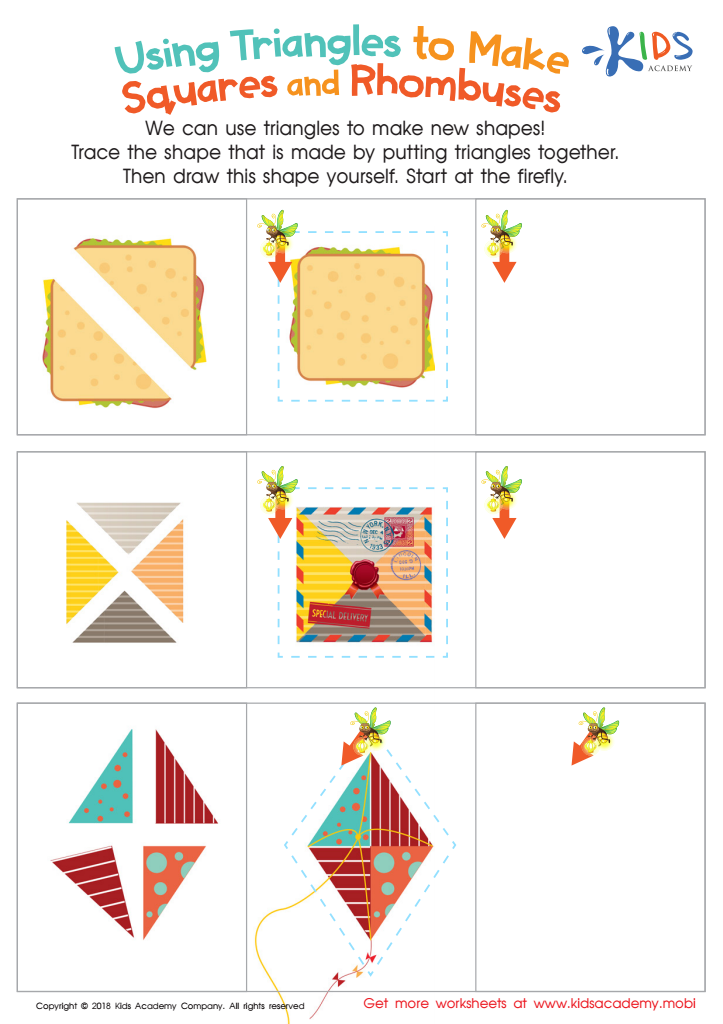
Using Triangles to Make Squares and Rhombuses Worksheet
Learning shapes is a fun way to boost spatial skills and critical thinking. This worksheet shows children how to use triangles to construct squares and rhombuses. Clear illustrations and a printout help children draw the new shape. A great activity for the math classroom! 80 words.
 Assign to My Students
Using Triangles to Make Squares and Rhombuses Worksheet
Worksheet
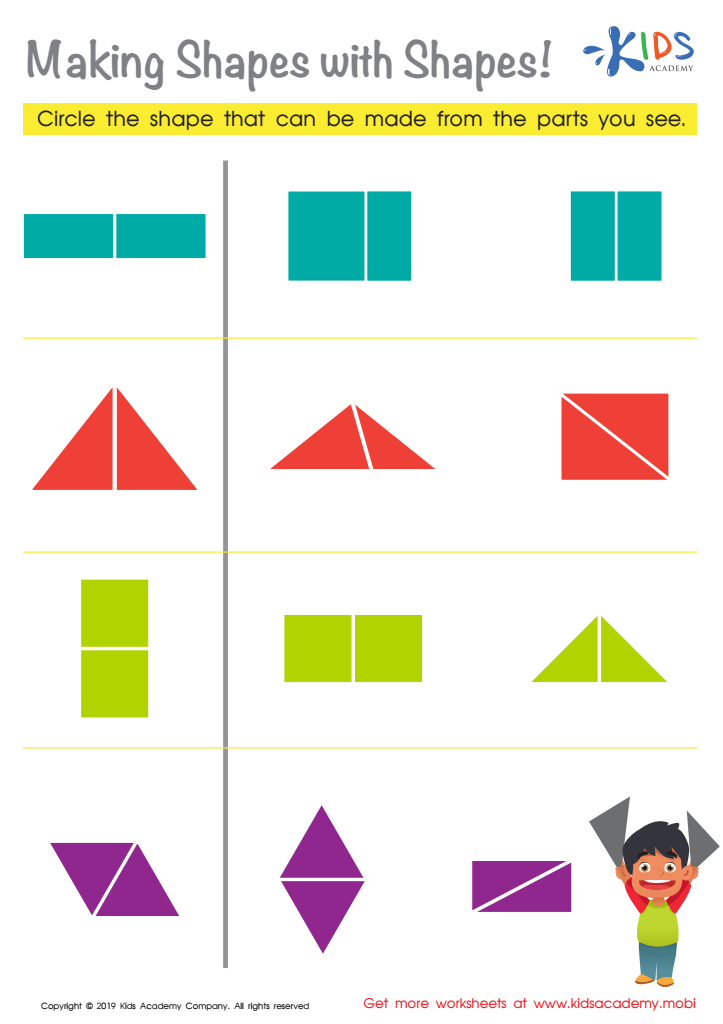
Making Shapes with Shapes Worksheet
Help your kindergartners identify shapes with this simple worksheet. Examine the shapes on the left and have them circle the one they can make from the parts in the picture. Shapes can be tricky, but this exercise will help clear up any confusion.
Making Shapes with Shapes Worksheet
Worksheet
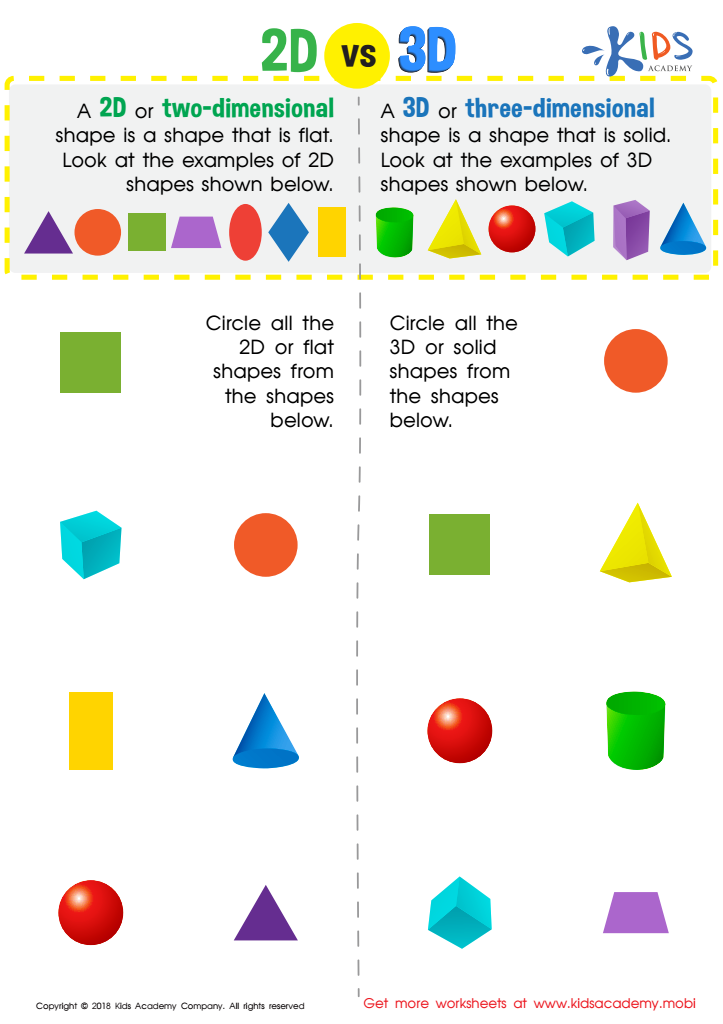
2D vs 3D Shapes Worksheet
Help your child understand 3D shapes using this engaging worksheet! Read the descriptions at the top and search for 2D and 3D shapes. An ideal activity for toddlers learning shapes. A fun way to understand the tricky concept of 3D shapes!
2D vs 3D Shapes Worksheet
Worksheet
Join Kids Academy for Free
Who is primarily going to use this learning content?


.jpg)





Spatial understanding in mathematics is crucial for 6-year-olds as it forms the foundation of countless essential skills and future academic success. Parents and teachers should prioritize spatial skills because they significantly enhance problem-solving and critical thinking abilities. These skills facilitate the comprehension of geometric concepts, such as shapes, patterns, and positions, which are central to early math education.
Furthermore, spatial awareness aids in the development of number sense and the ability to visualize mathematical problems, allowing children to grasp more abstract concepts with ease as they progress. Children with strong spatial skills are also better equipped to understand and navigate their physical environment, improving not only their mathematical acuity but also day-to-fay navigation and coordination.
Environmental spatial understanding encourages the growth of competencies necessary for STEM (Science, Technology, Engineering, and Mathematics) fields. Early development in these areas is linked to long-term academic and career success.
Incorporating spatial reasoning into learning experiences can make math more engaging and fun, fostering a positive attitude towards the subject. Therefore, parents and teachers should integrate spatial challenges through play, interactive activities, and virtual tools to nurture these skills early, ensuring children are well-prepared for educational demands ahead.








