
Understanding comparisons Math Worksheets for 6-Year-Olds
4 filtered results
Difficulty Level
Grade
Age
-
From - To
Subject
Activity
Standards
Introduce your 6-year-old to the world of comparisons with our engaging and educational math worksheets! Designed to boost early math skills, these worksheets help children understand concepts like bigger/smaller, more/less, and longer/shorter. With colorful illustrations and fun activities, kids will learn to compare objects and quantities in an enjoyable way. Perfect for home or classroom use, our worksheets make learning comparisons both interactive and effective. Give your child the tools they need to build a strong mathematical foundation while having fun! Suitable for kindergarten and first-grade students. Explore and download now at Kids Academy!
Favorites
With answer key
Interactive
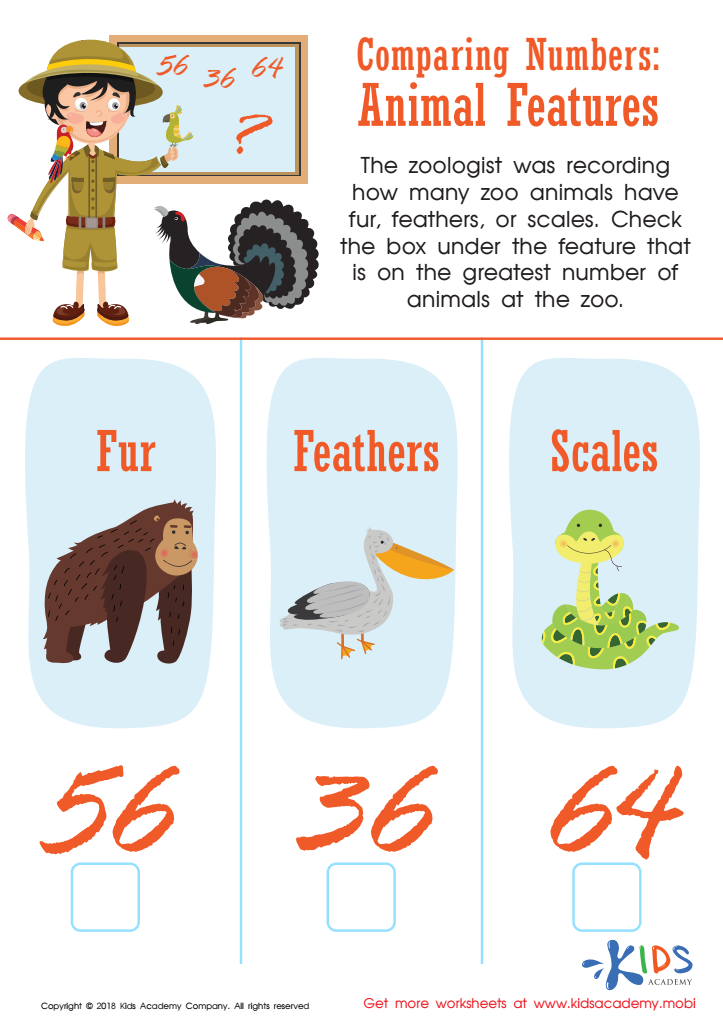
Animal Features Worksheet
Let your kids join a budding zoologist! They can count zoo animals' fur, feathers or scales, then use numbers and comparison to check the box with the most friends. The PDF will captivate them and help them understand how the value of '6' changes based on its position.
 Assign to My Students
Animal Features Worksheet
Worksheet
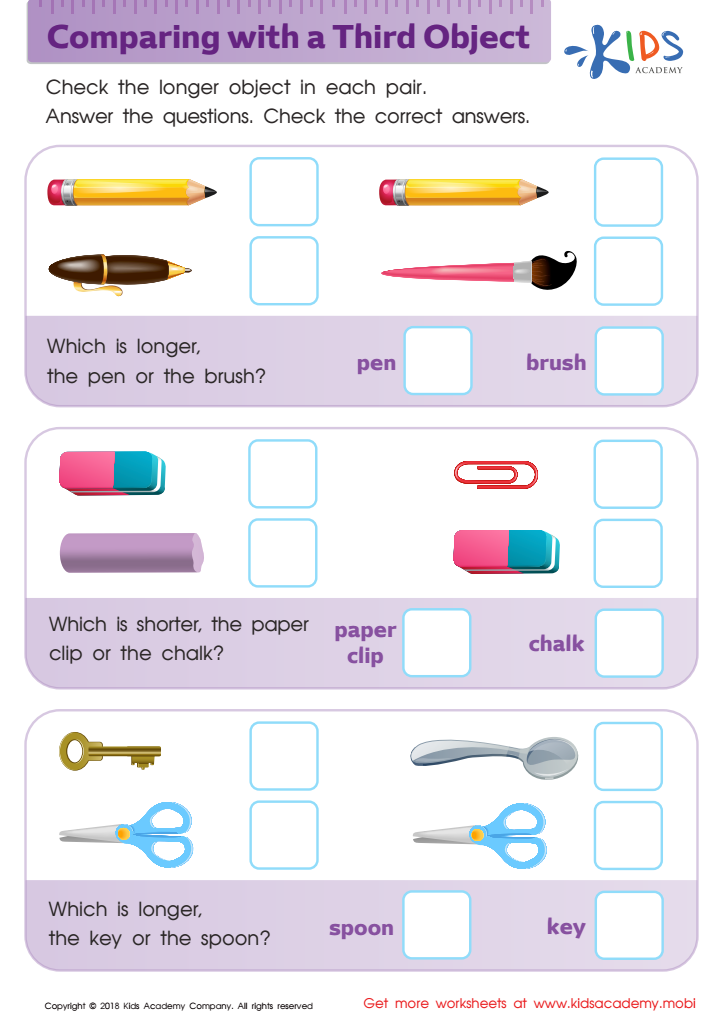
Comparing with a Third Object Worksheet
Help your child master measurement skills with this free downloadable math worksheet! Ask them to compare each pair of objects, checking the box for the longer one. Then, read the question and compare the objects across the pairs before ticking the box and continuing to the next group of pictures.
Comparing with a Third Object Worksheet
Worksheet
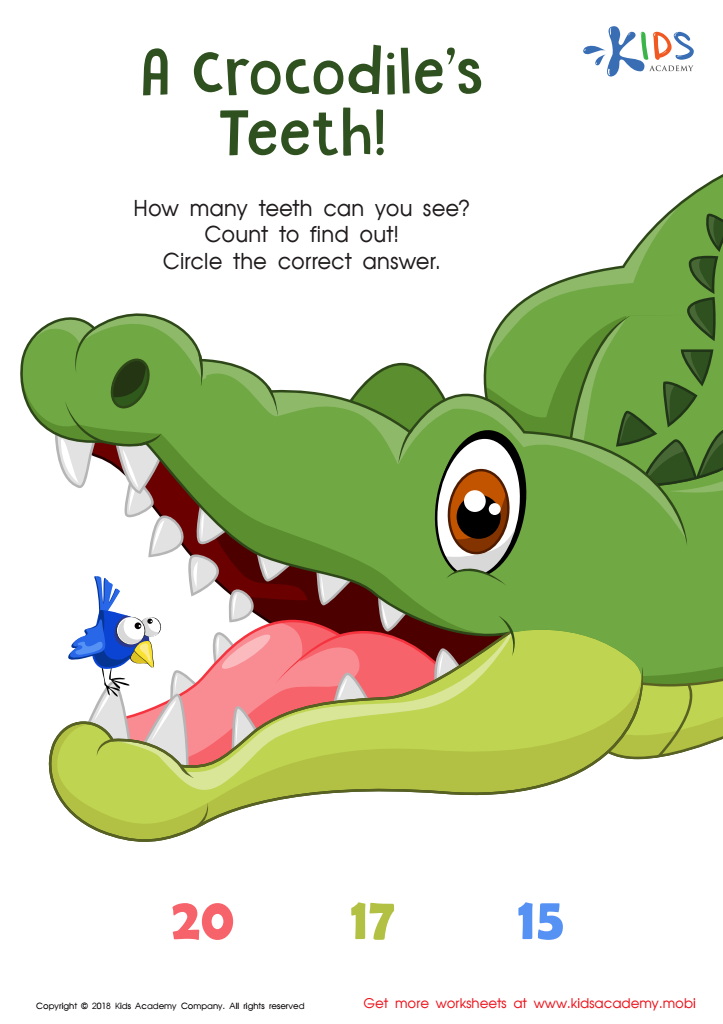
A Crocodile's Teeth Worksheet
Show your child the animal image and ask them to identify it. If they watch animal shows, they'll likely be interested. Count the teeth together, then look at the options and help them circle the right one.
A Crocodile's Teeth Worksheet
Worksheet
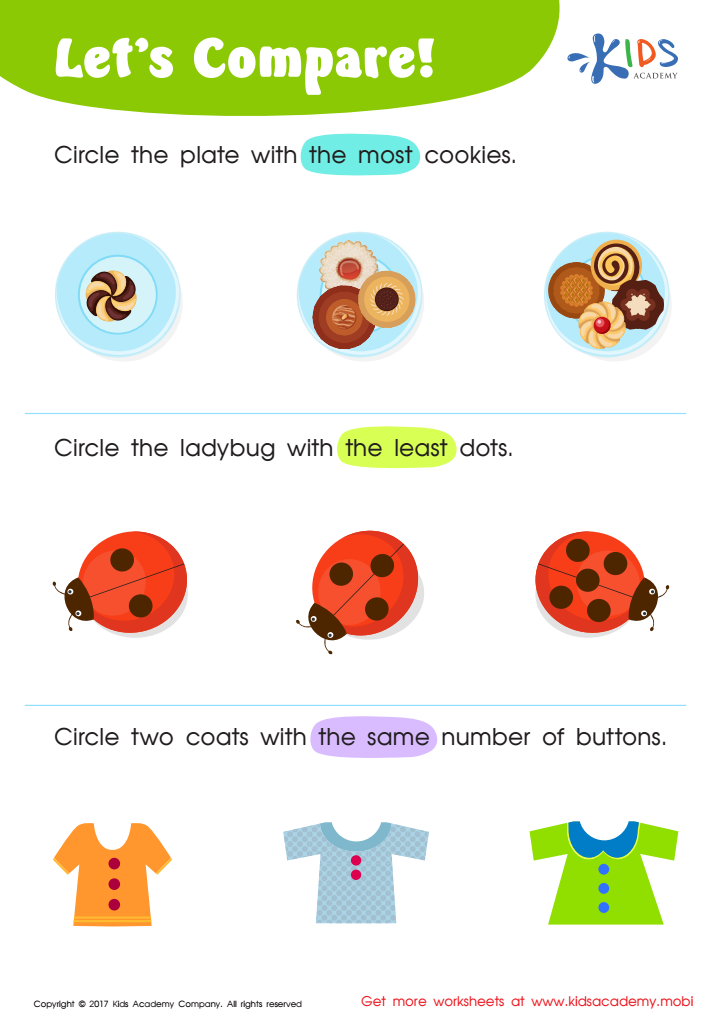
Matching: Classifying Toys by Size Worksheet
.
Have your young one's observation and counting skills ready for this worksheet; carefully look through the images and count the objects, then circle the plates with the least, most or equal number of patterns. Pay attention and have good counting abilities to make this task easy.
Matching: Classifying Toys by Size Worksheet
Worksheet
Join Kids Academy for Free
Who is primarily going to use this learning content?






Understanding comparisons in math is a fundamental skill that lays the groundwork for a child's future success in academia and everyday problem-solving. For 6-year-olds, grasping these concepts is crucial because it helps them develop critical thinking and analytical skills that are vital for more complex math tasks they will encounter later.
First, comparisons introduce basic mathematical vocabulary and concepts like "greater than," "less than," and "equal to," which are used throughout math education. By mastering these terms, children can better understand number relationships and use this knowledge to tackle various math problems.
Secondly, comparison exercises bolster a child's number sense, helping them intuitively understand quantities and numerical order. This foundational skill aids in more advanced arithmetic, including addition, subtraction, and beyond.
Moreover, engaging with comparisons in practical, fun ways strengthens other cognitive abilities such as observation, deduction, and spatial reasoning. Activities like comparing the lengths of objects or the number of items in two different sets can make learning interactive and relatable.
For parents and teachers, emphasizing comparisons ensures that students develop a strong mathematical base, making future learning experiences smoother and more enjoyable. In a broader context, these early skills fortify a child's ability to negotiate real-life situations, like comparing prices or determining the shortest path, contributing to their overall intellectual growth and confidence.








