
Motor skills improvement Worksheets for Ages 7-8
3 filtered results
Difficulty Level
Grade
Age
-
From - To
Subject
Activity
Standards
Enhance your child's dexterity with our Motor Skills Improvement Worksheets for Ages 7-8! Specifically designed to improve fine and gross motor skills, these engaging activities help children develop essential hand-eye coordination, precision, and control. Ideal for practicing through fun, interactive exercises such as tracing, cutting, and drawing, our worksheets support your child's physical development and prepare them for more complex tasks. With easy-to-follow instructions and colorful designs, kids will enjoy each learning moment. Foster their growth, boost confidence, and watch them excel both in and out of the classroom with our expertly crafted worksheets.
Favorites
With answer key
Interactive
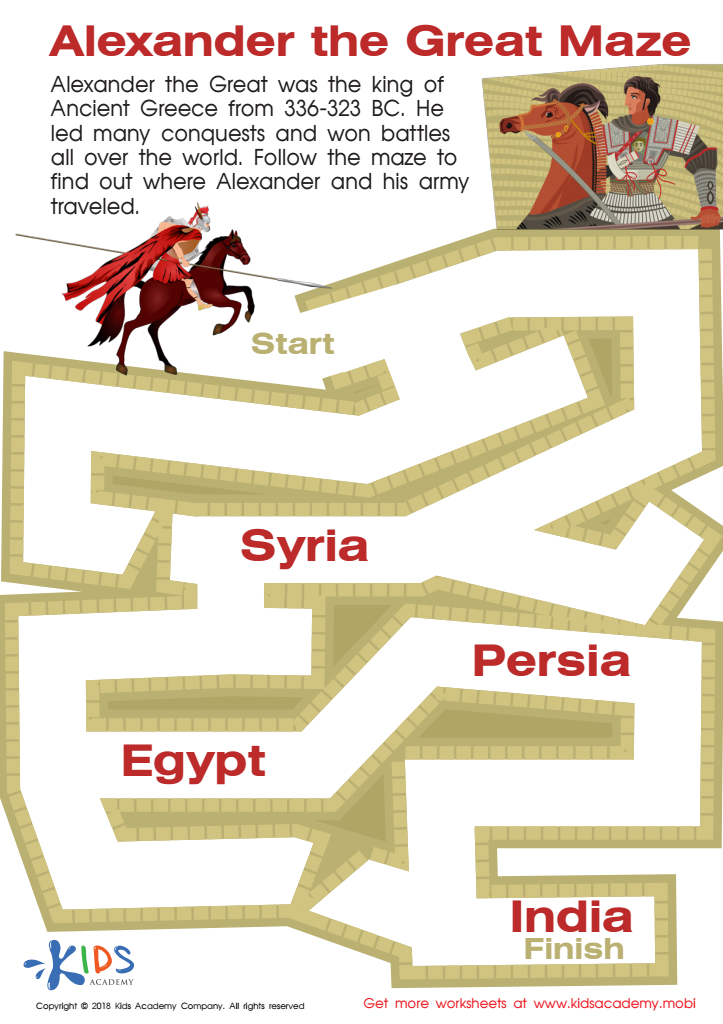
Alexander the Great Maze Worksheet
Kids Academy invites young historians to explore the legendary journey of Alexander the Great! Read the explanation and trace a path through the maze to find out where he and his army went: India! Along the way, they will learn about his amazing conquests, which made him one of the most famous figures in history.
 Assign to My Students
Alexander the Great Maze Worksheet
Worksheet
Join Kids Academy for Free
Who is primarily going to use this learning content?





Motor skills improvement is crucial for children ages 7-8 for several key reasons that parents and teachers should deeply care about. Firstly, motor skills form the foundation of a child's physical development. At this age, fine motor skills like writing, cutting with scissors, and tying shoelaces, and gross motor skills like running, jumping, and balancing are rapidly evolving. Improving these abilities fosters independence, enabling children to perform daily tasks with confidence and efficiency.
Secondly, motor skills are closely linked to academic success. Mastery of fine motor skills enhances handwriting quality, allowing children to better express their ideas on paper and engage fully in classroom activities. Additionally, physical activities that improve motor skills, such as sports or dance, enhance focus and cognitive function, which can positively influence academic performance.
Thirdly, good motor skills contribute significantly to a child’s social development. Participation in group activities and games teaches teamwork, communication, and social skills. Children who struggle with motor skills may experience frustration or exclusion, impacting their self-esteem and social interactions.
Lastly, encouraging motor skill improvement promotes lifelong health and wellness. Active engagement combats sedentary lifestyle habits, fosters a positive attitude towards physical activity, and sets the stage for a healthier future. Therefore, prioritizing motor skills development supports holistic growth—physical, cognitive, and social—for children ages 7-8.








