
Science knowledge application Worksheets for Ages 7-8
3 filtered results
Difficulty Level
Grade
Age
-
From - To
Subject
Activity
Standards
Our Science Knowledge Application Worksheets for Ages 7-8 offer engaging, hands-on activities designed to reinforce and apply scientific concepts. These worksheets help young learners understand the world around them through interactive lessons in topics like life sciences, earth sciences, and physical sciences. With activities focused on critical thinking and problem-solving, children can explore science in a practical, enjoyable way. Aligned with educational standards, our printable resources make it easy for teachers and parents to provide high-quality science education at home or in the classroom. Spark a lifelong love of learning with our expertly crafted science worksheets!
Favorites
With answer key
Interactive
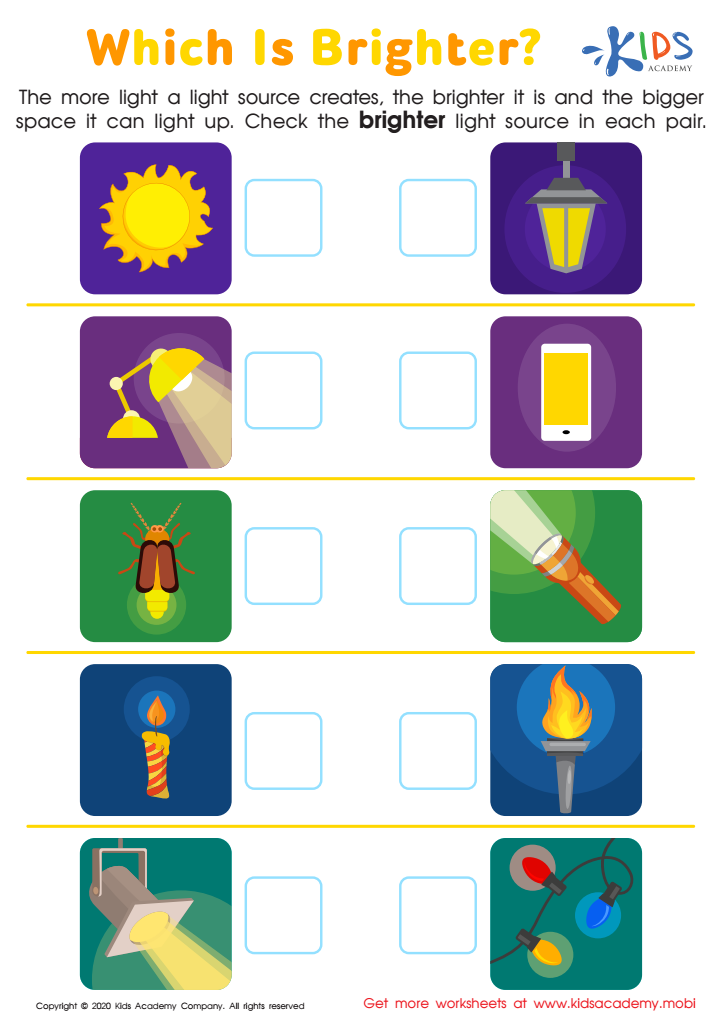
Which Is Brighter? Worksheet
Before the exercise, ask students to recall sources of light. Use this worksheet to explain that the brighter the light source, the more space it can light up. Identify the different light sources in the pictures, then check the brighter light source in each pair. The biggest natural source of light is the sun.
 Assign to My Students
Which Is Brighter? Worksheet
Worksheet
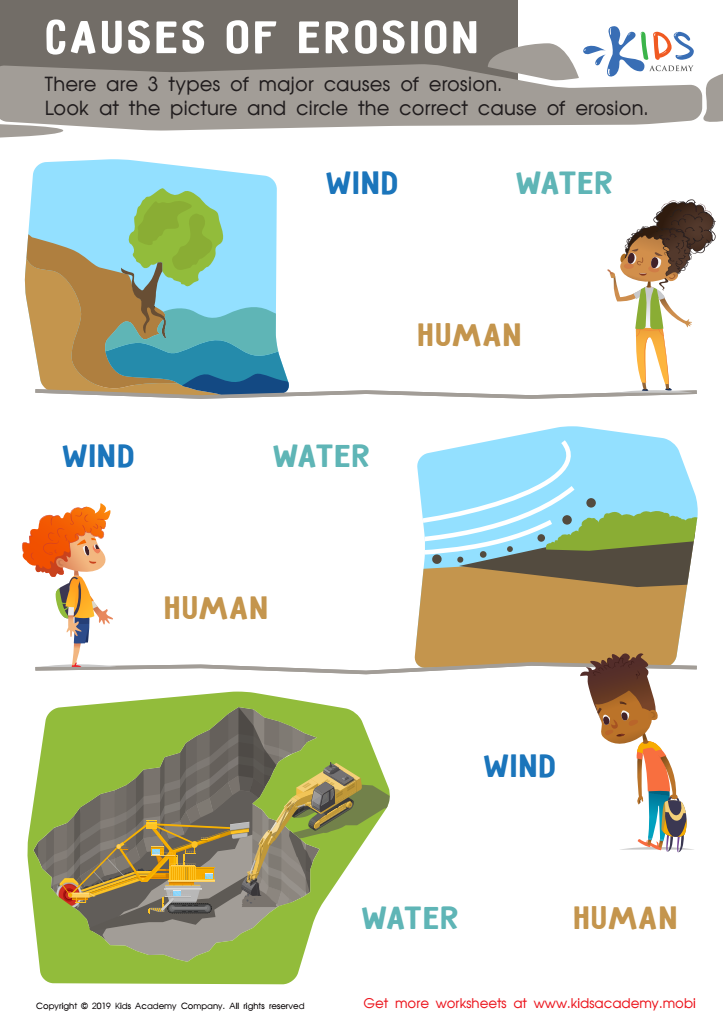
Causes of Erosion Worksheet
Earth is a habitable planet for humans and all life forms, providing us with what we need to survive. However, erosion caused by air, water or man can destroy or crumble parts of its surface. Teach kids the three causes of erosion and help them circle the correct one on a worksheet.
Causes of Erosion Worksheet
Worksheet
Join Kids Academy for Free
Who is primarily going to use this learning content?







Ensuring children aged 7-8 engage meaningfully with science education is essential for numerous reasons, profoundly impacting their development and future success. At this formative age, children's brains are incredibly receptive to new information and experiences, making it a crucial period for foundational learning. Science education fuels children’s natural curiosity, fostering a lifelong love of exploration and discovery.
By integrating science knowledge in practical, hands-on ways, parents and teachers stimulate critical thinking and problem-solving skills. Children learn to ask insightful questions, make predictions, and develop reasoning skills, all fundamental components of scientific literacy. This early engagement also helps demystify complex concepts and bridge gaps in understanding, making science relevant and accessible.
Moreover, applying science knowledge in real-life scenarios cultivates a host of important attributes, such as patience, perseverance, and collaboration. For instance, simple experiments and observations can teach children valuable lessons about ecosystems, weather patterns, or physics principles like gravity. These activities also encourage teamwork and communication among peers, enhancing social skills.
Lastly, in an increasingly technology-driven world, basic scientific literacy equips children with the competence to understand and navigate future innovations. Investing in science application at an early age lays the groundwork for informed, capable individuals ready to contribute thoughtfully to society.








