
Fraction Addition Numbers Worksheets for Ages 7-8
3 filtered results
Difficulty Level
Grade
Age
-
From - To
Subject
Activity
Standards
Enhance your child's math skills with our engaging Fraction Addition Numbers Worksheets designed for ages 7-8. These worksheets introduce young learners to the basics of fractions and their addition through fun and interactive exercises. Each sheet is crafted to simplify complex concepts, making it easier for kids to grasp addition of fractions with visuals and step-by-step problems. Perfect for classroom or home practice, these printable resources aim to build confidence and improve math proficiency. Download our expertly designed worksheets today and make learning fractions an enjoyable and rewarding experience for your child!
Favorites
With answer key
Interactive
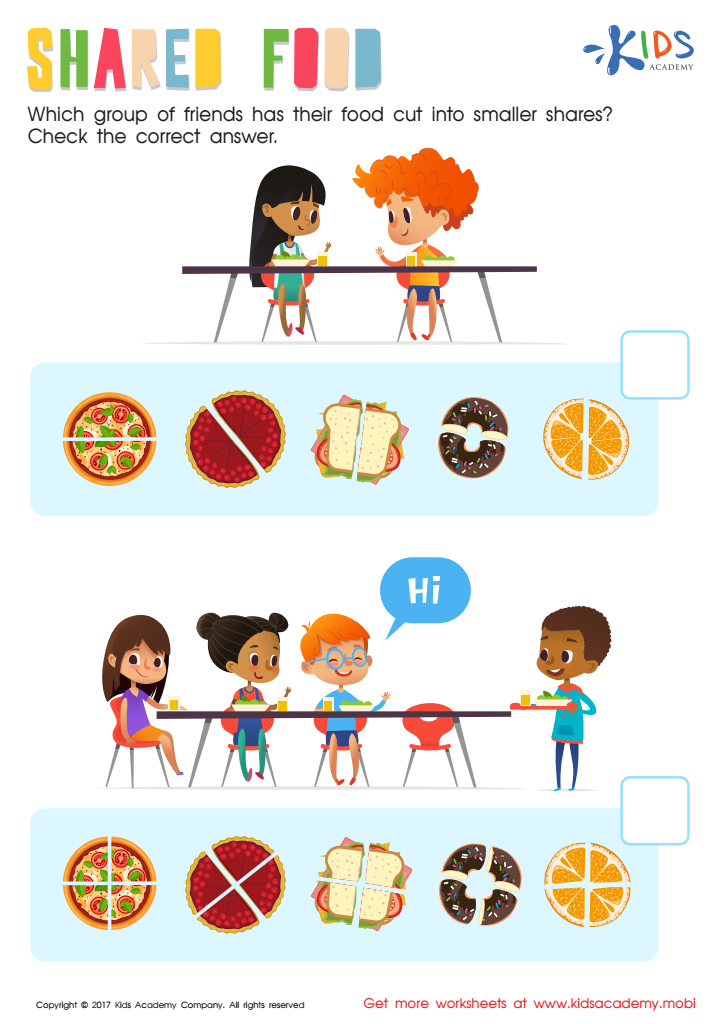
Shared Food Worksheet
In this worksheet, kids learn about sharing and cutting shapes into equal parts. There are two groups of friends: one with two, the other with four. Ask your child which group has their food cut into smaller shares, and help them find the right answer.
 Assign to My Students
Shared Food Worksheet
Worksheet
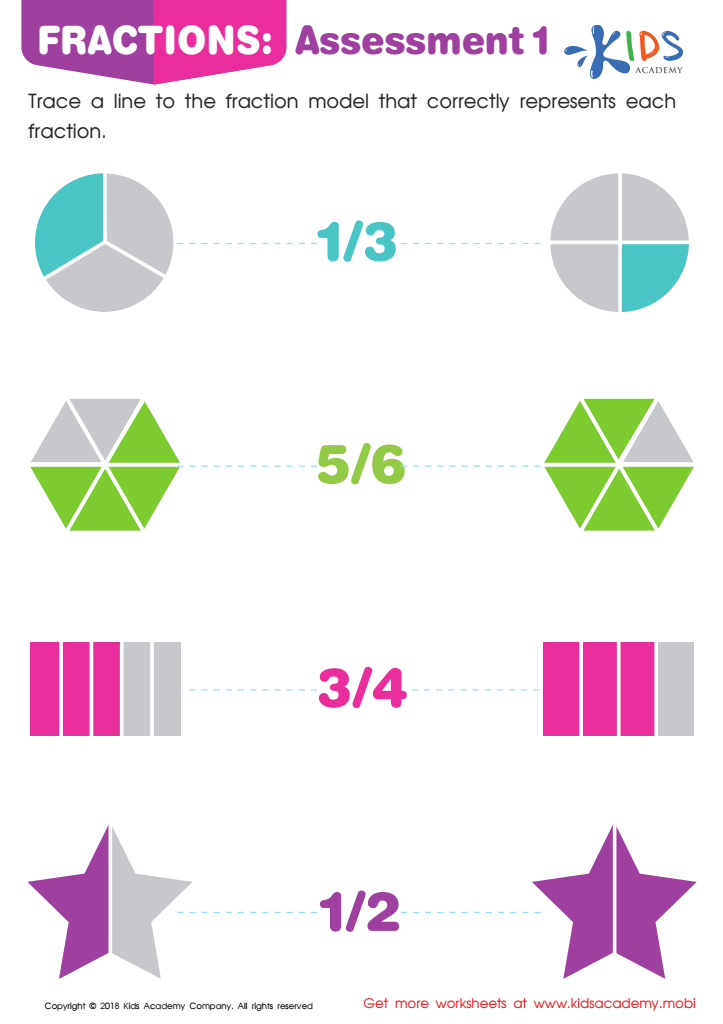
Fractions: Assessment 1 Worksheet
Master fractions easily with this worksheet! It has four sets of fraction models and fraction equations with two models each. Guide your kids to trace a line to the correct fraction model for each equation.
Fractions: Assessment 1 Worksheet
Worksheet
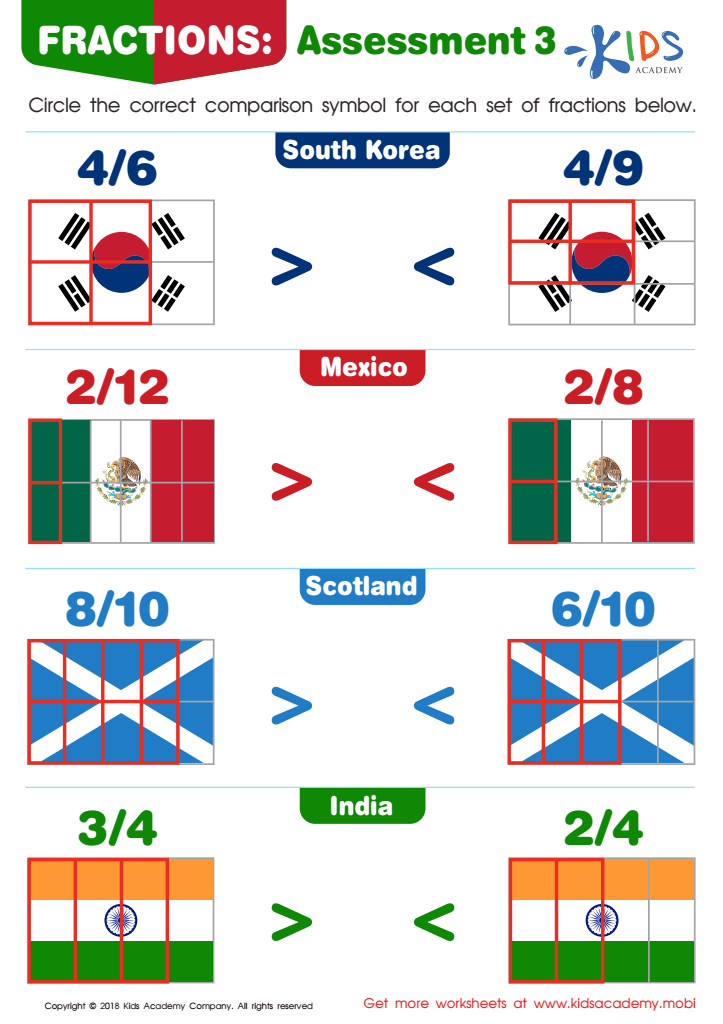
Fractions: Assessment 3 Worksheet
This worksheet helps teach kids about fractions and introduces them to countries and their flags. Have them read the country names and point to the flags. Then help them assess the fractions, and ask them to circle the symbol that shows their values.
Fractions: Assessment 3 Worksheet
Worksheet
Join Kids Academy for Free
Who is primarily going to use this learning content?


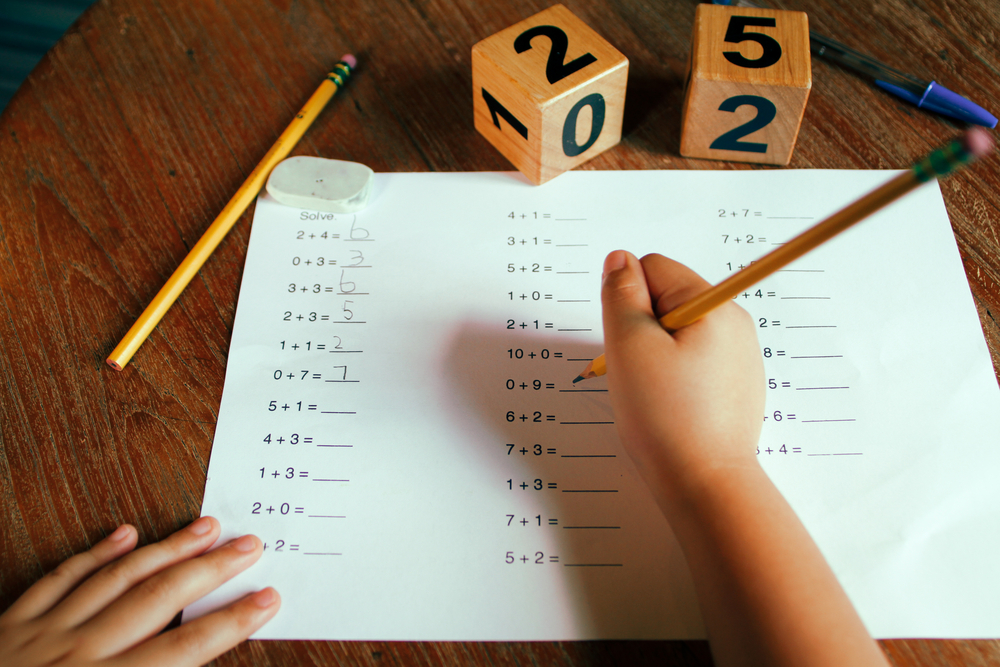




Parents and teachers should emphasize the importance of fraction addition for children aged 7-8 because it lays a crucial foundation for future mathematical learning and everyday problem-solving. At this developmental stage, children are shifting from basic arithmetic to more complex concepts, and understanding fractions is a key transitional skill.
Introducing fraction addition early helps build number sense, enhancing a child's ability to understand parts of a whole. This comprehension is essential for grasping more advanced mathematical ideas such as ratios, percentages, and algebra in later grades.
Moreover, fraction addition aligns closely with real-life scenarios, fostering practical skills. For example, in cooking, dividing time, or splitting resources, the ability to add fractions becomes invaluable. Cultivating this knowledge helps children see the relevance of math to everyday life, thus boosting their engagement and enthusiasm.
Teaching fraction addition also hones critical thinking and problem-solving abilities. Students learn to find common denominators, simplify results, and recognize equivalent fractions — all of which require logical thinking and precision. These cognitive skills are not only crucial in math but are transferable to other academic subjects and real-world situations.
By fostering a solid understanding of fraction addition, parents and teachers provide children with the tools they need for academic success and lifelong numeracy.








