
Comparing shapes Math Worksheets for Ages 7-8
5 filtered results
Difficulty Level
Grade
Age
-
From - To
Subject
Activity
Standards
Discover engaging "Comparing Shapes" math worksheets tailored for children ages 7-8! These worksheets promote critical thinking and enhance spatial awareness by encouraging students to identify, compare, and contrast various geometric shapes. Fun activities not only solidify shape recognition but also develop important math skills, such as sorting and categorizing objects. Ideal for classroom use or at-home learning, our colorful and interactive worksheets will keep young learners motivated while improving their understanding of basic geometry concepts. Perfect for reinforcing lessons and preparing for higher-level math, these resources support key learning objectives and make shape comparison enjoyable for kids!
Favorites
With answer key
Interactive
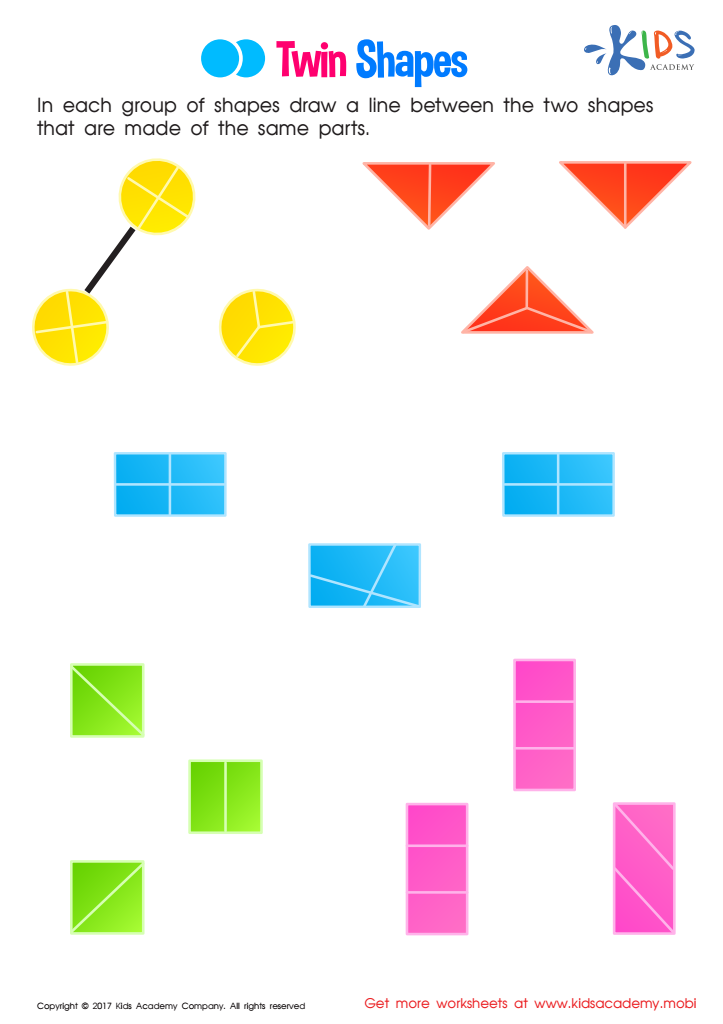
Twin Shapes Worksheet
Your students' goal in this worksheet is to find the twin shapes: drawing a line between two shapes made of the same parts. Likely, the first shapes encountered were circles, triangles, rectangles and squares - examples of which are seen frequently in everyday life. Encourage them to apply what they know and work out which is the twin shape!
 Assign to My Students
Twin Shapes Worksheet
Worksheet
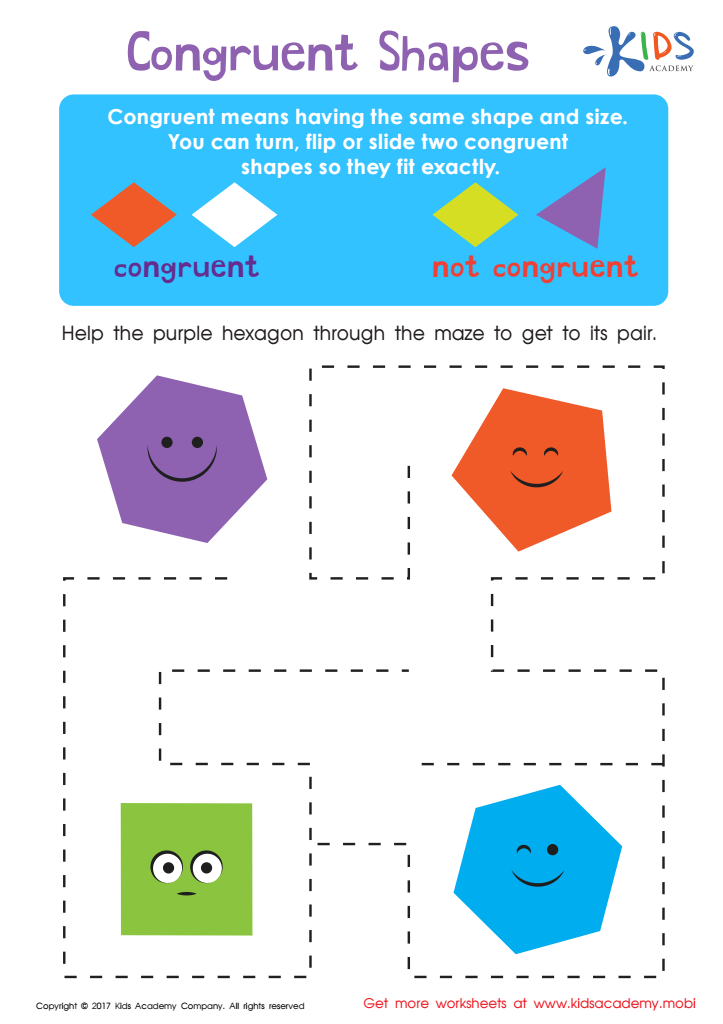
Congruent Shapes Worksheet
Help your child find the twin of the purple hexagon! This congruent shapes worksheet is great for increasing vocabulary while challenging mental rotation skills.
Congruent Shapes Worksheet
Worksheet
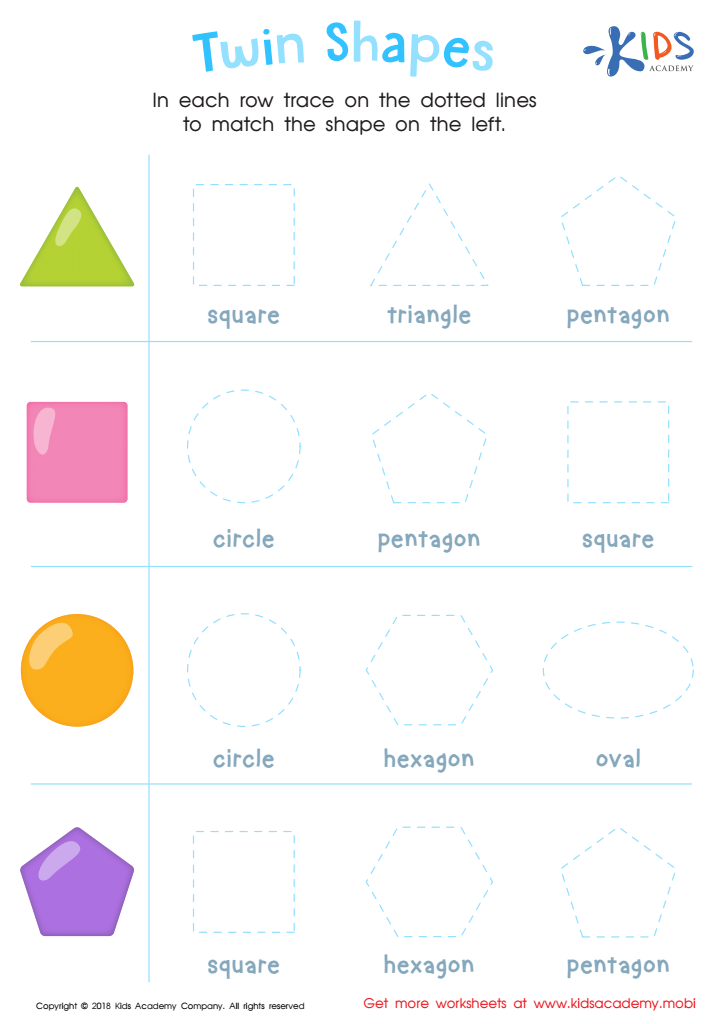
Twin Shapes Dot-to-Dot Worksheet
Test your child's ability to copy with this worksheet. Ask them to find and name the four shapes on the left. Then, they must match each with the dotted lines on the right. Help your child with all four shapes in this fun exercise.
Twin Shapes Dot-to-Dot Worksheet
Worksheet
Join Kids Academy for Free
Who is primarily going to use this learning content?








Comparing shapes is a critical mathematical concept for children aged 7-8, as it lays the foundation for their spatial awareness and geometric understanding. At this age, children are developing their ability to recognize and describe various shapes, such as circles, triangles, rectangles, and squares, which helps enhance their visual processing skills.
Parents and teachers should care about this topic because recognizing similarities and differences between shapes fosters critical thinking and analytical skills. When children engage in comparing shapes, they begin to formulate questions, make observations, and draw conclusions about their properties, such as size, angles, and sides. This process not only boosts their mathematical reasoning but also encourages problem-solving abilities that are essential for more advanced math concepts in the future.
Furthermore, learning about shapes is integral to everyday life, from reading maps to understanding architecture and design. By integrating fun activities, like shape scavenger hunts or art projects, adults can make learning enjoyable and meaningful.
In summary, emphasizing the importance of comparing shapes can enrich a child’s cognitive development and create a robust base for future learning in geometry, as well as in various real-world applications. Engaging with shapes reinforces their curiosity and creativity, vital traits for lifelong learning.








