
Enhancing comprehension Math Worksheets for Ages 7-8
3 filtered results
Difficulty Level
Grade
Age
-
From - To
Subject
Activity
Standards
Unlock your child's potential with our "Enhancing Comprehension Math Worksheets for Ages 7-8." Designed to solidify foundational skills, these worksheets go beyond basic calculations, helping students grasp underlying concepts. From problem-solving to logical reasoning, each activity encourages critical thinking and deep understanding. Tailored for young learners, engaging visuals and practical exercises make math fun and approachable. Perfect for classroom support or extra practice at home, these worksheets empower students to confidently tackle new challenges in their mathematical journey. Give your child the tools they need to succeed with our expertly crafted resources at Kids Academy.
Favorites
With answer key
Interactive
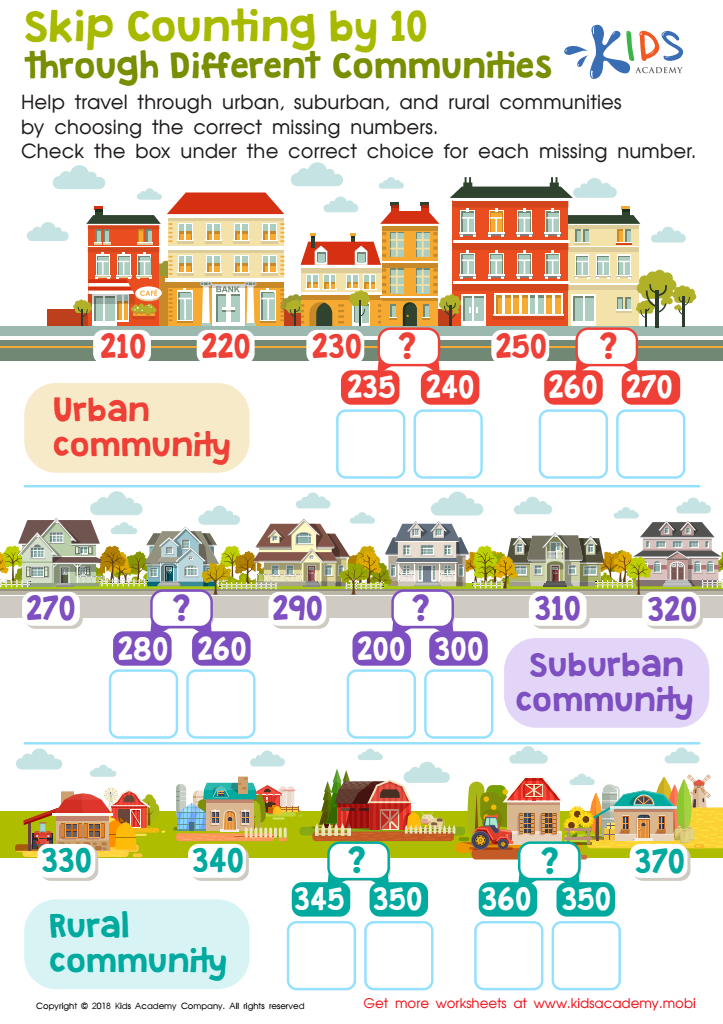
Skip Counting by 10 through Different Communities Worksheet
This free PDF worksheet helps students practice skip counting and 'making a ten', essential for math efficiency and accuracy. Students explore different types of communities (urban, suburban and rural) whilst honing their skills. A great combo of social studies and math!
 Assign to My Students
Skip Counting by 10 through Different Communities Worksheet
Worksheet
Join Kids Academy for Free
Who is primarily going to use this learning content?







.jpg)
Enhancing comprehension in math for ages 7-8 is crucial for several reasons. At this stage, children are laying the foundation for all future math learning. Their understanding of basic concepts like addition, subtraction, shapes, and simple measurements will serve as building blocks for more complex subjects such as multiplication, division, geometry, and algebra.
First, early comprehension in math promotes cognitive development. Doing math challenges children to think logically, recognize patterns, and solve problems systematically. This fosters critical thinking—a skill invaluable in all academic areas and daily life.
Second, successful math comprehension at a young age boosts confidence and reduces math anxiety. When children grasp fundamental concepts easily, they’re more likely to approach new problems with optimism and a can-do attitude, setting a positive tone for future learning.
Third, parents and teachers should understand that math skills are essential life skills. Proficiency in math promotes better decision-making and analytical abilities. Whether it's managing a budget, cooking following a recipe, or planning travel, math is intertwined with many daily tasks.
Lastly, positive early experiences with math contribute to a sustained interest in science, technology, engineering, and mathematics (STEM) fields. By investing in improved math comprehension now, parents and teachers pave the way for promising educational and career opportunities in the future.








