Identify shapes Math Worksheets for Ages 7-8
11 filtered results
-
From - To
Discover engaging and educational "Identify Shapes" math worksheets designed for children ages 7-8. These carefully crafted activities from Kids Academy help young learners master shape recognition, classification, and properties, enhancing crucial geometry skills. Each worksheet offers a variety of exercises that challenge students while making learning fun and interactive. Through hands-on practice, children improve their visual-spatial reasoning, critical thinking, and problem-solving abilities. Perfect for classroom use or additional home practice, these worksheets support academic growth and a deeper understanding of geometric concepts. Equip your child with the tools for math success with our unique and effective resources.
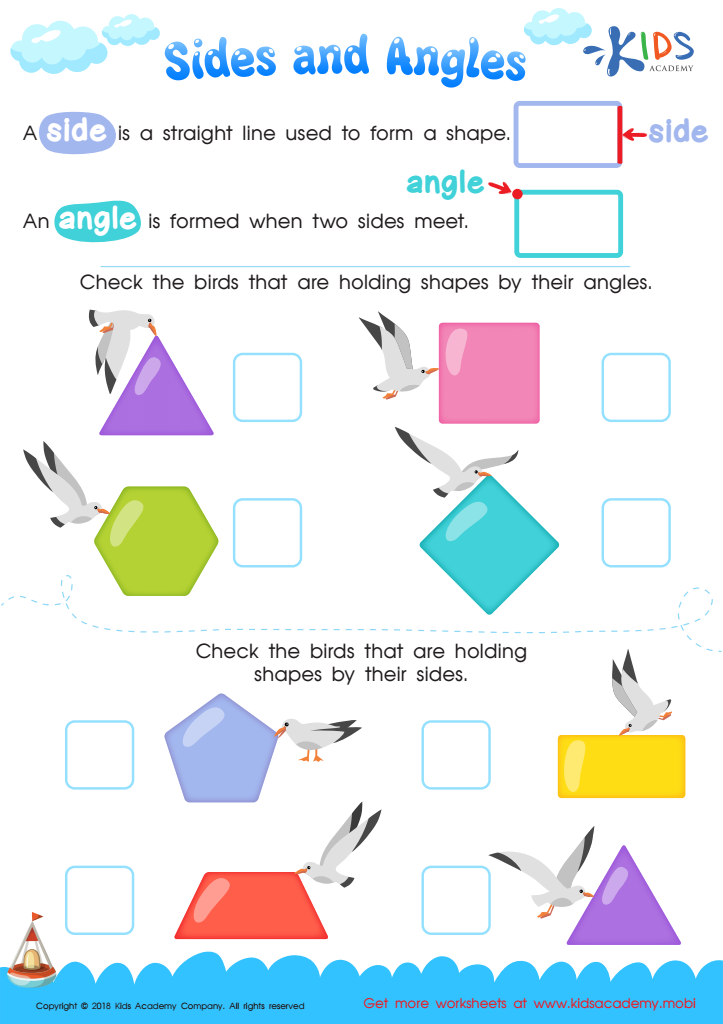
Sides and Angles Worksheet
 Assign to My Students







Understanding shapes is a crucial part of early math education for children aged 7-8. Learning to identify shapes is foundational as it lays the groundwork for more complex mathematical concepts that children will encounter later, such as geometry, algebra, and even data analysis. Recognizing shapes helps children develop spatial awareness, a skill essential for everyday tasks like reading maps, understanding diagrams, and even navigating the spaces around them.
Moreover, identifying shapes fosters critical thinking and problem-solving abilities. When children compare and classify different shapes based on their attributes (such as the number of sides or angles), they learn to observe, analyze, and communicate their findings clearly. These skills are not only vital in math but across all areas of learning.
Shapes also play a fundamental role in developing language skills. When children talk about the properties of shapes, they practice mathematical vocabulary and improve their ability to articulate ideas. Describe a pyramid’s points or an octagon’s many sides, they exercise precise language use.
Learning about shapes opens the door to understanding the world; recognizing patterns in nature, art, and architecture deepens children’s appreciation for the environment. Engaging with shapes through puzzles, drawings, and building blocks, children experience joy and motivation in learning, constructing a positive foundation for future mathematical endeavors.








