Number Sequencing Math Worksheets for Ages 7-8 - Page 2
27 filtered results
-
From - To
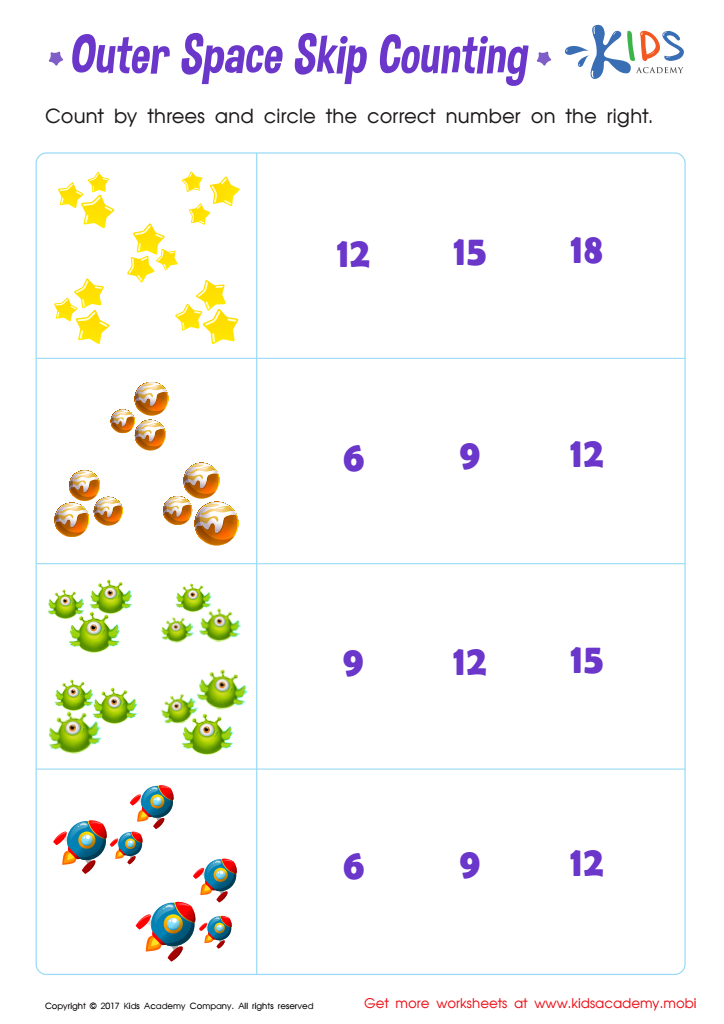
Skip Counting by 3s: Outer Space Skip Counting Printable
 Assign to My Students







Number sequencing is a fundamental aspect of early mathematics that significantly benefits children aged 7-8. During this developmental stage, students transition from basic arithmetic to more complex mathematical concepts, making it essential for their academic growth. Understanding number sequences helps children recognize patterns, which is crucial for problem-solving and algebraic thinking later on.
Parents and teachers should be particularly attentive to this skill because it lays the groundwork for various mathematical concepts, including addition, subtraction, and multiplication. Mastery of sequencing also boosts a child's confidence in their mathematical abilities, fostering a positive attitude toward learning. Moreover, number sequencing enhances critical thinking and cognitive skills, inspiring children to explore relationships between numbers and developing their ability to work with larger sets of data.
Incorporating number sequencing into daily activities can be enjoyable and engaging, whether through games, puzzles, or storytelling. By emphasizing this skill, parents and teachers not only strengthen students' numerical understanding but also prepare them for future mathematical challenges. In summary, embracing number sequencing at this critical age can promote persistence in learning, adaptability in problem-solving, and a lifelong appreciation for the world of mathematics.








