Recognizing equal parts Math Worksheets for Ages 7-8
3 filtered results
-
From - To
Explore our engaging "Recognizing Equal Parts" math worksheets designed specifically for children ages 7-8! These interactive resources will help your child master the concept of equal parts through colorful visuals and hands-on activities. Our worksheets provide diverse exercises that reinforce the understanding of fractions, such as dividing shapes and identifying equal portions. With a focus on playful learning, your child will enjoy developing essential math skills while building confidence. Perfect for classroom use or at-home practice, these worksheets are aligned with educational standards to support young learners in their mathematical journey. Unlock your child's potential in fractions today!
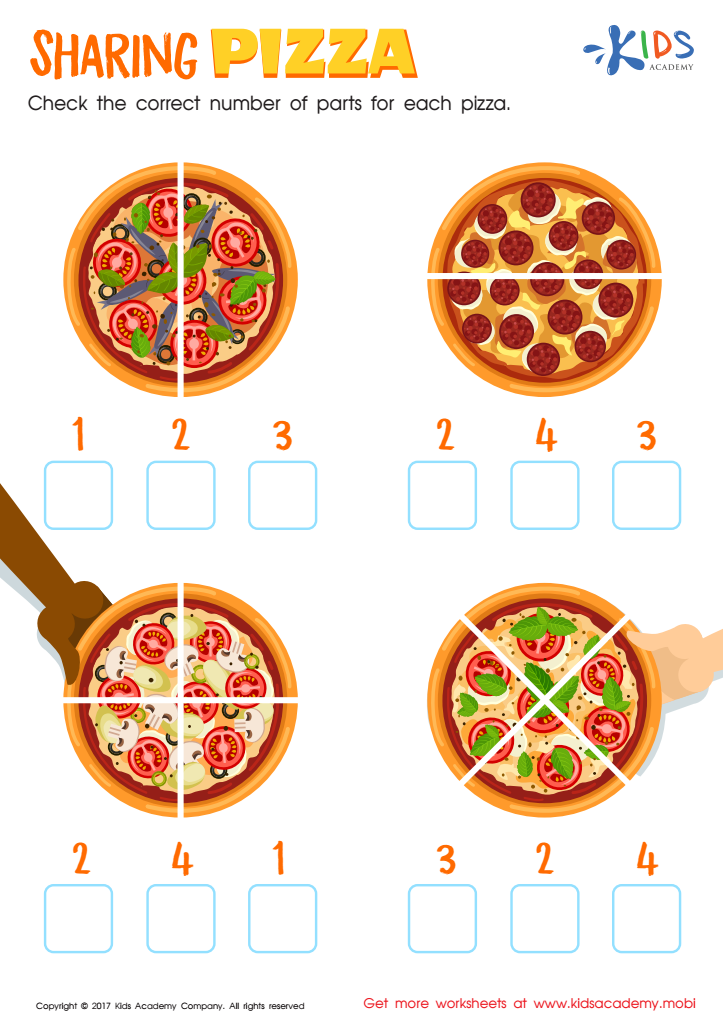
Sharing Pizza Worksheet
 Assign to My Students
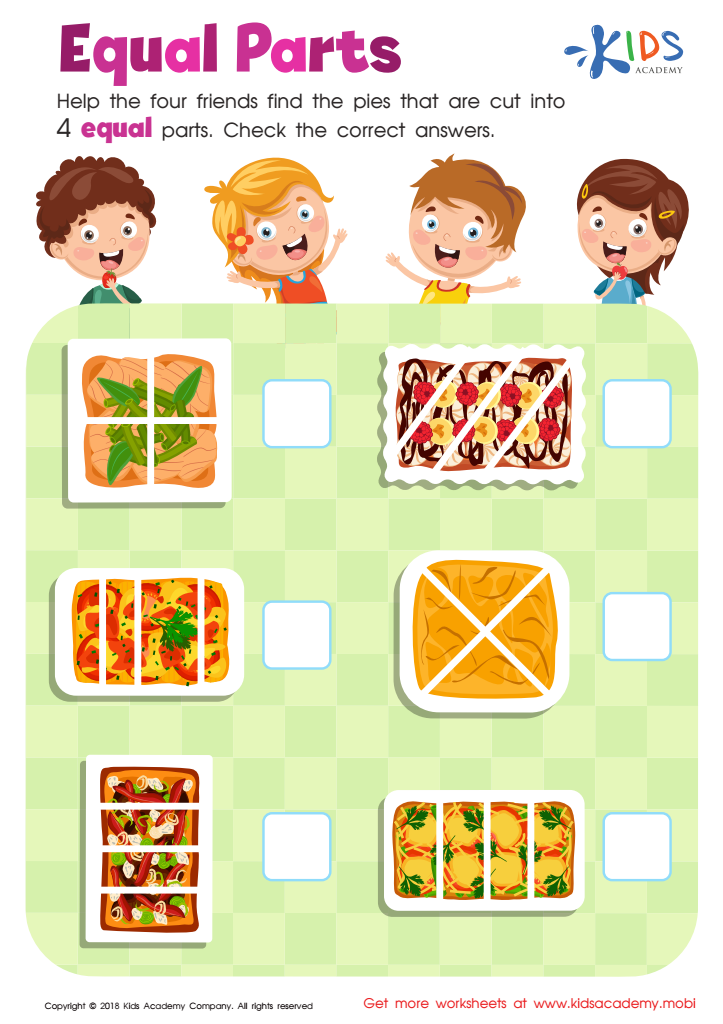
Equal Parts: Food Worksheet







Recognizing equal parts is a foundational concept in mathematics that plays a crucial role in a child's overall mathematical development, particularly for students aged 7-8. During this stage, children begin to shift from concrete to more abstract mathematical thinking, making it essential for them to grasp the idea of fractions and equality.
Understanding equal parts lays the groundwork for more advanced mathematical concepts, such as addition, subtraction, and proportion. When children become proficient at recognizing equal parts, they learn to identify simple fractions, which boosts their confidence in problem-solving and analytical skills.
Moreover, recognizing equal parts has practical applications in daily life. Whether it's dividing a pizza, measuring ingredients in a recipe, or sharing resources, an early understanding of equal portions helps children to make informed decisions and understand fairness in various contexts.
Parents and teachers play a vital role in facilitating this learning process. By engaging students in activities that promote this understanding—such as using visuals, hands-on materials, and real-world examples—they can foster a positive attitude toward math. Ultimately, recognizing equal parts sets the stage for future mathematical success and nurtures critical thinking skills that are essential throughout a child's education.








