
Understanding skip-counting Worksheets for Ages 7-9
3 filtered results
Difficulty Level
Grade
Age
-
From - To
Subject
Activity
Standards
Skip-counting is a foundational math skill that enhances number sense and arithmetic fluency in children. Designed for ages 7-9, our engaging skip-counting worksheets help kids practice counting by 2s, 5s, 10s, and beyond through fun and interactive activities. These printable worksheets not only support classroom learning but also make math practice enjoyable at home. By mastering skip-counting, young learners can quickly grasp more advanced mathematical concepts, such as multiplication and division, while boosting their confidence. Explore our collection and watch your child’s math skills flourish effortlessly. Download today and start their journey to numerical mastery!
Favorites
With answer key
Interactive
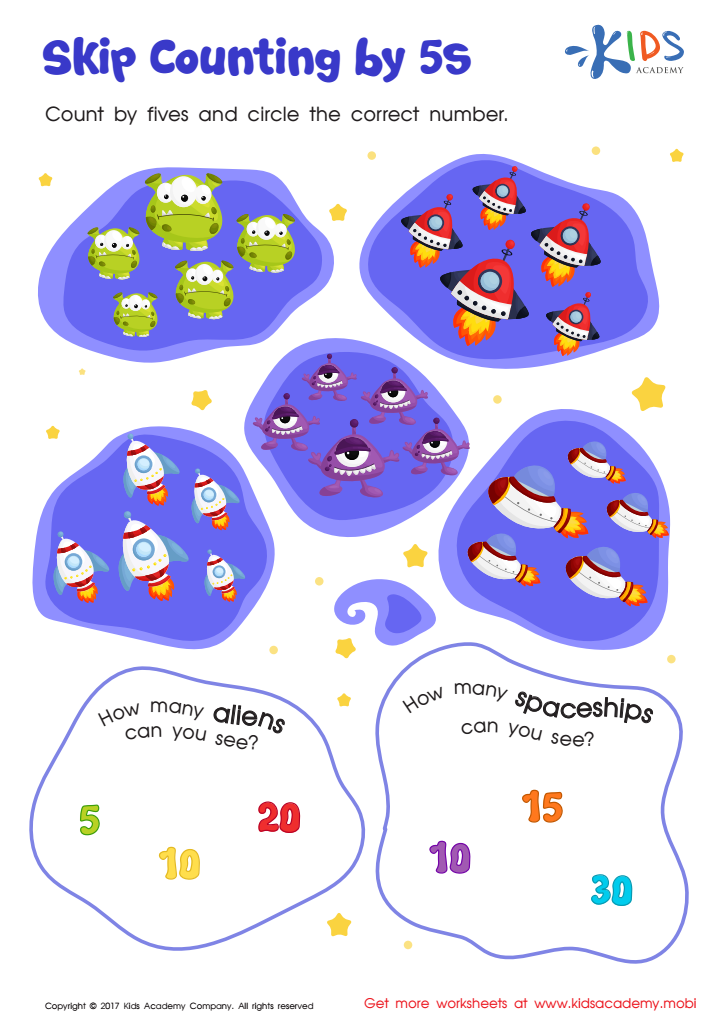
Skip Counting by 5s: Aliens and Spaceships Printable
Your child will love taking an intergalactic adventure as they practice skip counting by 5's with this worksheet! It'll help them identify and recognize large groups of numbers, categorize objects to count them, and prepare them for math concepts like multiplication. And with silly space graphics, they'll be motivated for more practice!
 Assign to My Students
Skip Counting by 5s: Aliens and Spaceships Printable
Worksheet
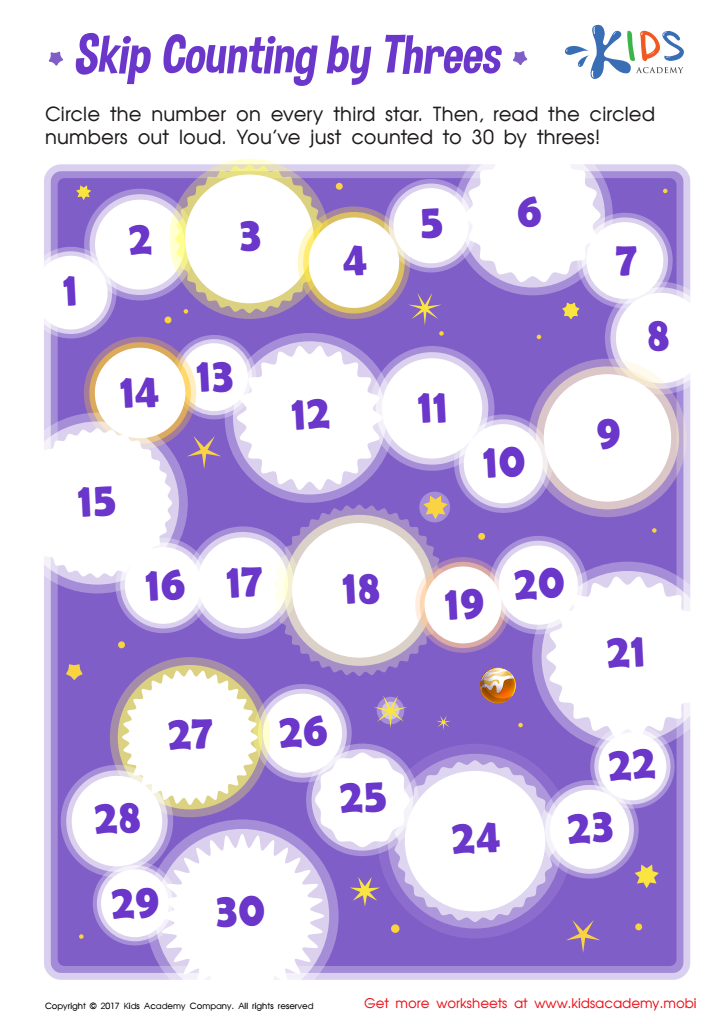
Skip Counting By Three Printable
Inspire your child with this star-themed skip counting worksheet! It offers a fun way to learn while providing a foundation for more advanced math skills, like adding, subtracting, and multiplication. It will help your child gain a sense of numeracy, practice problem solving, and stay ahead in math.
Skip Counting By Three Printable
Worksheet
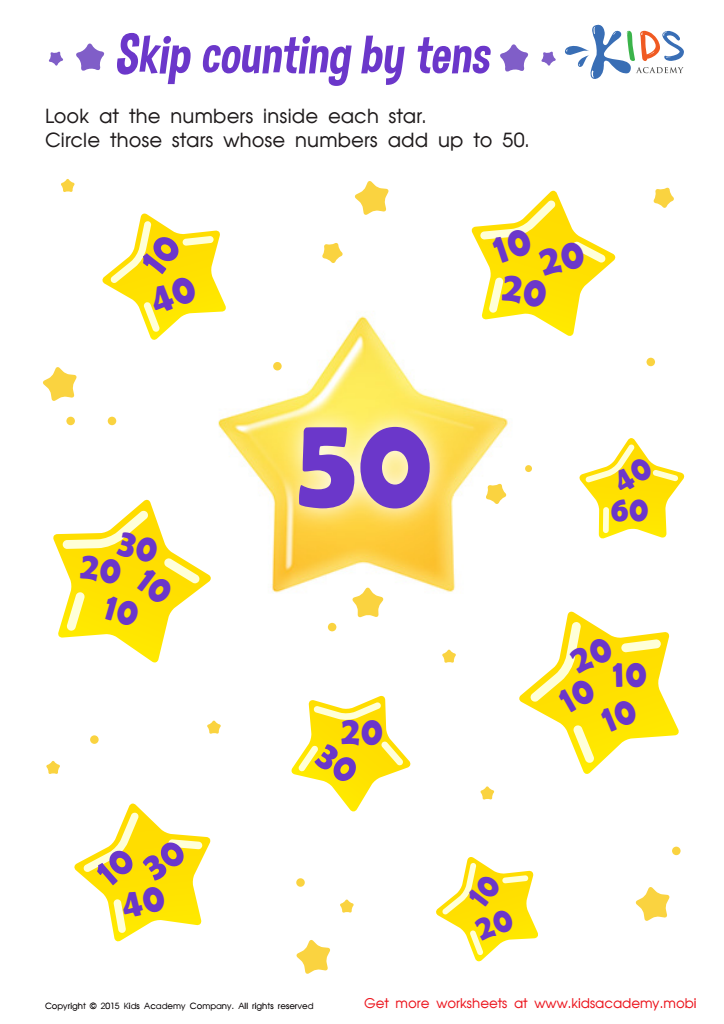
Learn Dozens: Skip Counting by Tens Printable
This skip counting by 10 worksheet helps kids strengthen fluency, practice addition & build number sense. They'll use problem-solving skills to find the correct answer, which is revealed by stars. This worksheet is a fun way to practice crucial foundational math skills.
Learn Dozens: Skip Counting by Tens Printable
Worksheet
Join Kids Academy for Free
Who is primarily going to use this learning content?







Skip-counting is a foundational math skill that benefits children aged 7-9 in numerous ways, making it imperative for parents and teachers to ensure children understand it. Skip-counting involves counting forward or backward by a given number (e.g., by 2s, 5s, 10s) and is essential for building number sense and mathematical fluency.
Firstly, skip-counting lays the groundwork for multiplication and division. Understanding these core concepts is crucial for higher-level math topics they'll encounter later. For example, being able to skip-count by 3s helps children solve 3 x 4 more intuitively as they can think 3, 6, 9, 12. It's a stepping stone to understanding times tables, which are fundamental in most arithmetic calculations.
Secondly, skip-counting improves pattern recognition and problem-solving skills. When children practice skip-counting, they start noticing numerical patterns, making it easier to predict sequences and solve more complex problems that rely on number patterns.
Lastly, reinforcing skip-counting in real-life contexts makes math enjoyable and practical. For instance, children can apply skip-counting when setting the table (counting utensils by groups of 2 or 4) or counting money (e.g., by 5s for nickels or by 10s for dimes). This real-life relevance motivates children and makes math feel less abstract and more grounded in their everyday experiences, fostering a positive attitude towards learning.
Thus, ensuring children understand skip-counting equips them with critical math skills, helps with cognitive development, and makes mathematical learning more engaging and relevant.








