Cognitive Development 2D Shapes Worksheets for Ages 7-9
3 filtered results
Difficulty Level
Grade
Age
-
From - To
Subject
Activity
Standards
Unlock your child's cognitive potential with our engaging 2D Shapes Worksheets designed for ages 7-9! These worksheets are crafted to enhance critical thinking and shape recognition through fun activities. Kids will explore various forms, learn to categorize and compare shapes, and build problem-solving skills. Our well-structured exercises promote visual learning, enabling children to identify and understand shapes in different contexts. Ideal for classroom use or home study, these worksheets provide a comprehensive approach to understanding geometry while fostering cognitive development. Empower your child’s math skills and boost their confidence with our interactive 2D shapes resources today!
Favorites
With answer key
Interactive
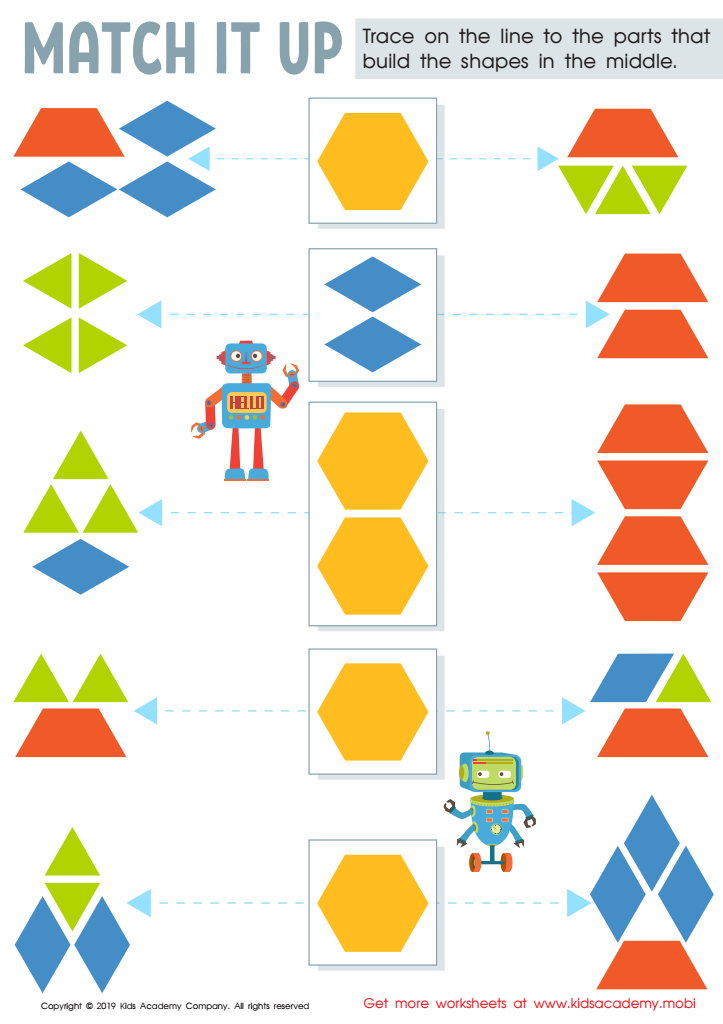
Match It up Worksheet
If your kids are into robots, they'll be thrilled to work on this worksheet. Ask them to name shapes they know, and help them draw and identify these shapes. Look at the shapes in the middle, and the sides. Finally, help your kids trace the lines to build the shapes in the middle.
 Assign to My Students
Match It up Worksheet
Worksheet











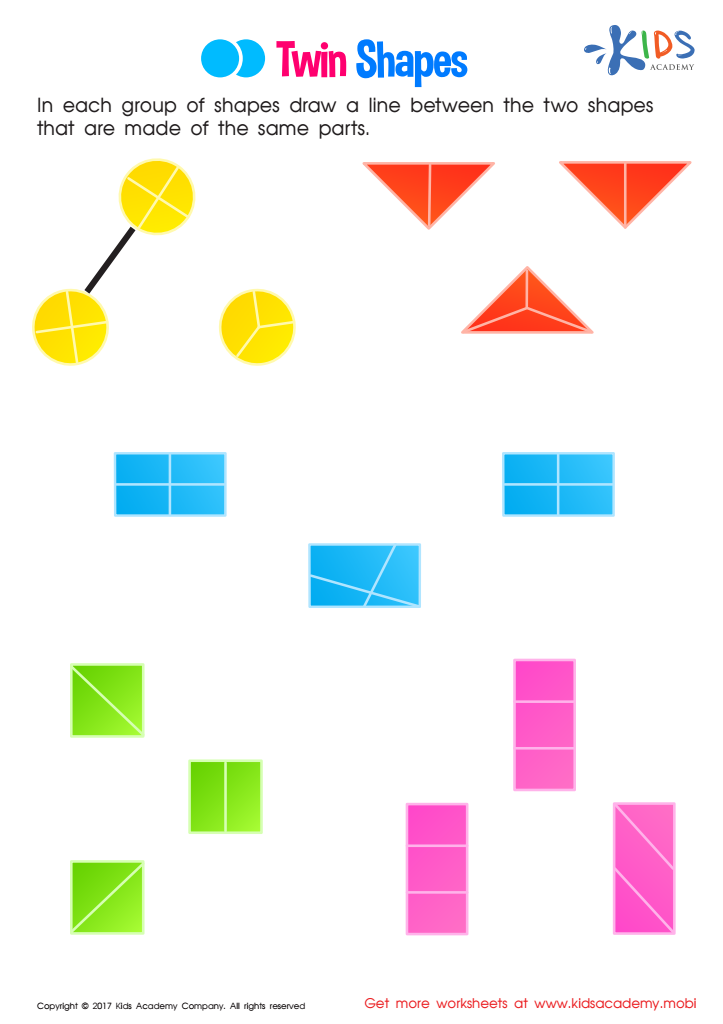
Twin Shapes Worksheet
Your students' goal in this worksheet is to find the twin shapes: drawing a line between two shapes made of the same parts. Likely, the first shapes encountered were circles, triangles, rectangles and squares - examples of which are seen frequently in everyday life. Encourage them to apply what they know and work out which is the twin shape!
Twin Shapes Worksheet
Worksheet
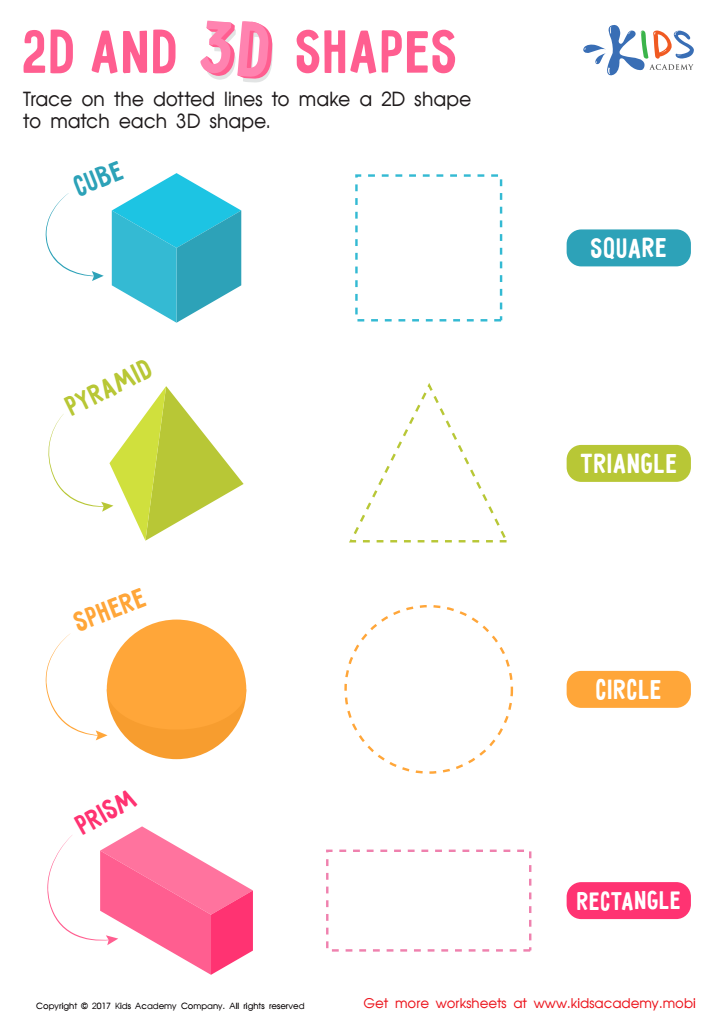
2D and 3D Shapes Worksheet
Introduce your child to 3D and 2D with this traceable worksheet. With dotted lines, help them trace and make a 2D shape for each 3D shape: square, triangle, rectangle, and circle. Show them there's more than one way to draw! You may have taken them to a 3D movie, or they've seen some fantastic 3D art. Now they can wonder no more.
2D and 3D Shapes Worksheet
Worksheet
Join Kids Academy for Free
Who is primarily going to use this learning content?








Cognitive development in children, particularly regarding understanding 2D shapes, plays a critical role in their overall learning and future academic success. For children aged 7 to 9, this foundational skill is essential as it enhances their ability to recognize, classify, and interact with their environment.
Engaging with 2D shapes reinforces spatial awareness, which is vital for mathematics and geometry. This understanding allows children to comprehend relationships between objects, aiding in problem-solving skills applicable beyond math. Furthermore, as they learn to draw, measure, and transform shapes, they develop fine motor skills and improve their visual processing capacity.
In a society increasingly driven by technology, a strong grasp of shapes lays the groundwork for success in fields like engineering, architecture, and graphic design. Teachers and parents should incorporate activities that promote this awareness, such as art, building projects, and games, to foster curiosity and deeper learning.
Moreover, recognizing shapes contributes to critical thinking skills, essential not just in academics but also in daily decision-making. By prioritizing cognitive development of 2D shapes, parents and teachers are not just teaching geometrical concepts—they are equipping children with imperative skills for lifelong learning and adaptability.