Understanding Quantities Addition & Subtraction Worksheets for Ages 7-9
4 filtered results
-
From - To
Explore our "Understanding Quantities Addition & Subtraction Worksheets" designed specifically for ages 7-9. These engaging resources help young learners grasp the fundamentals of addition and subtraction by focusing on quantities. Our worksheets offer a variety of interactive activities, including visuals and real-life scenarios, making math concepts both fun and relatable. Children will develop essential skills in comparing, measuring, and manipulating numbers, fostering confidence and independence in their mathematical abilities. Perfect for classroom use or homeschooling, these worksheets empower students to embrace math while enhancing critical thinking and problem-solving skills. Discover the joy of learning with our specially crafted materials!
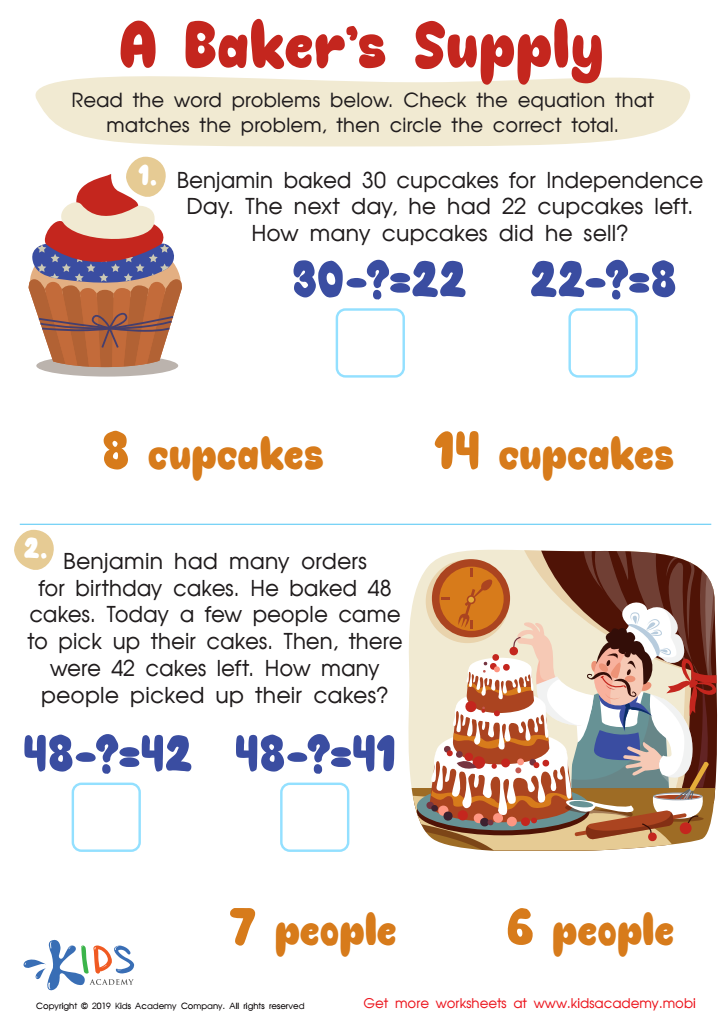
A Baker's Supply Worksheet
 Assign to My Students
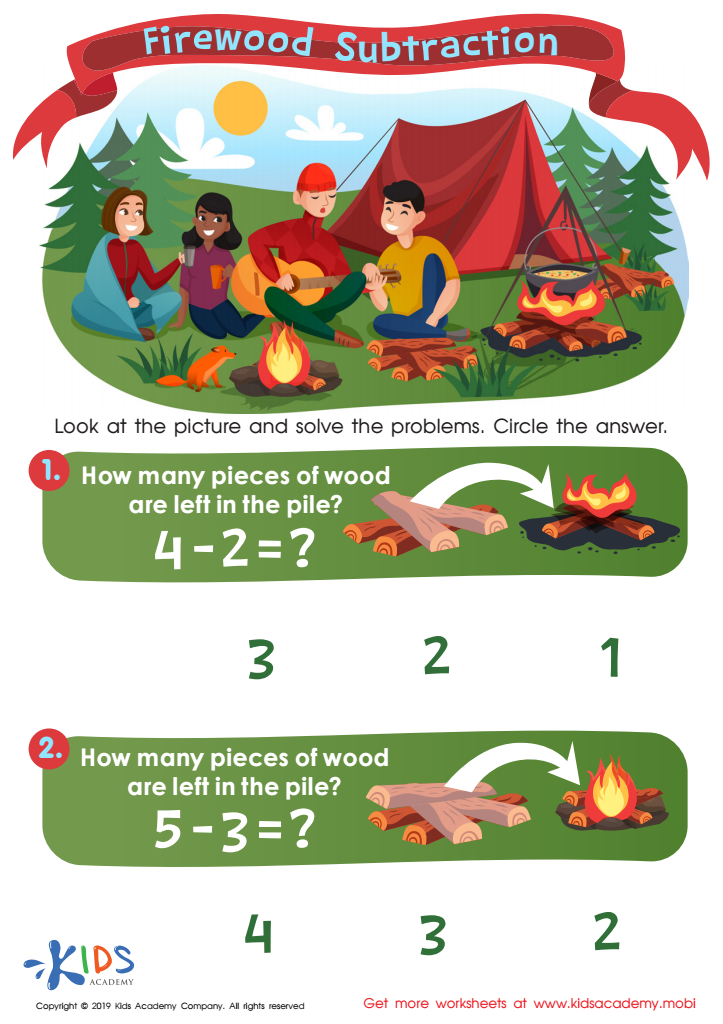
Firewood Subtraction Worksheet








Understanding quantities in addition and subtraction is crucial for children aged 7-9 as it lays the foundation for their mathematical development. During this age, children transition from basic arithmetic to more complex problem-solving and critical thinking skills. Mastery of these concepts enhances their ability to compare and manipulate numbers, fostering a deeper comprehension of how numbers relate to one another.
When parents and teachers emphasize understanding quantities, they encourage children to grasp the idea of 'how many' in various contexts, whether in counting objects, solving word problems, or even in everyday situations like shopping or cooking. This comprehension promotes a sense of mathematical fluency, allowing children to perform operations with confidence and accuracy.
Additionally, understanding quantities prepares students for more advanced mathematics, such as algebra and fractions, which rely heavily on these basic skills. It also cultivates perseverance and resilience, as children learn to tackle increasingly challenging problems.
Moreover, fostering a strong mathematical foundation nurtures a positive attitude toward math, counteracting any anxiety associated with the subject. Supporting children in this developmental stage ensures they are well-equipped for future academic success and everyday life, making it a priority for parents and educators alike.








