Problem-solving abilities Addition Worksheets for Ages 7-9
15 filtered results
-
From - To
Our Addition Worksheets for Ages 7-9 are designed to enhance problem-solving abilities in young learners. Through engaging activities, children develop critical thinking and mathematical skills that go beyond simple calculation. Each worksheet provides real-life scenarios requiring students to apply addition concepts effectively, fostering logical reasoning and analytical skills. Perfect for classrooms or at-home learning, these printable resources align with educational standards and are crafted by experienced educators. Boost your child’s confidence and proficiency in math with these fun and challenging problem-solving worksheets. Equip your little learners with the tools they need to succeed academically and in everyday life.
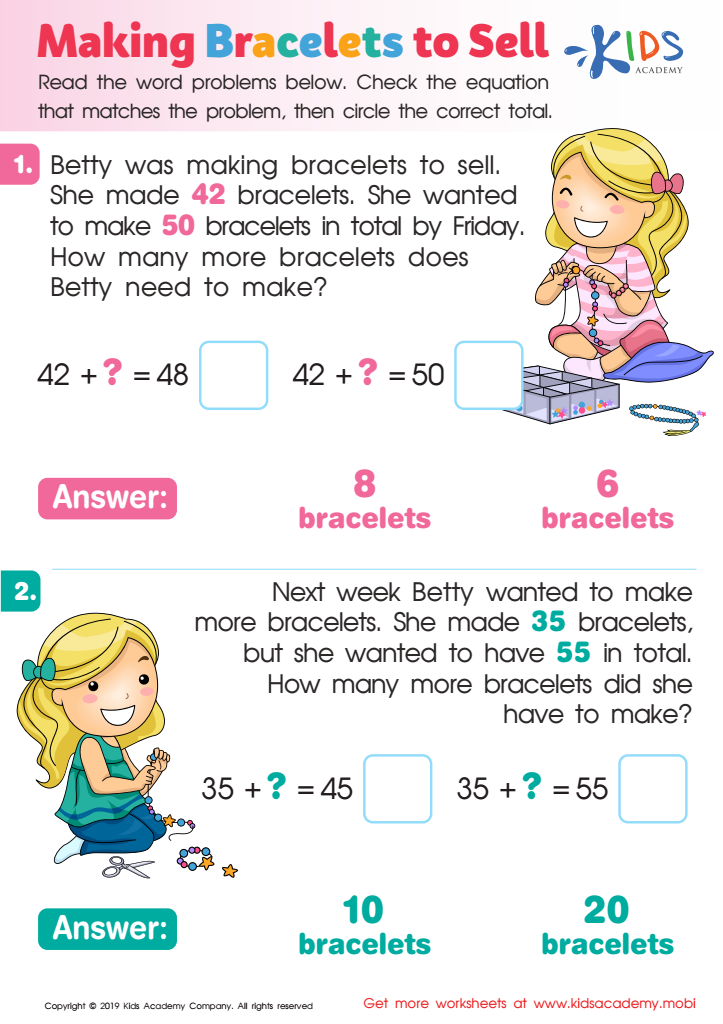
Making Bracelets to Sell Worksheet
 Assign to My Students

Adding at the Hospital Worksheet
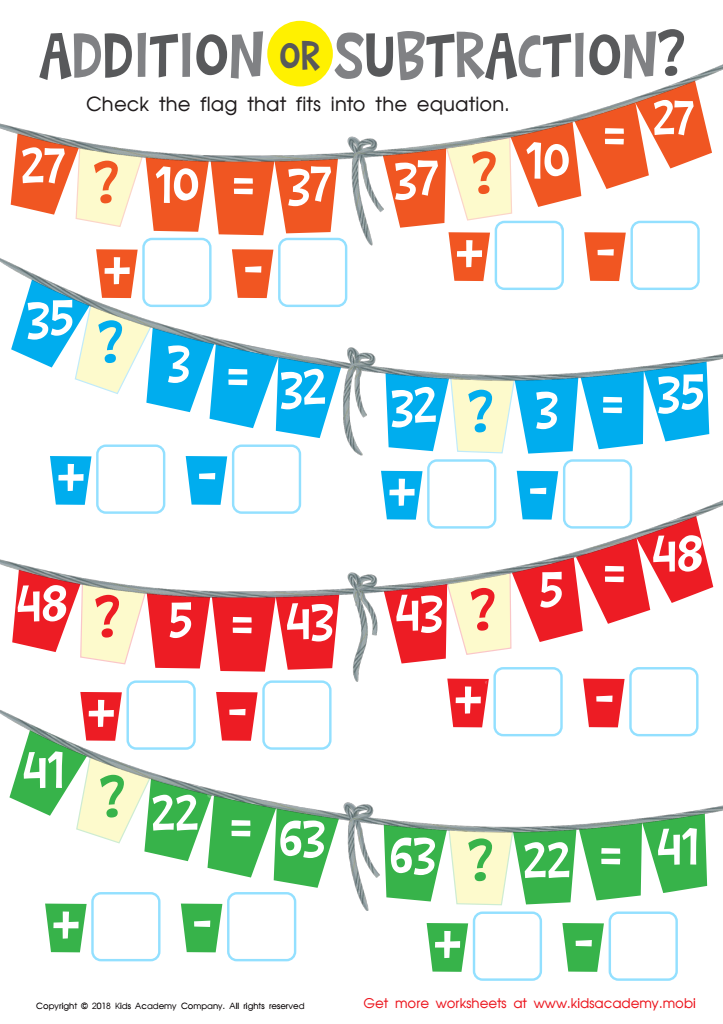
Addition or Subtraction? Worksheet
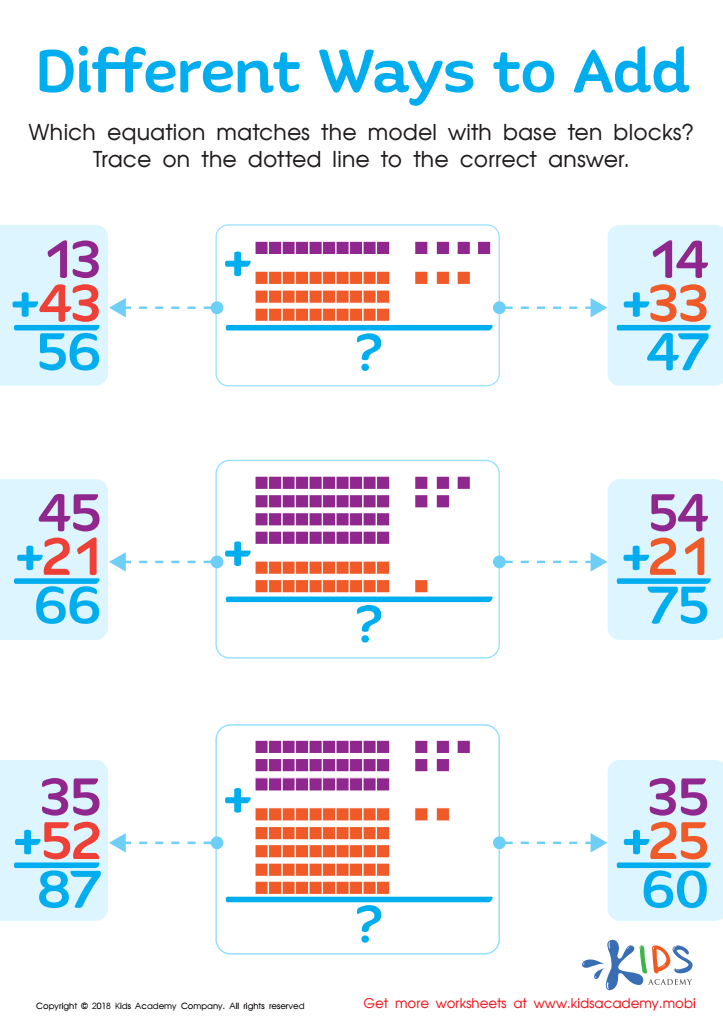
Different Ways to Add Worksheet








Teaching problem-solving abilities through addition to children aged 7-9 is fundamental for several reasons. Firstly, problem-solving with addition enhances critical thinking skills. When students tackle addition problems, they employ strategies to find solutions, which develop their logical and analytical thinking. These skills are transferable to other areas of mathematics and everyday life.
Secondly, addition is a foundational math concept that supports the learning of more complex mathematical operations. Mastering addition at an early age aids in the comprehension of subtraction, multiplication, and division. This foundational knowledge forms the building blocks necessary for later success in subjects such as algebra, geometry, and beyond.
Additionally, engaging with problem-solving through addition fosters perseverance and resilience. As children work through problems and encounter challenges, they learn the value of persistence and the satisfaction that comes from overcoming obstacles.
Moreover, successful problem-solving experiences build confidence in young learners. Confidence in their ability to solve addition problems can encourage a positive attitude toward math as a whole. With math anxiety being a common issue, fostering early competence can have long-term benefits on a child's educational journey.
Lastly, collaboration in solving addition problems encourages teamwork and communication skills when done in a group setting. Children can learn from peers, discuss strategies, and collectively find solutions, promoting a collaborative learning environment.
Overall, caring about problem-solving abilities through addition at this stage ensures well-rounded cognitive and emotional development, laying the groundwork for future academic success and lifelong problem-solving skills.








