Understanding area Area and Perimeter Worksheets for Ages 7-9
3 filtered results
Difficulty Level
Grade
Age
-
From - To
Subject
Activity
Standards
Enhance your child's math skills with our Understanding Area and Perimeter Worksheets for Ages 7-9. These engaging activities are designed to make learning fun and interactive, helping kids grasp the concepts of area and perimeter seamlessly. From simple shapes to more complex figures, each worksheet is tailored to develop problem-solving skills and mathematical reasoning. Perfect for home or classroom use, these resources align with educational standards to support young learners effectively. Help your child build a strong foundation in math with our expertly crafted worksheets, ensuring they master essential skills through practice and play.
Favorites
With answer key
Interactive
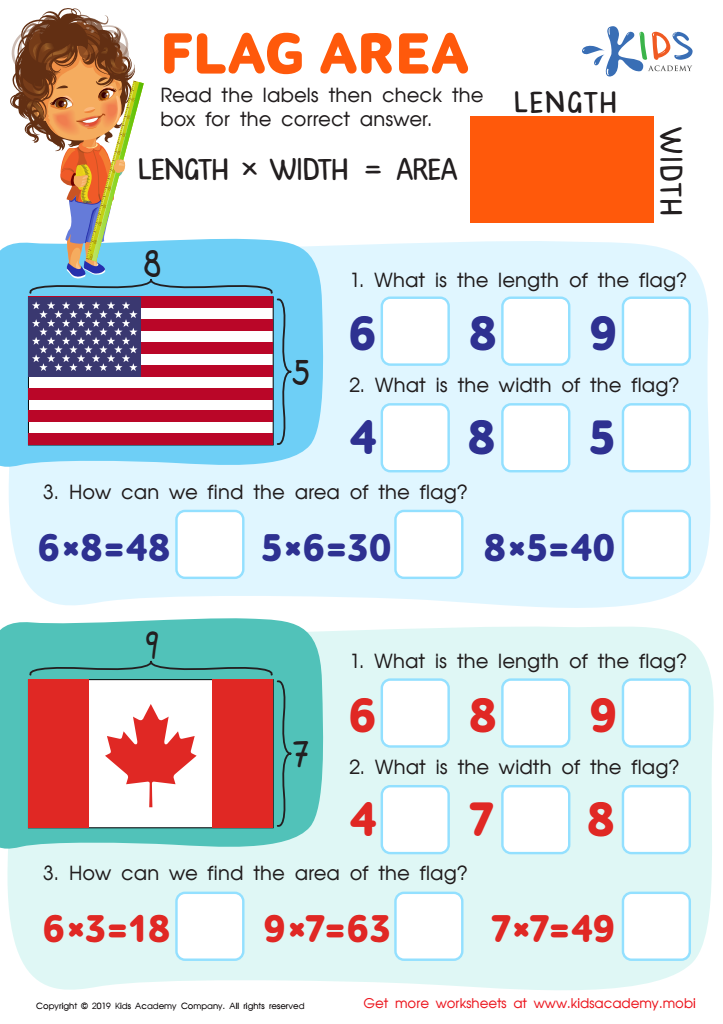
Flag Area Worksheet
Test your child's knowledge of flags by asking which ones they can identify in the image. Then, study the worksheet together. There are 6 questions with labels. Have them read each label and check the box for the correct answer.
 Assign to My Students
Flag Area Worksheet
Worksheet
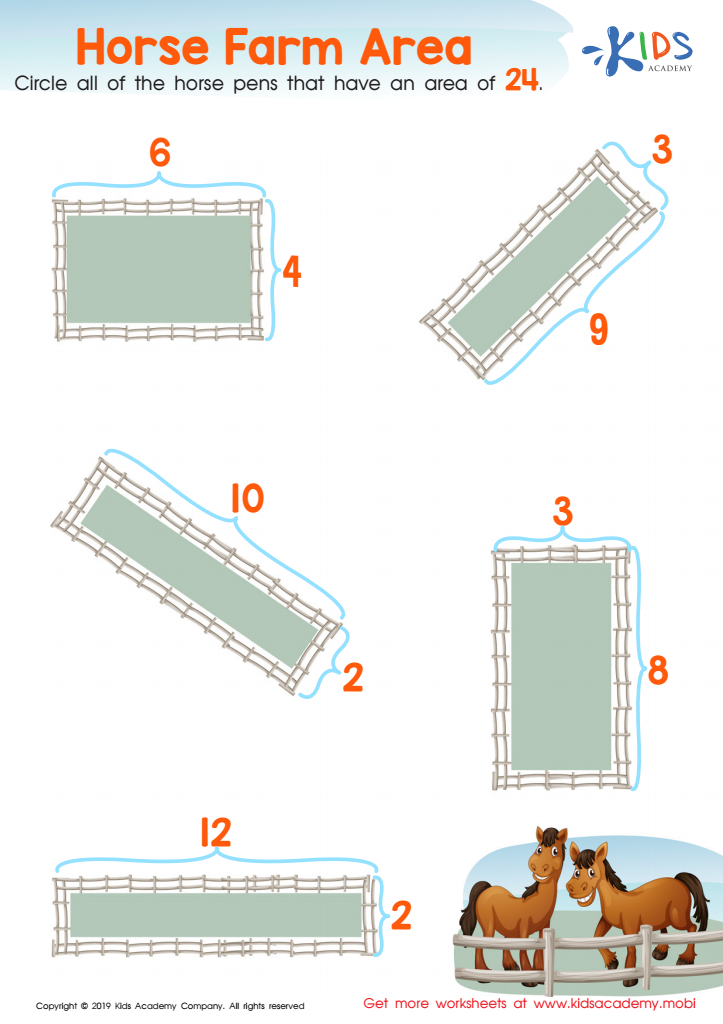
Horse Farm Area Worksheet
Take your kids to a horse farm! They'll love it – there's lots to explore, plus they can ride horses. Then challenge them with a geometry worksheet: help them calculate the area of all the horse pens, then circle the ones with an area of 24.
Horse Farm Area Worksheet
Worksheet
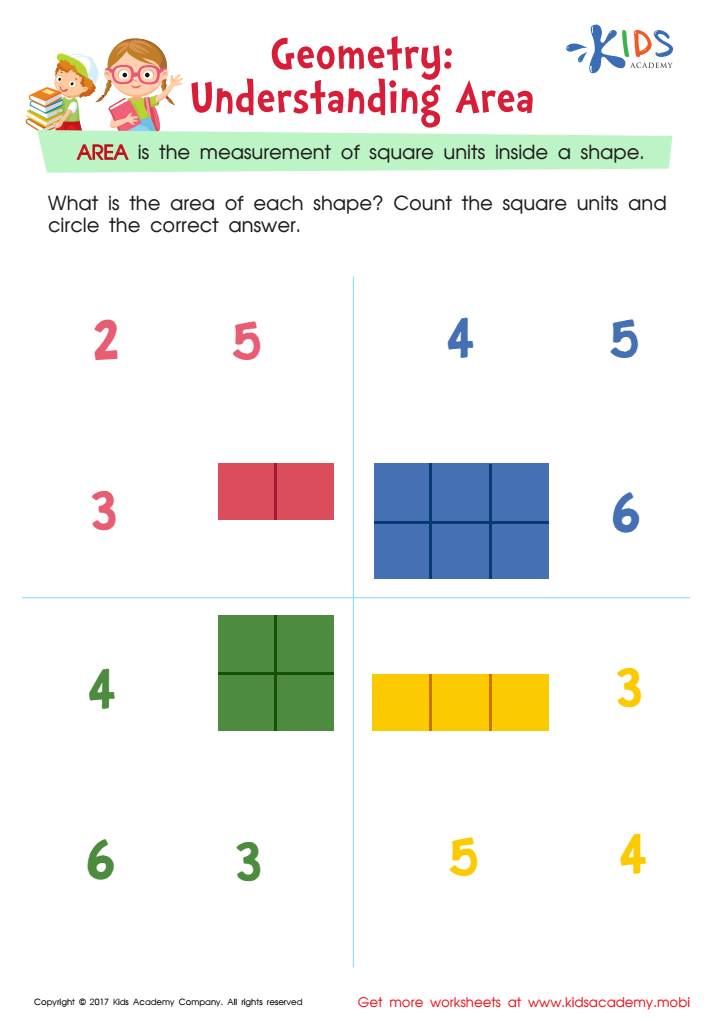
Understanding Area Worksheet
This helps them develop a better understanding and an easier way to learn instead of memorizing a formula.
Understanding Area Worksheet
Worksheet
Join Kids Academy for Free
Who is primarily going to use this learning content?








Understanding area and perimeter is crucial for children aged 7-9 as it lays the foundation for more complex mathematical concepts and everyday practical skills. Firstly, it enhances their spatial awareness, helping them recognize how different shapes and spaces interact. This understanding is fundamental in subjects like geography, art, and even physical education where spatial orientation is key.
Academically, a solid grasp of area and perimeter helps in boosting problem-solving skills. When students learn to calculate the perimeter (the distance around a shape) and the area (the space within a shape), they develop logical reasoning and critical thinking skills. These skills are applicable beyond mathematics, aiding in science experiments, technology projects, and other STEM activities.
Practically, understanding area and perimeter has real-world applications. From estimating the amount of paint needed for a wall or wrapping paper for a gift, to arranging furniture in a room, children learn the usefulness of these measurements early on. This contributes to their independence and ability to make sound decisions as they grow.
Moreover, fostering enthusiasm and competence in math at a young age can build confidence. When children understand and apply concepts like area and perimeter successfully, they gain confidence in their capabilities, setting a positive outlook towards future learning. Therefore, parents and teachers should very much care about nurturing these spatial and mathematical understandings in young learners.