Fraction comparison Geometry Worksheets for Ages 7-9
3 filtered results
-
From - To
Unlock the exciting world of fractions for young learners with our Fraction Comparison Geometry Worksheets designed for kids aged 7-9. These engaging worksheets help children grasp essential math concepts while enhancing their geometry skills. Through fun exercises, students learn to compare and interpret fractions, boosting their problem-solving abilities. Our expertly crafted worksheets are perfect for both classroom use and home practice, ensuring a solid foundation in math. Enhance your child’s learning journey today with our Fraction Comparison Geometry Worksheets, making math both educational and enjoyable for young minds. Explore now and watch them excel!
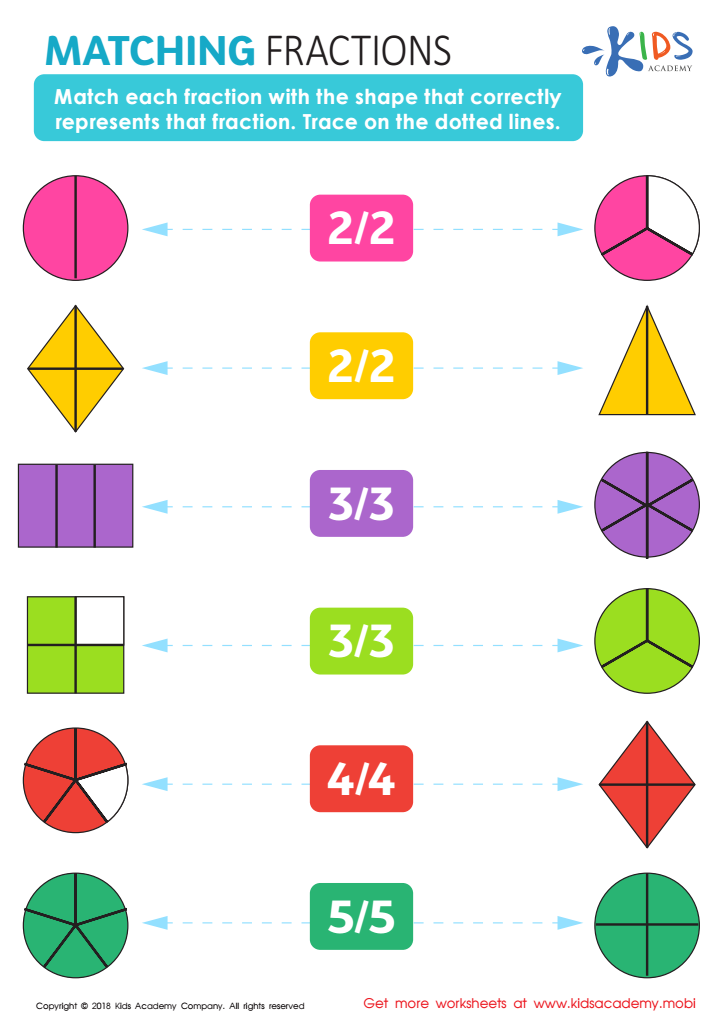
Matching Fractions Worksheet
 Assign to My Students











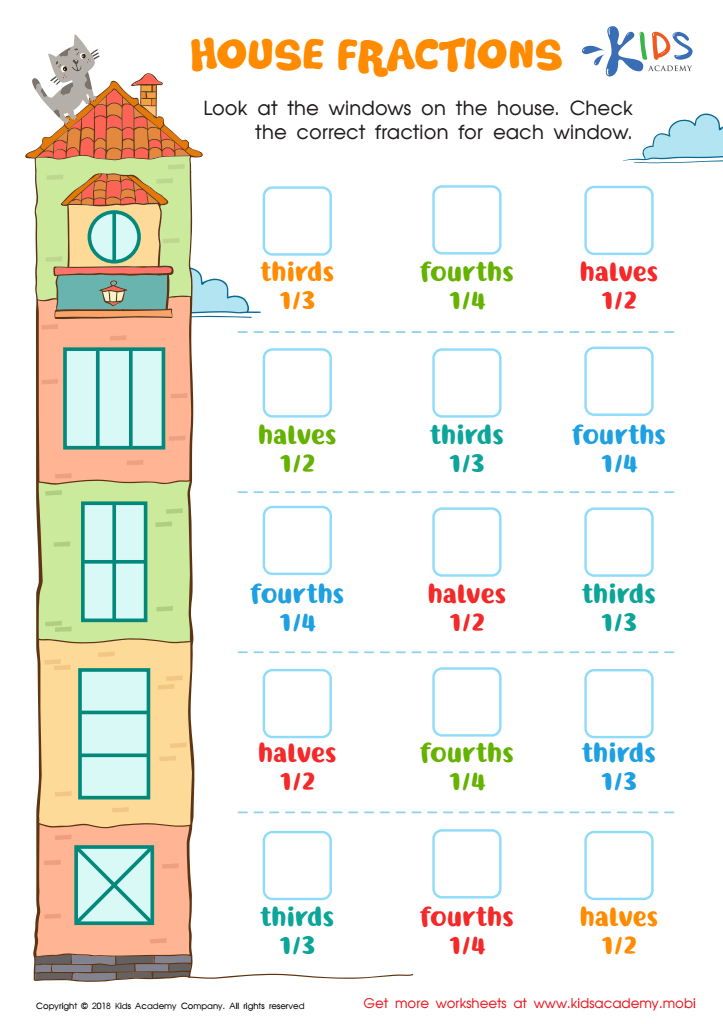
House Fractions Worksheet
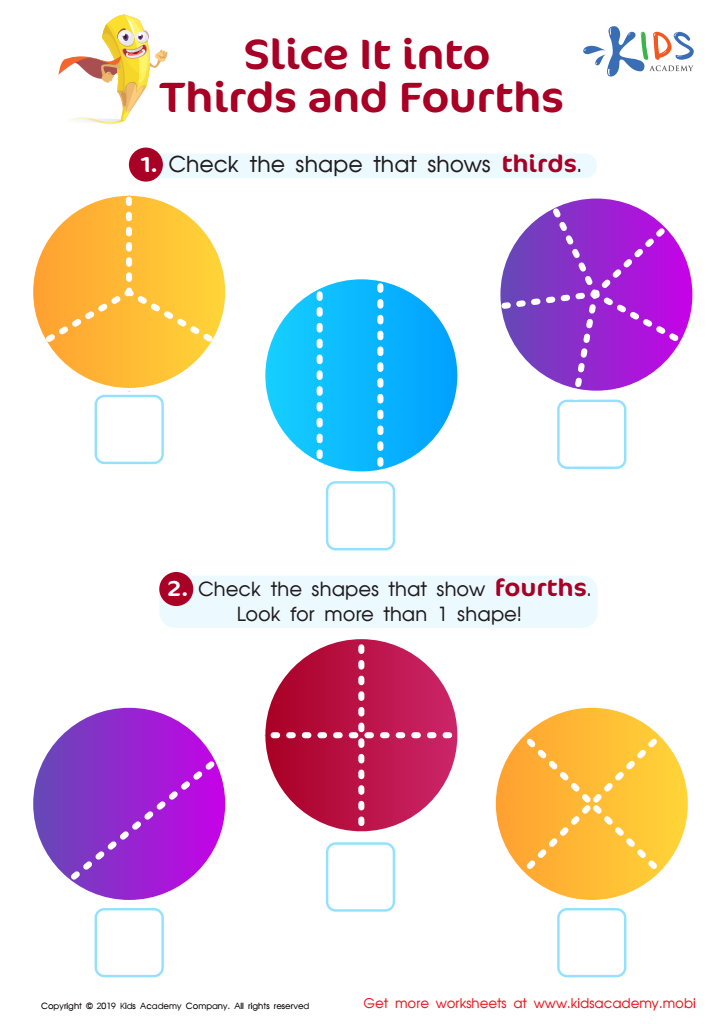
Slice in Thirds Fourths Worksheet








Fostering an understanding of fraction comparison and basic geometry in children aged 7-9 is crucial for multiple reasons. At this formative age, children's brains are actively developing foundational skills that will support advanced mathematical concepts later.
Understanding fractions helps children grasp the notion of parts of a whole, which is essential for future arithmetic and algebraic thinking. When children learn to compare fractions, they also develop critical reasoning and problem-solving skills. This involves recognizing the size of different fractions, which can improve their sense of quantity and proportion, valuable in both daily life and more complex mathematical tasks.
Geometry, on the other hand, introduces children to the properties and relationships of shapes and spaces around them. Basic geometric concepts such as recognizing shapes, understanding symmetry, and grasping spatial relationships enhance their visual thinking and logical reasoning abilities. It helps children develop the ability to visualize and describe the physical world accurately, supporting fields ranging from art and architecture to engineering and computer graphics.
By prioritizing fraction and geometry education for young learners, parents and teachers set a strong foundation that not only enriches mathematical competence but also fosters transferrable skills like analytical thinking, persistence in problem-solving, and systematic reasoning.








