Basic geometry knowledge Math Worksheets for Ages 7-9
3 filtered results
-
From - To
Welcome to our Basic Geometry Knowledge Math Worksheets for Ages 7-9! Explore an engaging collection designed to enhance your child's understanding of fundamental geometric concepts. Our worksheets cover essential topics such as shapes, angles, symmetry, and spatial reasoning, providing a fun and interactive way for young learners to develop their skills. Each activity promotes critical thinking and problem-solving, allowing your child to gain confidence in their math abilities. Ideal for home or classroom use, these worksheets are perfect for reinforcing geometry knowledge while making learning enjoyable. Discover the joy of math today and watch your child excel in geometry!
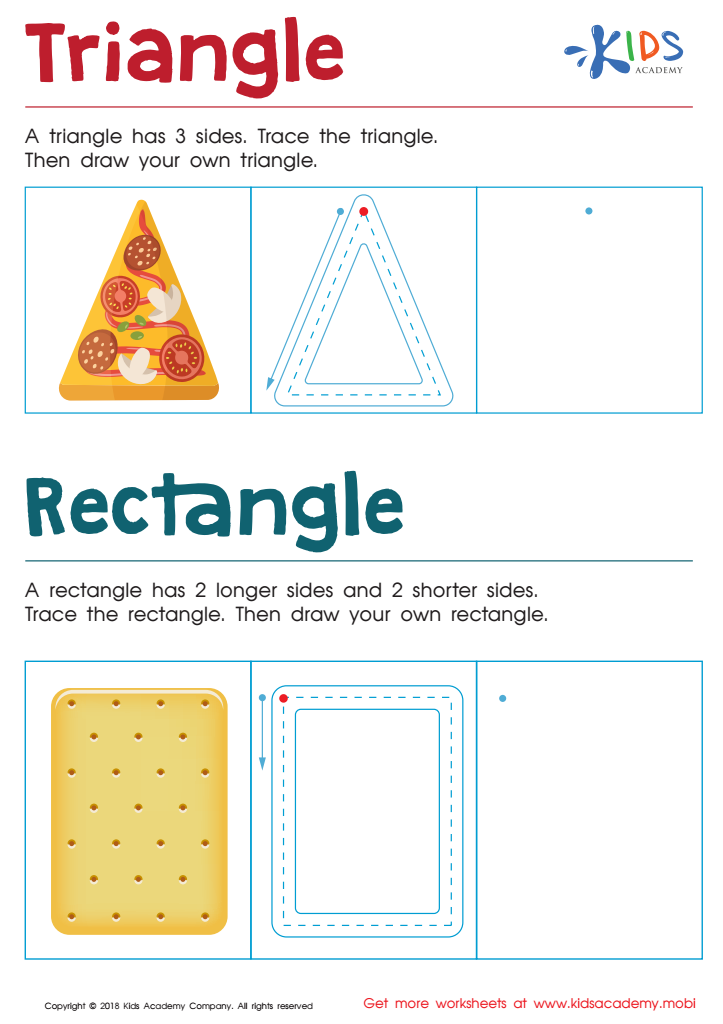
Triangle Rectangle Worksheet
 Assign to My Students
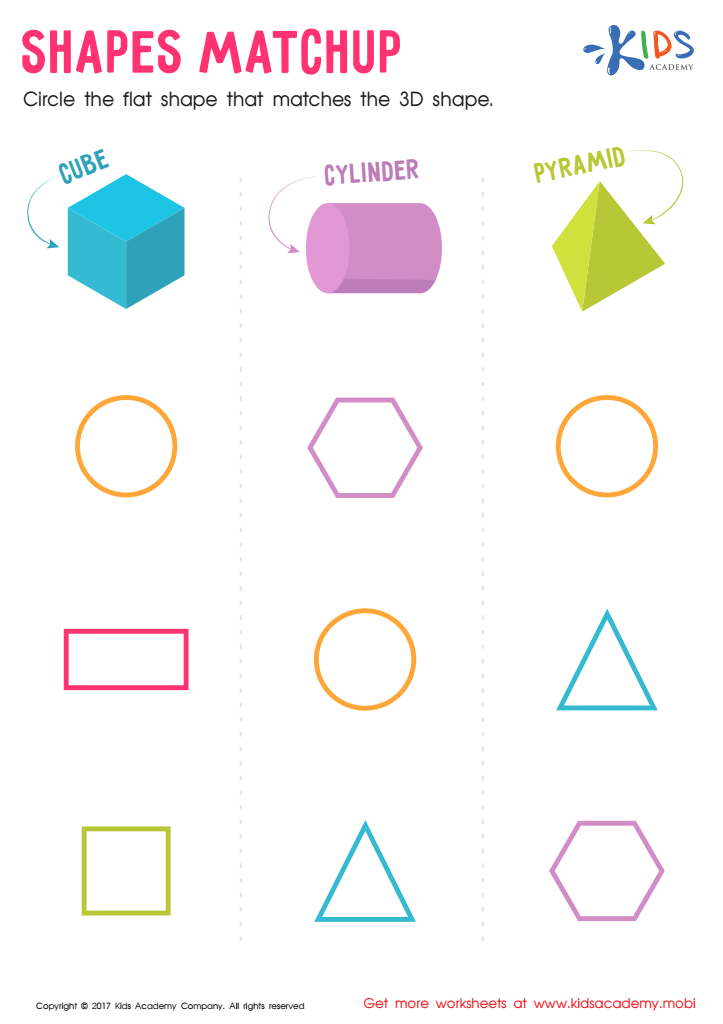
Shapes Matchup Worksheet








Understanding basic geometry is crucial for children aged 7-9 as it lays the foundation for their mathematical reasoning and problem-solving skills. At this age, children's cognitive abilities are rapidly developing, making it an ideal time to introduce geometric concepts such as shapes, area, volume, and angles. Mastering these concepts not only enhances a child’s mathematical foundation but also cultivates critical thinking skills, which are transferable to other subjects, including science, art, and everyday life.
Moreover, geometry fosters spatial awareness, helping children to visualize and manipulate objects in their environment. This skill is essential not just in math but also in areas like navigation, architecture, and even sports. Furthermore, incorporating geometry into learning connects math to real-world applications, making lessons more engaging and relevant.
Parents and teachers should also be aware that struggles with geometry can lead to gaps in understanding that might affect future math learning. Encouraging children to embrace geometry can boost their confidence and interest in math, paving the way for academic success. In short, nurturing basic geometry knowledge significantly contributes to a child's intellectual and emotional growth during these formative years.








