
Comparing shapes Math Worksheets for Ages 7-9
5 filtered results
Difficulty Level
Grade
Age
-
From - To
Subject
Activity
Standards
Discover the exciting world of shapes with our "Comparing Shapes Math Worksheets" designed for ages 7-9! These engaging and educational worksheets help young learners enhance their geometry skills by comparing different shapes. Students will master recognizing, analyzing, and classifying shapes while having fun. Perfect for both classroom and home use, these worksheets provide a variety of exercises that foster critical thinking and improve spatial understanding. Boost your child's confidence in math with our carefully crafted activities. Explore now and see how easy and enjoyable comparing shapes can be!
Favorites
With answer key
Interactive
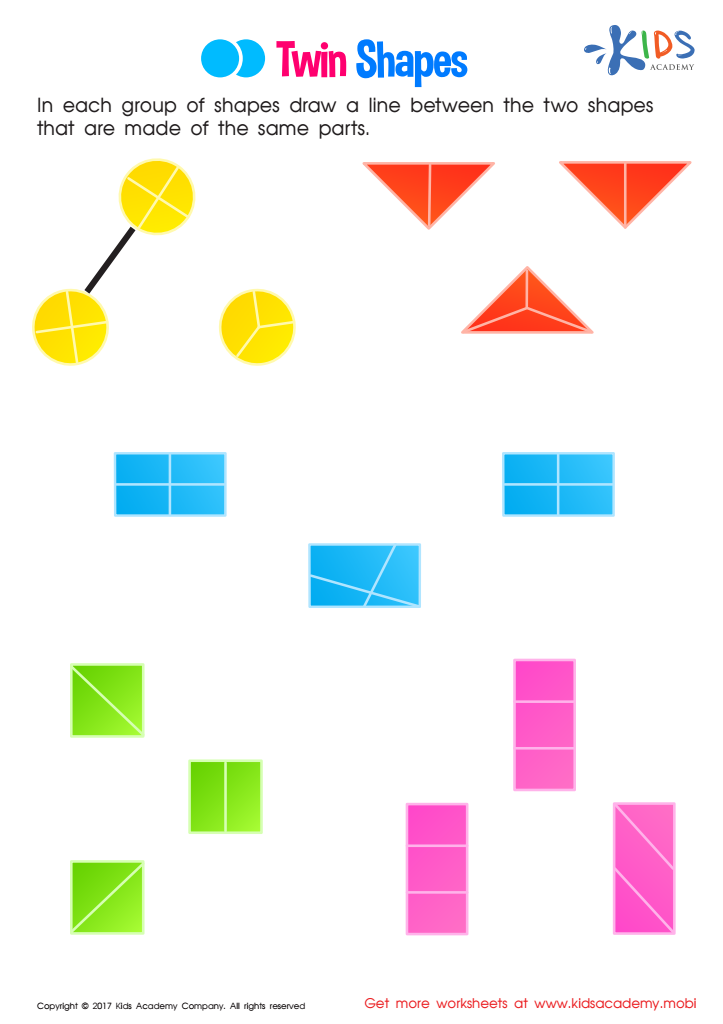
Twin Shapes Worksheet
Your students' goal in this worksheet is to find the twin shapes: drawing a line between two shapes made of the same parts. Likely, the first shapes encountered were circles, triangles, rectangles and squares - examples of which are seen frequently in everyday life. Encourage them to apply what they know and work out which is the twin shape!
 Assign to My Students
Twin Shapes Worksheet
Worksheet
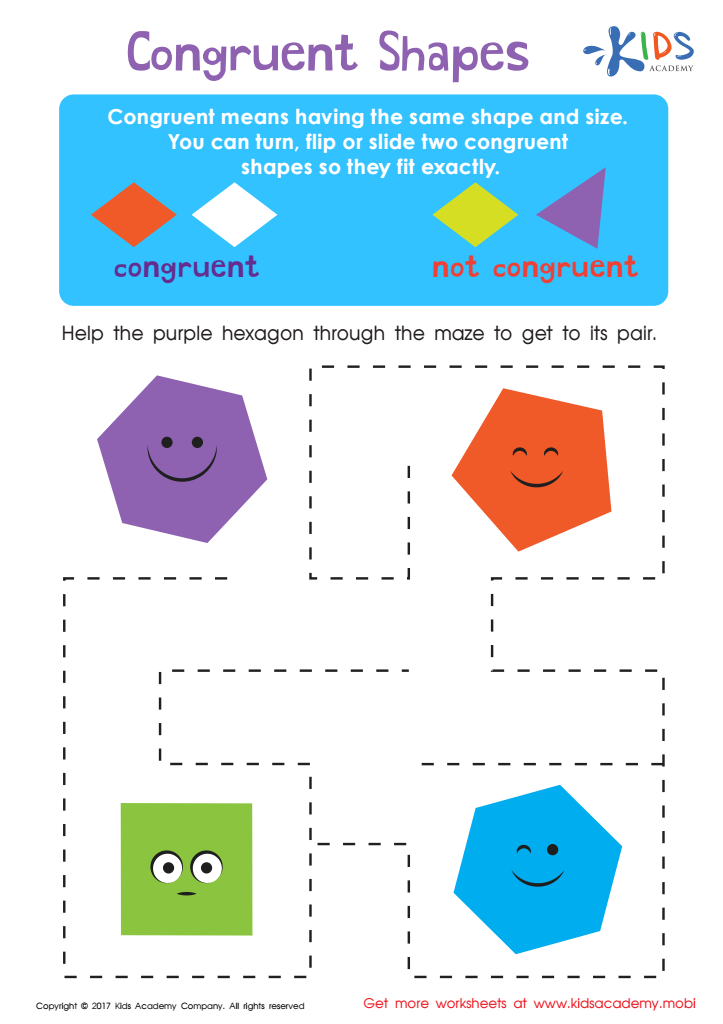
Congruent Shapes Worksheet
Help your child find the twin of the purple hexagon! This congruent shapes worksheet is great for increasing vocabulary while challenging mental rotation skills.
Congruent Shapes Worksheet
Worksheet
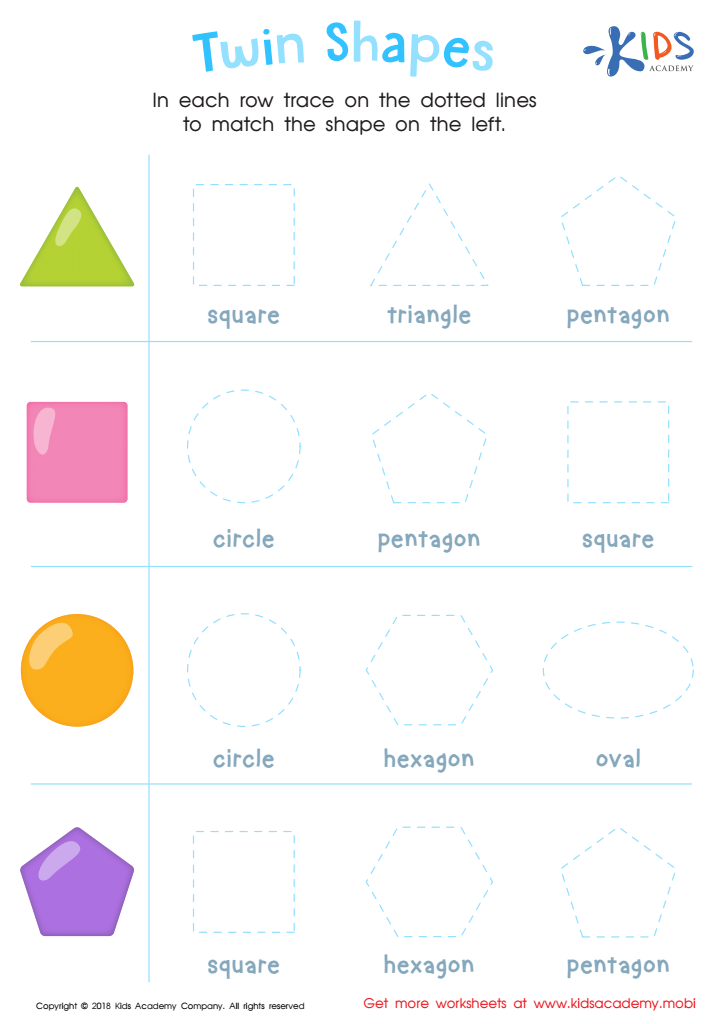
Twin Shapes Dot-to-Dot Worksheet
Test your child's ability to copy with this worksheet. Ask them to find and name the four shapes on the left. Then, they must match each with the dotted lines on the right. Help your child with all four shapes in this fun exercise.
Twin Shapes Dot-to-Dot Worksheet
Worksheet
Join Kids Academy for Free
Who is primarily going to use this learning content?


.jpg)




Parents and teachers should care about teaching children ages 7-9 to compare shapes because it builds foundational skills in geometry that are crucial for their cognitive development. Understanding shapes and how they relate to one another promotes essential spatial reasoning and problem-solving abilities. When children compare shapes, they learn to observe, analyze, and describe their characteristics, such as the number of sides, angles, and symmetry.
These exercises nurture critical thinking as kids are encouraged to discern patterns and categorize objects, which contributes to logical reasoning and early computational skills. This understanding sets the groundwork for more complex mathematical concepts they will encounter later, such as fractions, area, perimeter, and volume.
Moreover, competence in geometry enriches daily life experiences since shapes are encountered everywhere—from playing with toys and navigating environments to building projects with blocks. Early exposure encourages a healthy mathematical mindset, helping children see math as a part of the everyday world rather than an abstract subject confined to the classroom.
Incorporating fun, hands-on activities like drawing, building, and sorting shapes fosters an engaging learning environment, boosting children’s confidence and interest in math. Therefore, nurturing a solid understanding of comparing shapes is vital for holistic educational development and forming positive attitudes toward lifelong learning in mathematics.








