
Identifying fractions Math Worksheets for Ages 7-9
5 filtered results
Difficulty Level
Grade
Age
-
From - To
Subject
Activity
Standards
Our "Identifying Fractions Math Worksheets for Ages 7-9" offer an engaging way for children to grasp the fundamentals of fractions. These expertly designed worksheets simplify complex concepts, helping young learners visually understand halves, thirds, quarters, and more. Through fun activities, kids practice recognizing and comparing fractions, solidifying their math foundation. Ideal for classroom use or at-home learning, these resources aim to boost confidence and skill. Use our worksheets to transform abstract numbers into easy-to-understand visual formats, preparing kids for more advanced math challenges while making learning enjoyable and accessible. Perfect for ages 7-9!
Favorites
With answer key
Interactive
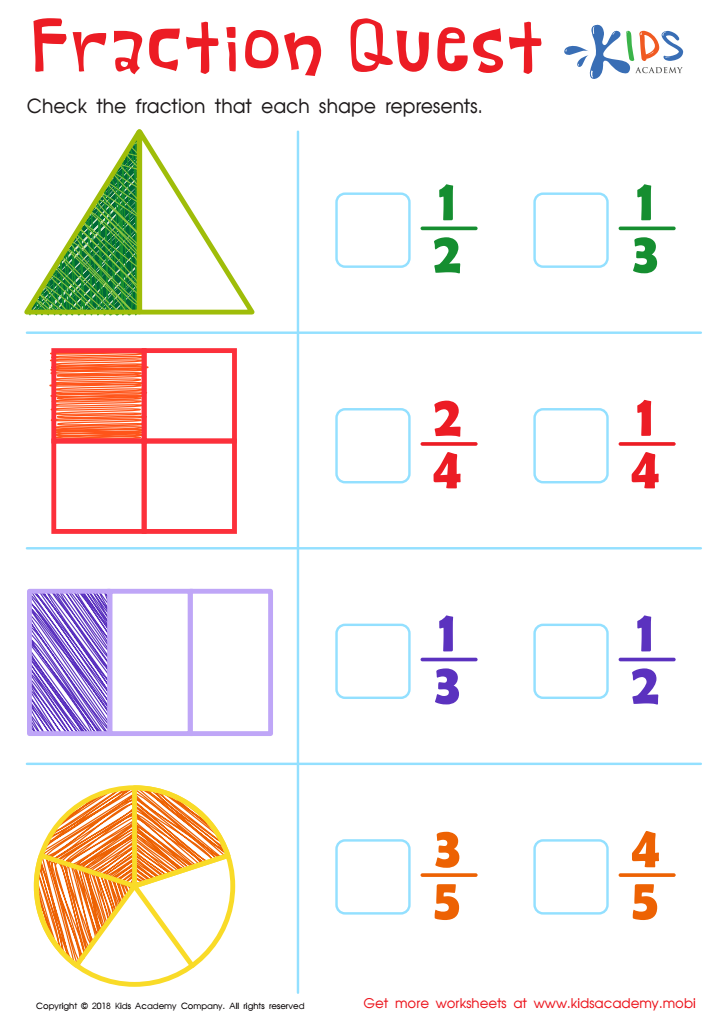
Fraction Quest Worksheet
This colorful and educative worksheet can help kids conquer their fractions struggles. Ask them to identify the four shapes, then the fractions they represent. They can then check the correct answers from the options given.
 Assign to My Students
Fraction Quest Worksheet
Worksheet
Join Kids Academy for Free
Who is primarily going to use this learning content?








Understanding fractions is a crucial mathematical skill that serves as a foundation for more complex concepts in higher grades. For children aged 7-9, grasping fractions is a cornerstone of their overall numerical literacy. When parents and teachers prioritize identifying fractions, they enable children to develop strong analytical and problem-solving skills early on, impacting future academic success.
Fractions extend beyond the classroom to everyday life. For instance, they are essential for measuring ingredients in recipes, dividing up portions equally, and understanding time. Familiarity with fractions helps kids see relationships within parts and wholes, facilitating logical thinking and decision-making abilities.
Teaching fractions also enhances students’ abilities in other core areas such as division, ratios, and even algebra. This understanding is indispensable not only in advanced mathematics but also in various fields like science, engineering, and technology. Additionally, engaging with fractions helps improve spatial reasoning and learns to visualize parts of a whole, competencies vital in numerous professions.
Moreover, making early and effective interventions in teaching fractions can help combat math anxiety. When children master fundamental concepts early, they build confidence and develop a positive attitude toward math. Consequently, ensuring that kids grasp these basics sets them up for long-term academic and real-world success.








