Telling time Math Worksheets for Ages 7-9
4 filtered results
-
From - To
Discover engaging and educational Telling Time Math Worksheets tailored for ages 7-9 at Kids Academy. Our expertly designed worksheets help children master the essential skill of telling time, featuring a variety of analog and digital clock exercises. Fun, hands-on activities make learning exciting while strengthening time-reading abilities and boosting confidence in mathematical skills. Perfect for both classroom use and at-home practice, these worksheets ensure steady progress. Equip your child with the tools they need to excel in time-telling with Kids Academy’s comprehensive and interactive worksheets. Join us in making math easy and enjoyable for young learners!
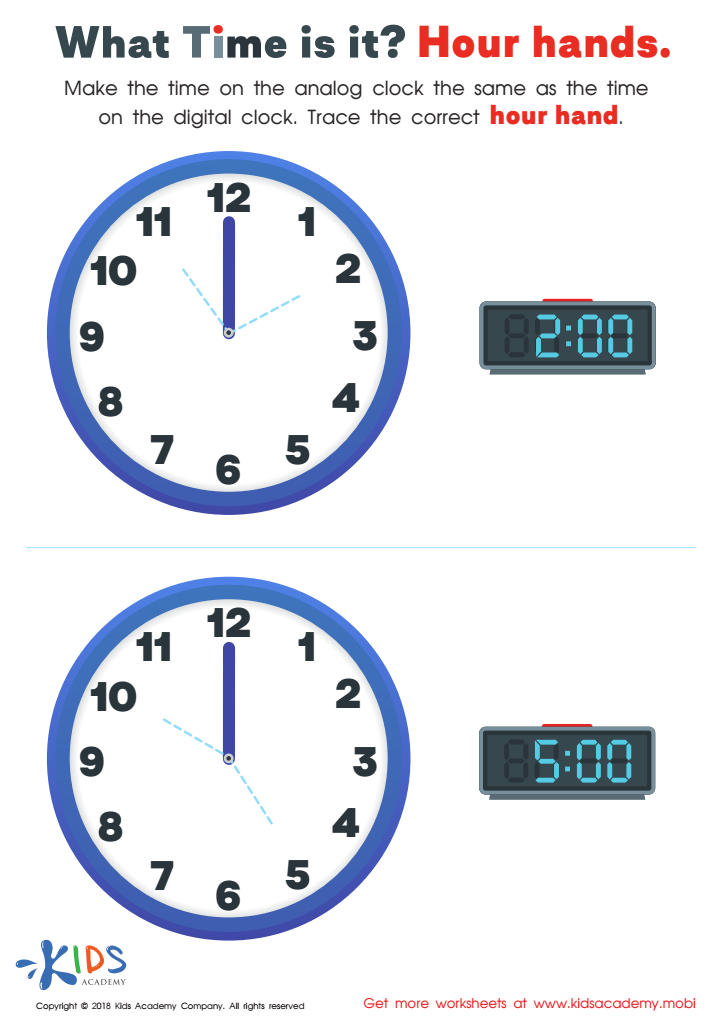
What Time Is it? Hour Hands Worksheet
 Assign to My Students








Telling time is an essential skill that extends far beyond simply reading a clock. For ages 7-9, learning to tell time serves as a foundational element in a child's cognitive and mathematical development. Firstly, it cultivates numeral recognition and counting by fives, which are critical components of arithmetic. As children decipher hours and minutes on an analog clock, they enhance their addition and subtraction skills.
Moreover, understanding time nurtures a child's grasp of the concept of elapsed time, which is crucial for managing daily routines and setting future events. This time management skill is indispensable not only for academic success but also for enhancing a child's organizational and problem-solving abilities.
From a practical perspective, being proficient in telling time fosters independence. Children can begin to assay their own schedules, understanding when it’s time for specific activities like school, homework, and play. This initiative directly contributes to their sense of responsibility and reliability.
Lastly, telling time integrates seamlessly with other subject areas, such as history and science, by helping children understand timelines and sequences. In sum, by caring about and promoting time-telling skills, parents and teachers equip children with versatile and lifelong competencies crucial for both academic and personal growth.








