
Visual Perception Skills Math Worksheets for Ages 7-9
3 filtered results
Difficulty Level
Grade
Age
-
From - To
Subject
Activity
Standards
Boost your child's math abilities with our Visual Perception Skills Math Worksheets designed for ages 7-9! These engaging worksheets focus on enhancing visual-spatial skills, crucial for problem-solving and number recognition in math. Each activity offers fun exercises that improve visual discrimination, pattern recognition, and spatial reasoning. Ideal for home or classroom use, these worksheets make learning math enjoyable while helping children develop a strong foundation in essential skills. Ensure your young learner excels in math by nurturing their visual perception. Explore our diverse assortment of worksheets today and watch their confidence and competence flourish! Perfect for budding mathematicians!
Favorites
With answer key
Interactive
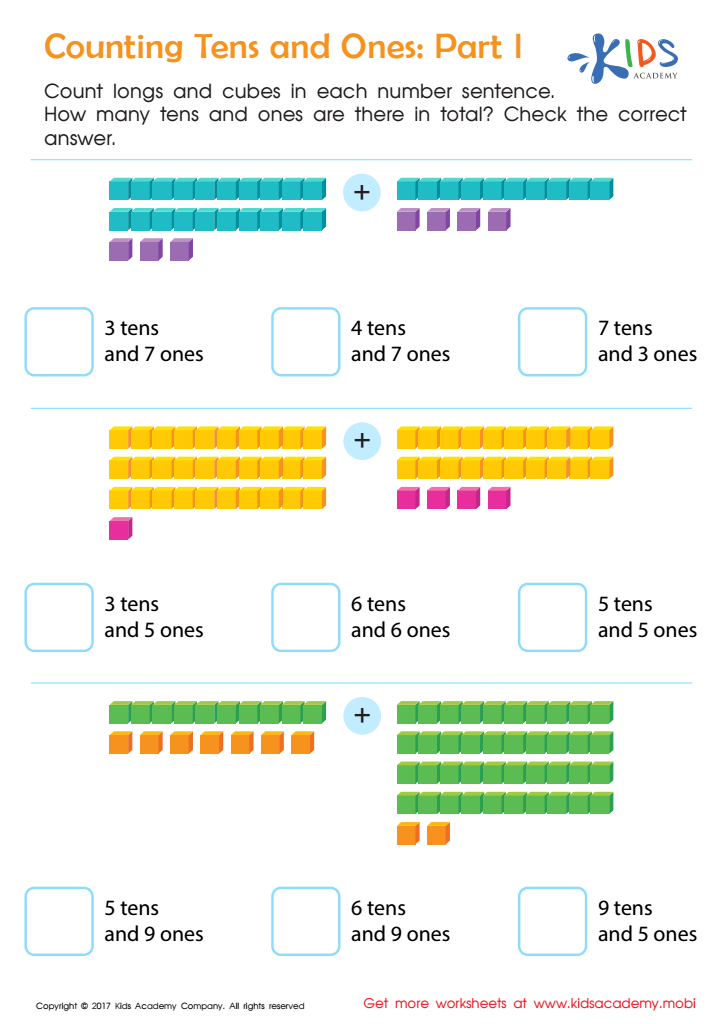
Counting Tens and Ones: Part 1 Worksheet
Kids Academy has a great place value worksheet to help kids learn when they don't have manipulatives at home! It includes longs and cubes that kids can count and add to find the sum. Colorful and downloadable, this page will help kids understand addition and place value better. Give it a try!
 Assign to My Students
Counting Tens and Ones: Part 1 Worksheet
Worksheet
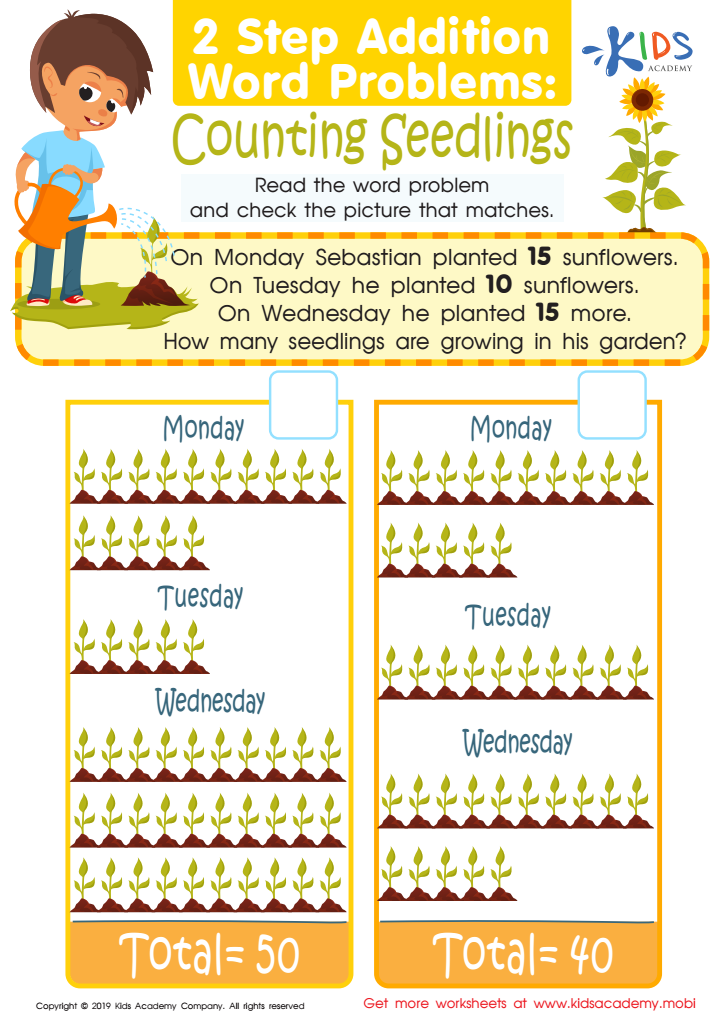
Counting Seedlings Worksheet
Understanding math word problems is key. Multiple steps can prove challenging - this free worksheet provides one-to-one picture representation to help kids solve multi-step addition word problems. Strengthen addition skills by choosing the matching picture to the answer.
Counting Seedlings Worksheet
Worksheet
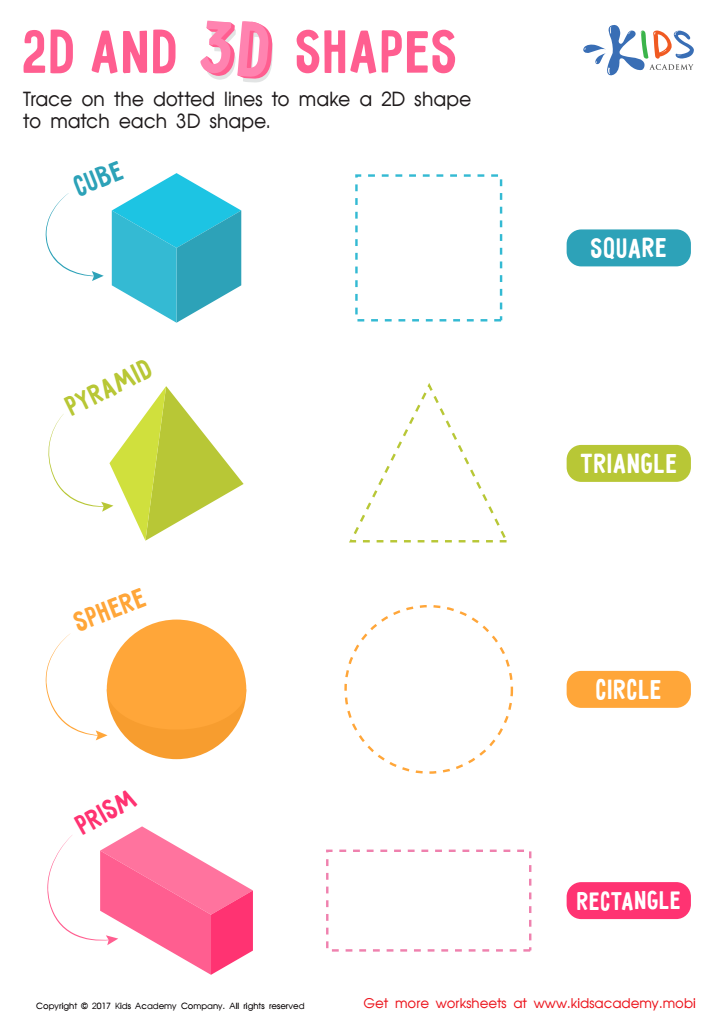
2D and 3D Shapes Worksheet
Introduce your child to 3D and 2D with this traceable worksheet. With dotted lines, help them trace and make a 2D shape for each 3D shape: square, triangle, rectangle, and circle. Show them there's more than one way to draw! You may have taken them to a 3D movie, or they've seen some fantastic 3D art. Now they can wonder no more.
2D and 3D Shapes Worksheet
Worksheet
Join Kids Academy for Free
Who is primarily going to use this learning content?





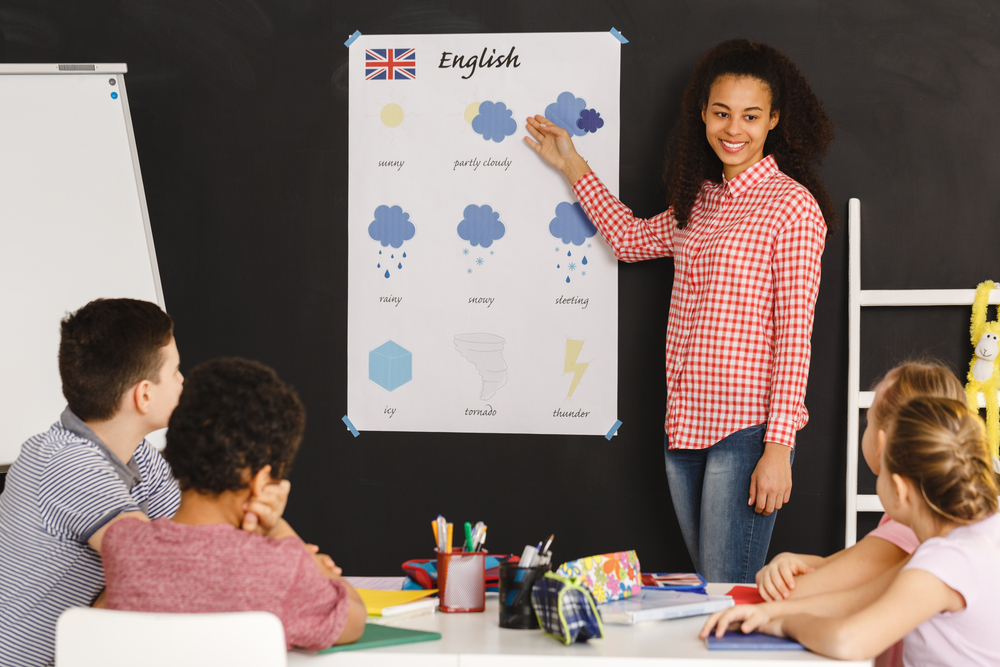


Visual perception skills are crucial for children aged 7-9, especially in the context of math. During this developmental stage, students encounter increasingly complex mathematical concepts, such as geometry, fractions, and spatial reasoning. Strong visual perception skills aid children in accurately recognizing shapes, understanding spatial relationships, and interpreting graphs and charts.
When children can visualize mathematical problems and manipulate visual information, they are better equipped to solve problems and reason through challenges. This capability fosters critical thinking, which is essential as math problems become less straightforward. Parents and teachers should care about developing these skills because students with strong visual perception tend to perform better academically, build confidence, and maintain a positive attitude toward math.
Additionally, teaching visual perception alongside traditional math lessons can lead to more concrete understanding and retention of concepts. Engaging in activities that strengthen these skills—like puzzles, drawing, and interactive games—can boost comprehension and application in real-world scenarios. By prioritizing the development of visual perception skills, parents and teachers can help set a solid foundation for children's overall academic success, equipping them to tackle even more complex subjects ahead. This holistic approach ensures a well-rounded education that empowers children in their learning journey.








