Math problem-solving Building Vocabulary Worksheets for Ages 7-9
5 filtered results
-
From - To
Our "Math Problem-solving Building Vocabulary Worksheets for Ages 7-9" are designed to sharpen your child's mathematical thinking and vocabulary skills. These engaging worksheets combine fun problem-solving exercises with key vocabulary building, ensuring students grasp the terms critical for their academic success. With activities tailored specifically for ages 7-9, our resources foster a strong foundation in math language, enhancing comprehension and confidence. Perfect for classroom use or home practice, these expertly crafted worksheets support comprehensive learning, making math vocabulary accessible and enjoyable. Explore our collection today and watch your child's understanding and love for math blossom!











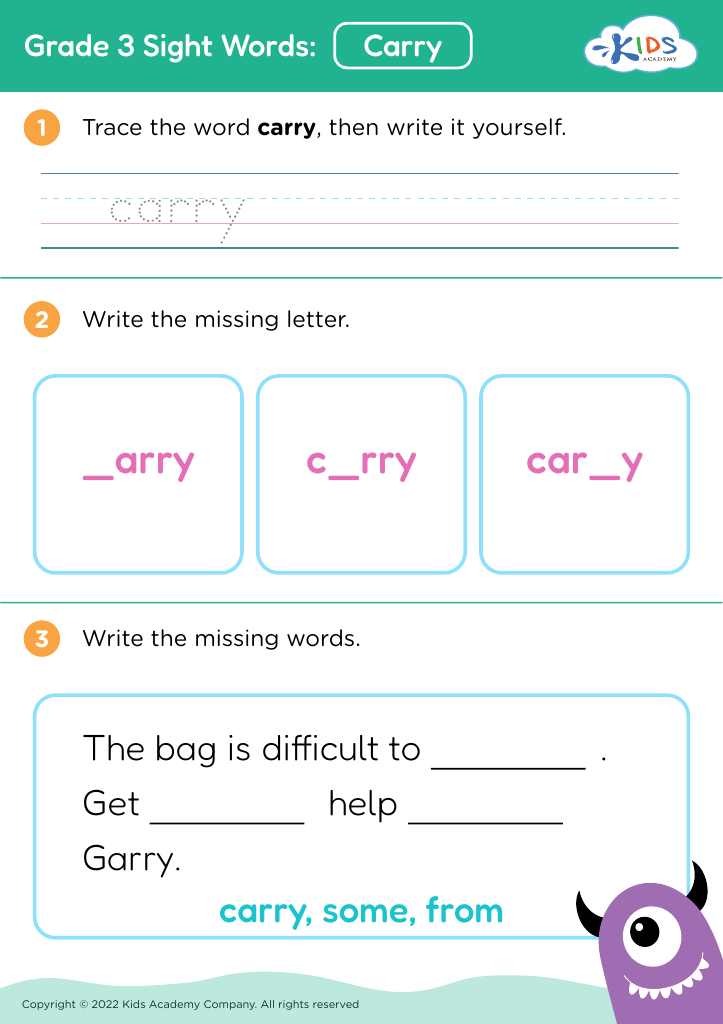








Math problem-solving and vocabulary are critically important for children ages 7-9 because these skills form the foundation for future academic success and everyday functionalities. At this developmental stage, children's cognitive abilities are expanding, and their capacity to understand and apply complex concepts is growing. By focusing on math problem-solving, we not only improve their numerical and analytical abilities but also bolster their critical thinking and logical reasoning.
Building a strong math vocabulary is crucial because language is the medium through which complex concepts are understood and communicated. Terms like "sum," "difference," "product," and "quotient" might seem simple, but they are the building blocks for understanding more advanced topics like fractions, algebra, and geometry later on. Without a solid grasp of these terms, children may struggle to comprehend instructions, follow problems, or articulate their reasoning.
Parents and teachers who prioritize math vocabulary enable children to decode problems more efficiently and apply appropriate methods to reach solutions. This dual focus enhances their confidence and reduces math-related anxiety, creating a positive attitude towards learning. Ultimately, these skills are not confined to the classroom; they are essential for everyday decision-making, financial literacy, and embracing technology, all of which are necessary for a successful future.








