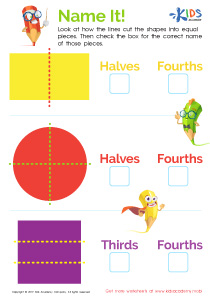
Cognitive Development 2D Shapes Worksheets for 7-Year-Olds
3 filtered results
Difficulty Level
Grade
Age
-
From - To
Subject
Activity
Standards
Foster cognitive growth in seven-year-olds with our engaging 2D shapes worksheets, designed to enhance mathematical skills and spatial awareness. Each worksheet offers fun, interactive activities aimed at helping kids recognize, distinguish, and understand various two-dimensional shapes. By incorporating shapes into problem-solving exercises, these activities support critical thinking, memory retention, and fine motor skills. Perfect for classroom or home use, these printable worksheets make learning an enjoyable adventure while laying a solid foundation for future math success. Equip your child with the tools they need to build a bright and intelligent future in a fun, beautiful package.
Favorites
With answer key
Interactive
Match It up Worksheet
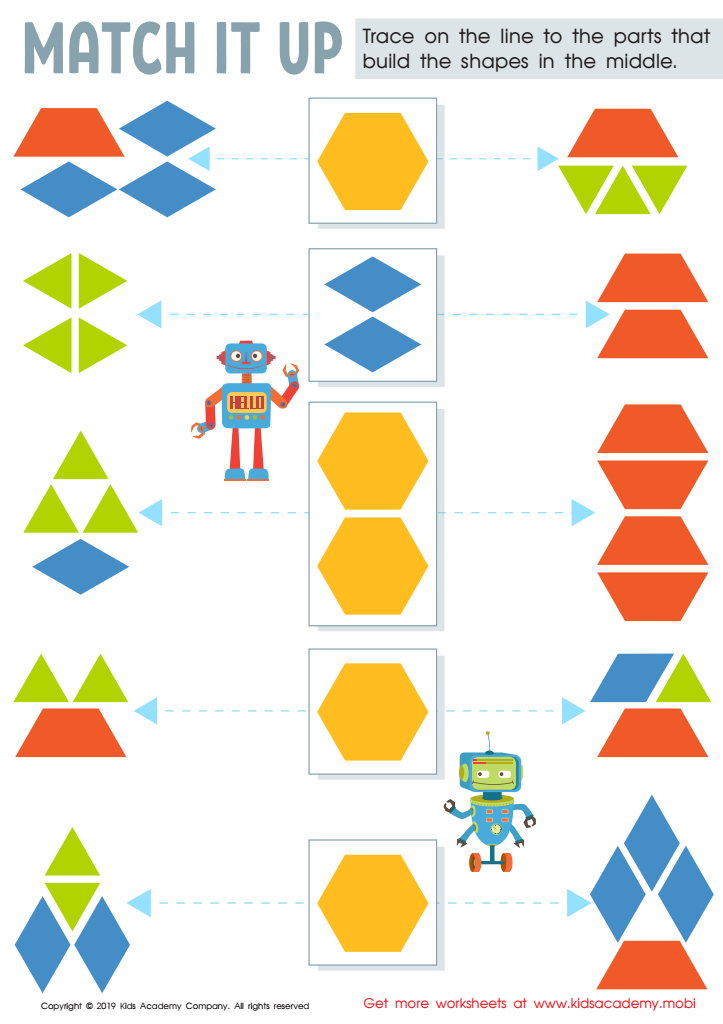
If your kids are into robots, they'll be thrilled to work on this worksheet. Ask them to name shapes they know, and help them draw and identify these shapes. Look at the shapes in the middle, and the sides. Finally, help your kids trace the lines to build the shapes in the middle.
 Assign to My Students
Match It up Worksheet
Worksheet


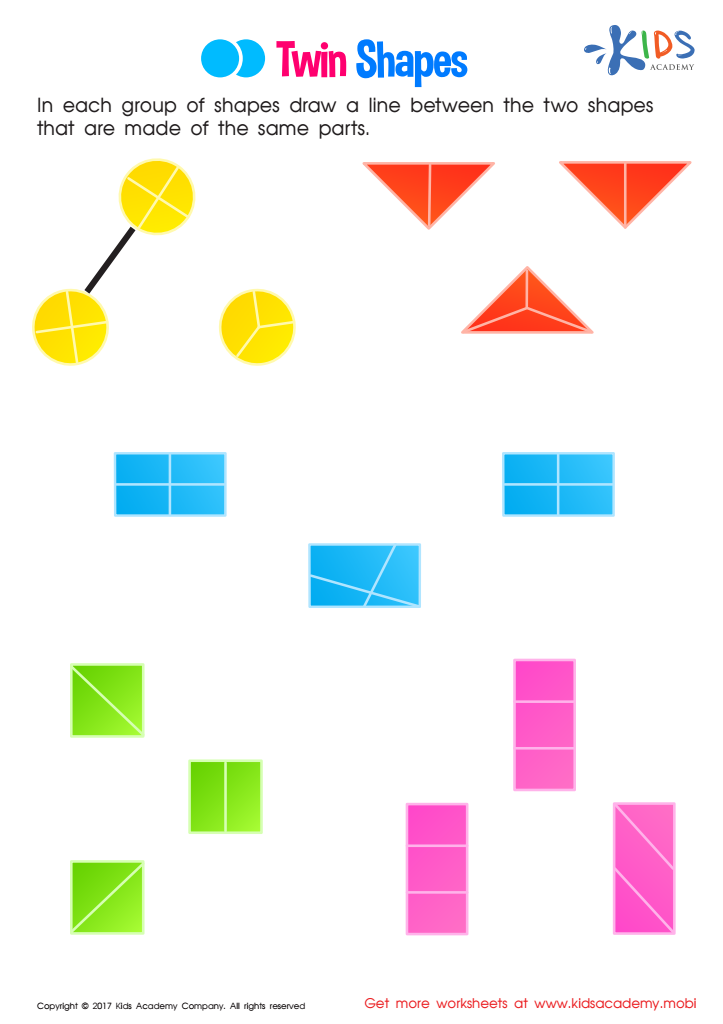
Twin Shapes Worksheet
Your students' goal in this worksheet is to find the twin shapes: drawing a line between two shapes made of the same parts. Likely, the first shapes encountered were circles, triangles, rectangles and squares - examples of which are seen frequently in everyday life. Encourage them to apply what they know and work out which is the twin shape!
Twin Shapes Worksheet
Worksheet
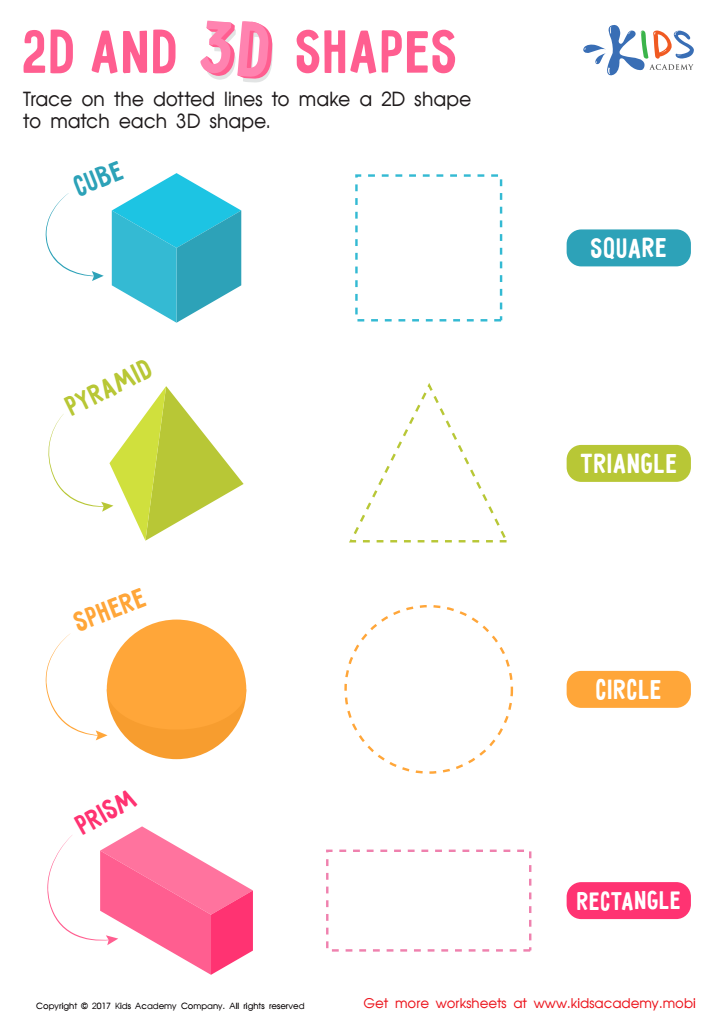
2D and 3D Shapes Worksheet
Introduce your child to 3D and 2D with this traceable worksheet. With dotted lines, help them trace and make a 2D shape for each 3D shape: square, triangle, rectangle, and circle. Show them there's more than one way to draw! You may have taken them to a 3D movie, or they've seen some fantastic 3D art. Now they can wonder no more.
2D and 3D Shapes Worksheet
Worksheet
Join Kids Academy for Free
Who is primarily going to use this learning content?








Parents and teachers should care about cognitive development involving 2D shapes for 7-year-olds because it represents a crucial step in building a child’s foundational math and reasoning skills. At this age, children are developing their spatial awareness and cognitive abilities, which are essential for understanding and interacting with their environment. Learning about 2D shapes such as circles, squares, triangles, and rectangles helps strengthen their ability to recognize patterns, describe the world around them, and build early geometry skills.
Understanding 2D shapes also enhances their problem-solving and critical-thinking skills, as children learn to distinguish shapes, compare their properties, and sort them into categories based on various attributes. These activities stimulate their brains and aid both visual and cognitive development. Additionally, knowledge of 2D shapes lays the groundwork for more complex mathematical concepts they will encounter in later grades, including the understanding of symmetry, angles, and measurements.
From an educational standpoint, grasping 2D shapes in early childhood forms part of the essential standards in most curriculums, ensuring that children have the necessary tools to succeed academically. Furthermore, this knowledge spills over to practical skills such as reading maps, understanding graphics, and even performing simple daily tasks. Development at this stage sets a precedent for lifelong learning and cognitive skill refinement.