
Pattern identification Addition & Subtraction Worksheets for 7-Year-Olds
3 filtered results
Difficulty Level
Grade
Age
-
From - To
Subject
Activity
Standards
Discover our engaging Pattern Identification Addition and Subtraction Worksheets designed specifically for 7-year-olds! These worksheets enhance critical math skills through fun and interactive exercises that challenge young learners to recognize numerical patterns while practicing addition and subtraction. Perfect for reinforcing classroom learning or as an at-home activity, our resources support children in developing logical thinking necessary for mastering math concepts. With colorful designs and age-appropriate activities, your child will enjoy exploring patterns while building their confidence in math. Download our printable worksheets today and watch your child's mathematical abilities flourish! Excellent for teachers and parents alike seeking to enrich young minds.
Favorites
With answer key
Interactive
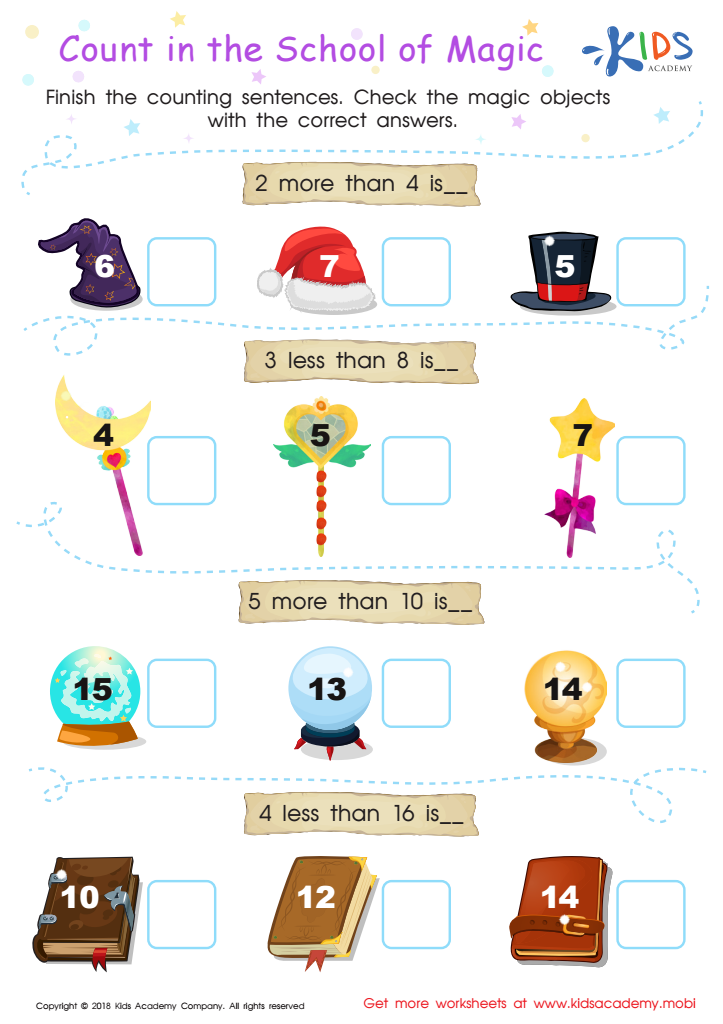
Count in the School of Magic Worksheet
Your math learners can explore the School of Magic with this worksheet. They'll read equations with addition and subtraction numbers under 20, count back and forth to find the answer, then complete the counting sentences. Fun pictures and easy accuracy make it an enjoyable and successful learning experience.
 Assign to My Students
Count in the School of Magic Worksheet
Worksheet
Join Kids Academy for Free
Who is primarily going to use this learning content?








Pattern identification in addition and subtraction is crucial for 7-year-olds as it lays a strong foundation for their mathematical understanding. Children at this age are developing cognitive skills that help them recognize relationships and predict outcomes based on established patterns. When parents and teachers emphasize patterns, children grasp how numbers interact, which enhances their problem-solving abilities and reinforces their understanding of basic operations.
Recognizing patterns in addition and subtraction helps children become more efficient in calculations. For instance, understanding that adding two odd numbers results in an even number allows them to make quicker calculations. Similarly, identifying patterns in subtraction, such as knowing that decreasing a number by a consistent value leads to predictable outcomes, reinforces their mathematical reasoning.
Moreover, fostering pattern recognition nurtures critical thinking and promotes confidence in tackling more complex math topics in the future. As students progress in school, skills in recognizing and applying patterns become indispensable, especially in subjects like algebra. By prioritizing this aspect of mathematics, parents and teachers invest in a child's overall academic success and lifelong learning skills, setting them up for future achievement across various subjects.








