Basic geometry knowledge Math Worksheets for 7-Year-Olds
3 filtered results
-
From - To
Unlock the world of shapes and spatial understanding with our Basic Geometry Math Worksheets for 7-Year-Olds! Designed to engage young learners, these worksheets cover essential geometric concepts including identifying shapes, understanding symmetry, and measuring angles. Each activity is age-appropriate, fun, and aligned with educational standards, making it easy for children to build confidence in their math skills. Printable and easy to use, these resources promote problem-solving and critical thinking while making learning enjoyable. Perfect for homeschooling or classroom settings, our worksheets will help your child master geometry fundamentals and lay a strong foundation for future math success. Start exploring today!
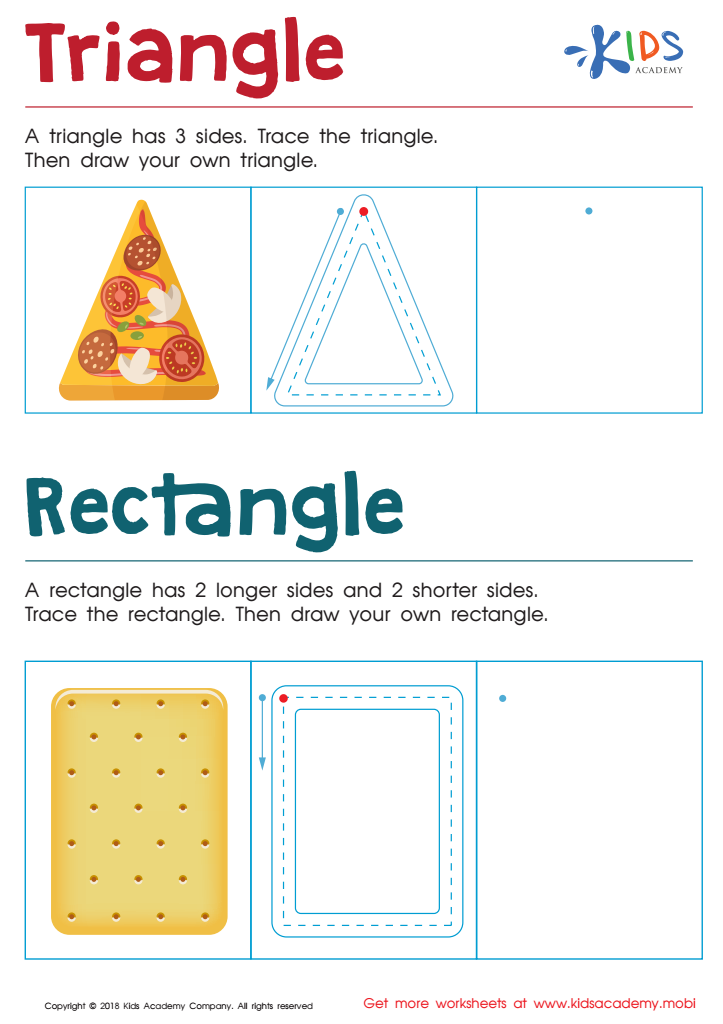
Triangle Rectangle Worksheet
 Assign to My Students
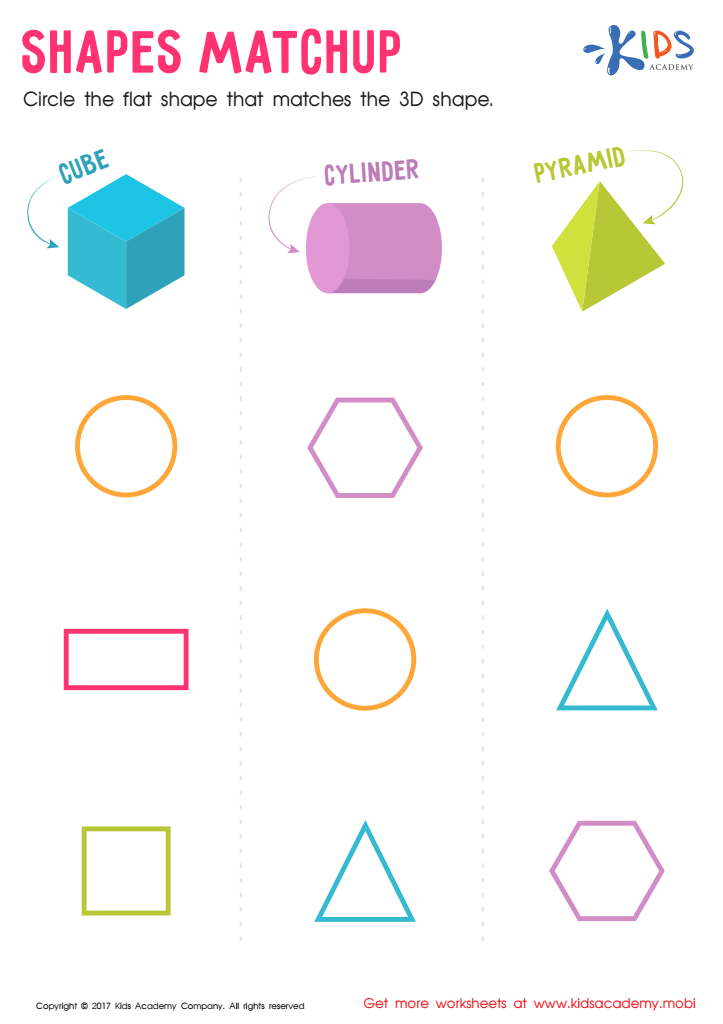
Shapes Matchup Worksheet








Basic geometry knowledge is crucial for 7-year-olds as it forms the foundation for various critical cognitive skills and real-life applications. At this age, children are beginning to understand shapes, sizes, and spatial relationships, which enhances their overall mathematical comprehension. Geometry teaches kids to think patterns, recognize similarities and differences, and develop problem-solving skills, which are vital in their academic progress.
Moreover, geometry encourages observational skills and boosts creativity. When children explore shapes in their environment or engage in activities like building with blocks, they learn to see the world in a more analytical way. This hands-on experience fosters critical thinking as they visualize and manipulate different shapes and layouts.
Additionally, basic geometry is seamlessly woven into everyday life. Understanding concepts such as area, perimeter, and spatial reasoning is beneficial for tasks like art projects, cooking, or even navigating spaces. By nurturing their love for geometry early, parents and teachers can instill in children a strong mathematical foundation that will help in future learning, as higher-level math concepts build upon these fundamental ideas. In summary, geometry knowledge empowers children academically, creatively, and socially, making it an essential area of focus for educators and parents.








