
Visual interpretation Math Worksheets for 7-Year-Olds
5 filtered results
Difficulty Level
Grade
Age
-
From - To
Subject
Activity
Standards
Discover our engaging Visual Interpretation Math Worksheets designed specifically for 7-year-olds. These worksheets encourage young learners to enhance their problem-solving skills by interpreting diagrams, charts, and visual representations of mathematical concepts. Through fun and interactive activities, children will develop the ability to analyze, compare, and draw conclusions from visual data, fostering a deeper understanding of math. Each worksheet aligns with educational standards and is crafted to keep students motivated and excited about learning. Perfect for classroom use or home practice, our resources will help build a solid foundation in mathematics while enhancing critical thinking and visual analysis skills. Explore today!
Favorites
With answer key
Interactive
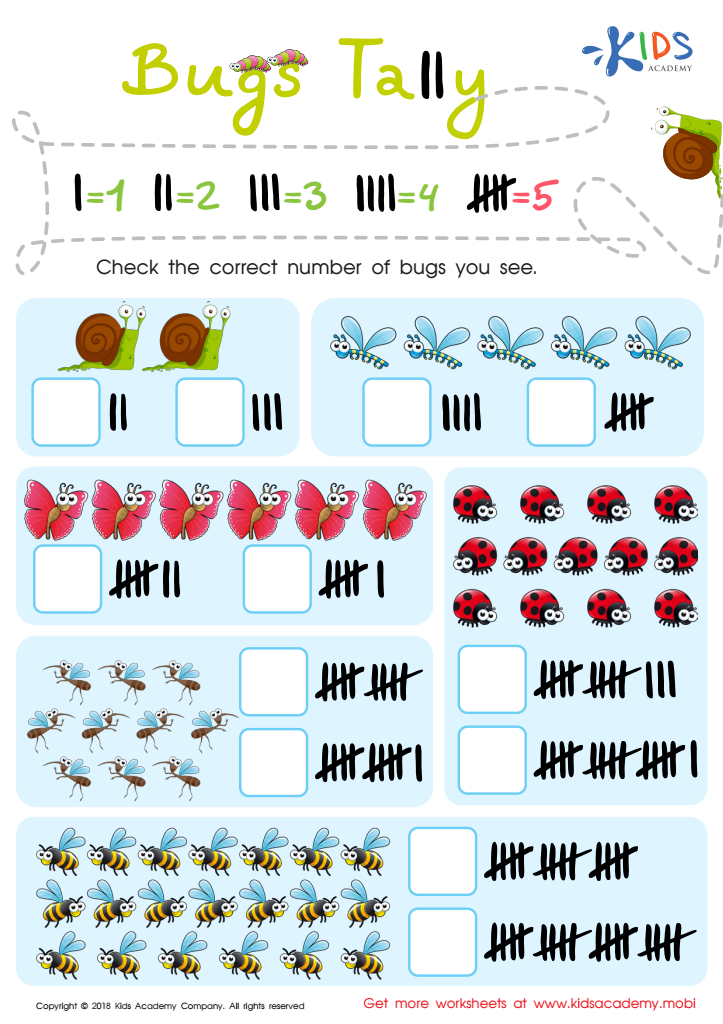
Bugs Tally Worksheet
This fun worksheet uses friendly bugs to help young mathematicians learn numbers and tally marks. They'll gain real-world skills to help with adding, subtracting and counting. Representations will solidify number reasoning, aiding with game playing and more.
 Assign to My Students
Bugs Tally Worksheet
Worksheet
Join Kids Academy for Free
Who is primarily going to use this learning content?







Visual interpretation in mathematics for 7-year-olds is crucial as it shapes foundational skills in understanding mathematical concepts. At this age, children are naturally curious and perceptive, making it an ideal time to introduce visual strategies that cater to their cognitive development. Visual aids, such as graphs, charts, and diagrams, help children grasp abstract ideas, fostering a deeper understanding of numbers, relationships, and problem-solving.
Parents and teachers should care about this approach because visual interpretation not only enhances comprehension but also builds confidence in young learners. As children progress through their education, strong visual interpretation skills can lead to better performance in mathematics and other subjects. It also encourages critical thinking, as students learn to analyze information and draw conclusions from visual data.
Incorporating visual methods into teaching can make learning more engaging and enjoyable, promoting a positive attitude toward math. When children can see math in action, they’re more likely to stay motivated and interested. Ultimately, nurturing visual interpretation skills equips children with essential tools for academic success and everyday life, laying the groundwork for lifelong learning and appreciation of mathematics.








