
Time reading skills Measurement Worksheets for 7-Year-Olds
3 filtered results
Difficulty Level
Grade
Age
-
From - To
Subject
Activity
Standards
Boost your 7-year-old's time-telling proficiency with our engaging time reading skills measurement worksheets! Designed to make learning fun and effective, these printable worksheets from Kids Academy offer a variety of exercises to help children master reading clocks, identifying times, and understanding different time increments. With eye-catching visuals and simple instructions, kids will build competence and confidence in reading both analog and digital clocks. Ideal for classroom use or at-home practice, our worksheets ensure young learners develop essential time-telling abilities while enjoying every minute of the learning process. Download now to turn time reading into an exciting adventure!
Favorites
With answer key
Interactive
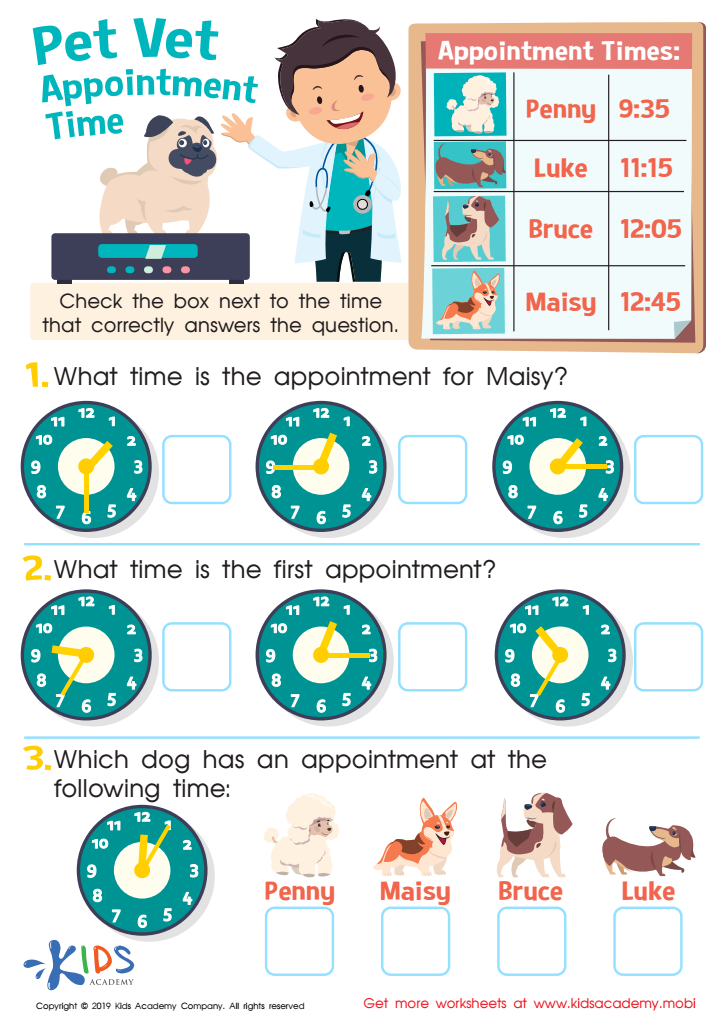
Pet Vet Appointment Time Worksheet
Teach your child how to read the time early, so they can master it. Explain the importance of being able to tell the time. Use this worksheet to have your child practice. Have them look at the clocks and check the box of the time that correctly answers the three questions.
 Assign to My Students
Pet Vet Appointment Time Worksheet
Worksheet
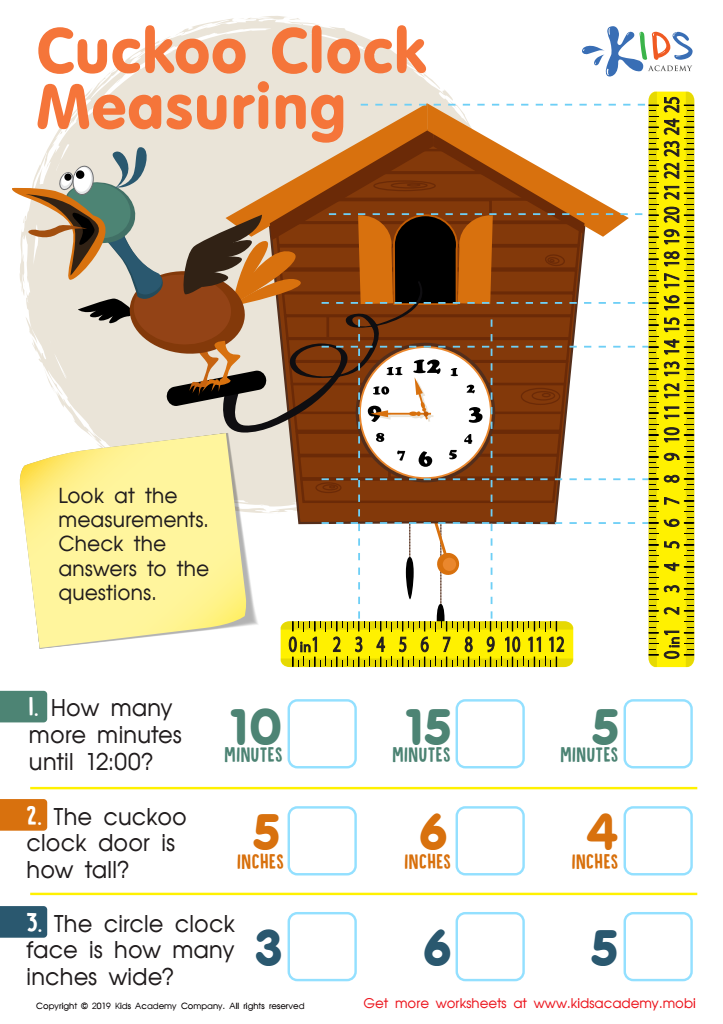
Cuckoo Clock Measuring Worksheet
Check out the fun picture in this worksheet. Ask your kids to identify the object. It's a cuckoo clock - the bird pops out every hour to announce the time. See if your child knows how to measure the clock. Help them answer the 3 questions and test their knowledge of time!
Cuckoo Clock Measuring Worksheet
Worksheet
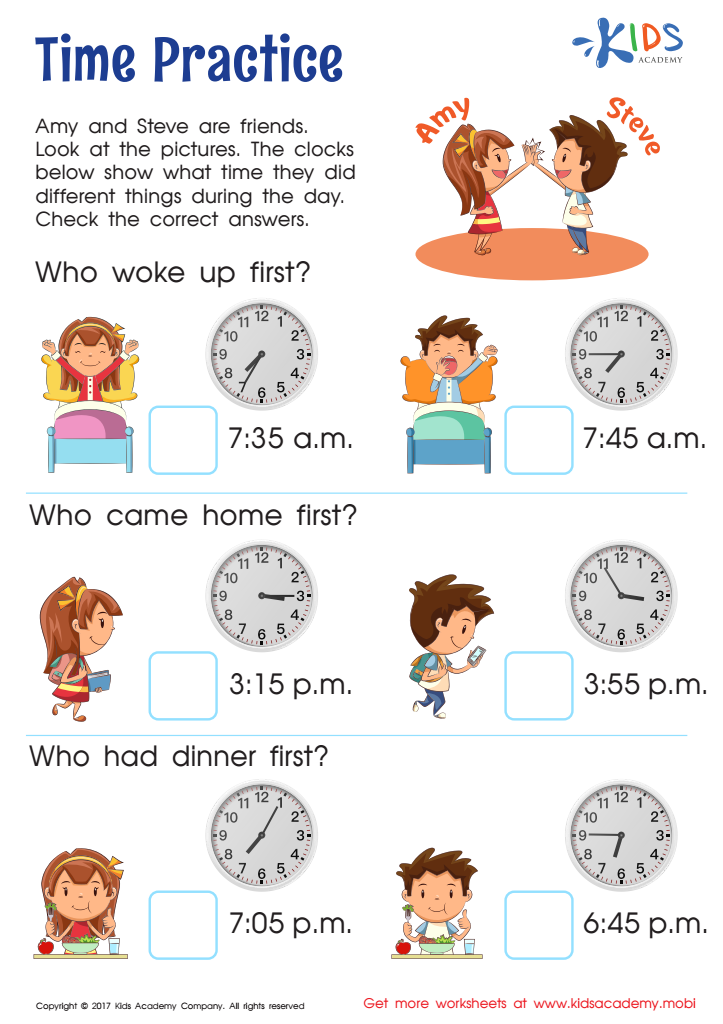
Time Practice Worksheet
It's perfect for 2nd graders as they gain a better understanding of time. Get them to tell the time on analog clocks, improve their math skills, and boost their confidence!
Second graders can brush up on timekeeping with our time practice worksheets. They'll learn to read minutes on analog clocks, honing math and confidence. Perfect for mastering this tricky concept!
Time Practice Worksheet
Worksheet
Join Kids Academy for Free
Who is primarily going to use this learning content?








Understanding time reading skills is essential for 7-year-olds as it forms a cornerstone for various facets of their development and daily routine. When children can accurately read time, they gain a sense of autonomy and responsibility. It helps them to grasp the concept of scheduling, deadlines, and the distribution of their day into manageable segments. This foundational skill aids in organizing their activities, from knowing when it's time for school, play, homework, or bedtime, thereby promoting punctuality and discipline.
Moreover, reading time enhances cognitive skills, such as sequencing, math comprehension, and memory. Children learn to understand the relationship between numbers and increment divisions, which underpins more advanced mathematical concepts. Recognizing the passage of time can motivate children to complete tasks without procrastination and understand time management.
On an emotional level, understanding time helps children to feel more secure and confident. They know what to expect when, reducing anxiety about upcoming events. Furthermore, synchronizing activities with peers is more manageable, fostering better social interactions.
For parents and teachers, reinforcing time-reading skills sets a foundation for academic success and life-long habits. Hence, investing effort in teaching time not only supports their immediate daily functioning but also prepares children for future responsibilities.








