
Basic subtraction skills Worksheets for Ages 8-9
3 filtered results
Difficulty Level
Grade
Age
-
From - To
Subject
Activity
Standards
Discover our expertly crafted Basic Subtraction Skills Worksheets for ages 8-9 designed to make learning foundational math easy and fun. These worksheets are perfect for third and fourth graders, offering a variety of engaging exercises to help children master subtraction. Our resources are teacher-approved, ensuring they align with educational standards and aid in boosting problem-solving skills and mathematical confidence. Each printable worksheet includes colorful illustrations and appealing activities to keep young learners motivated. Visit Kids Academy to provide your child with the highest quality educational tools to make mastering subtraction a delightful adventure!
Favorites
With answer key
Interactive
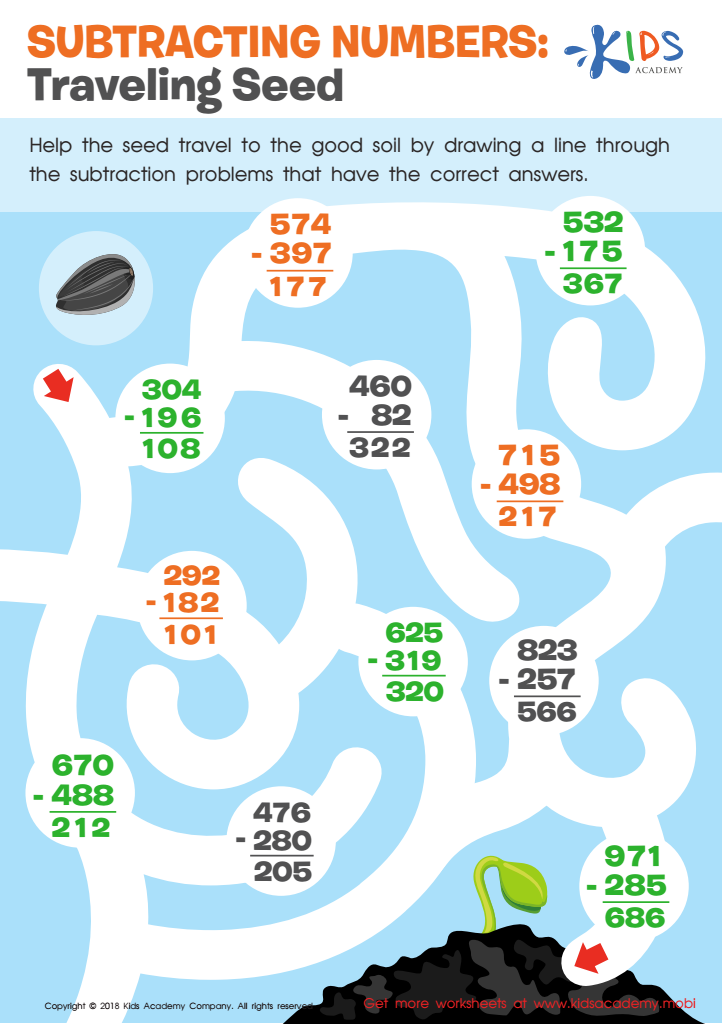
Subtracting Numbers: Traveling Seeds Worksheet
Introduce students to subtracting equations with this math worksheet! Engaging images will help them practice. Draw a line through the subtraction problems with the right answers to help the image reach the good soil. Let your students solve the math maze and have fun while they learn!
 Assign to My Students
Subtracting Numbers: Traveling Seeds Worksheet
Worksheet
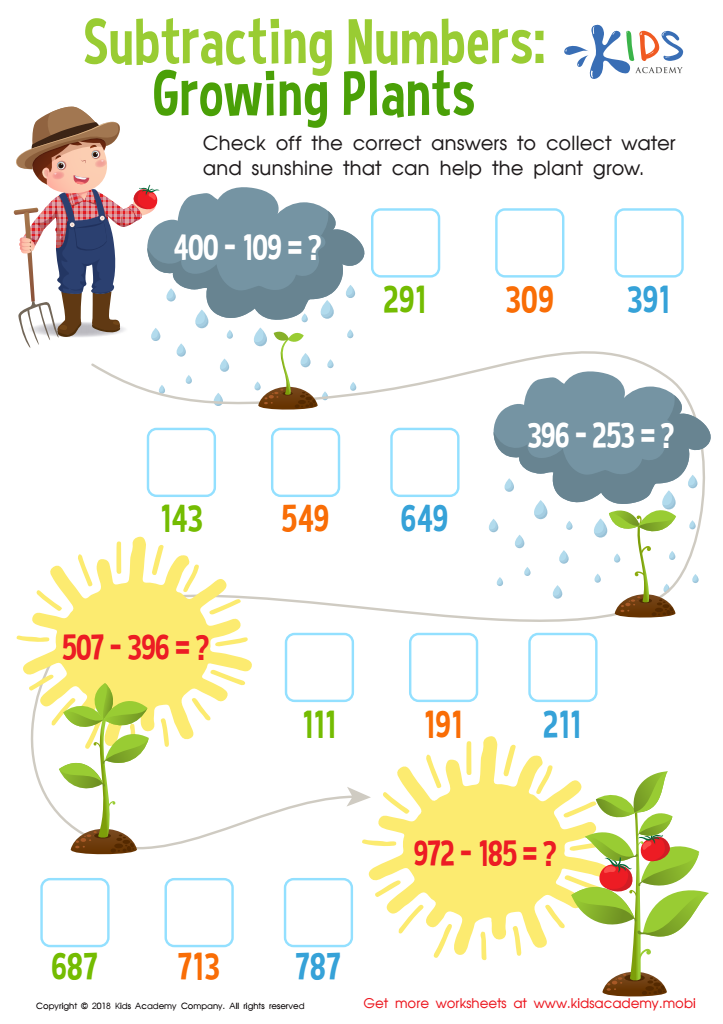
Subtracting Numbers: Growing Plants Worksheet
Farmers plant and nurture crops for us to eat. To help them, check off the items a plant needs to survive: water and sunshine. Ask your child to explain more!
Subtracting Numbers: Growing Plants Worksheet
Worksheet
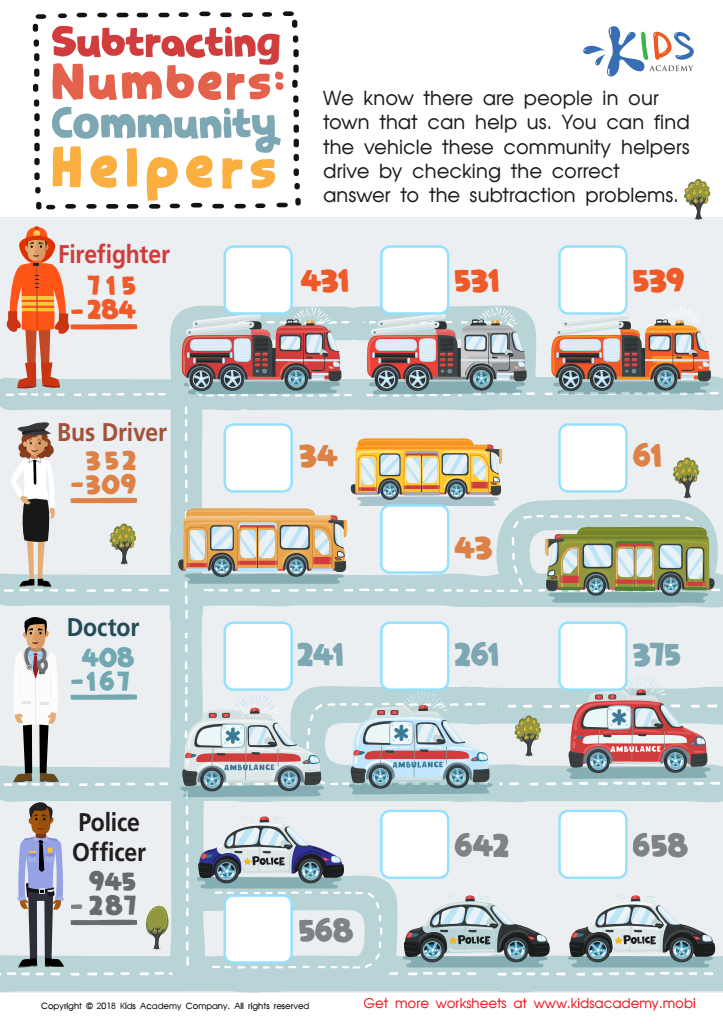
Subtracting Numbers: Community Helpers Worksheet
A community is an area of different people, buildings and other elements. People in a community have varied roles and work together to make it thrive. Ask your child what community helpers they know and how they help. Match the helpers to their vehicles by solving subtraction problems!
Subtracting Numbers: Community Helpers Worksheet
Worksheet
Learning Skills
Join Kids Academy for Free
Who is primarily going to use this learning content?








Parents and teachers should deeply care about basic subtraction skills for ages 8-9, as these formative years are crucial for laying down the mathematical foundation critical for advanced learning. Subtraction, a fundamental arithmetic operation, stands at the core of problem-solving and daily life applications. Mastering these skills early on helps children develop number sense, which is critical for understanding more complex mathematical concepts later, such as multiplication, division, fractions, and algebra.
At ages 8-9, children are transitioning from simple, single-digit calculations to more sophisticated multi-digit operations. Developing fluency in basic subtraction minimizes cognitive load, allowing them to focus on advanced problem-solving and application rather than being bogged down by fundamental operations. Equally, strong subtraction skills contribute to critical thinking and logical reasoning, abilities that are invaluable both within and outside the math classroom.
Furthermore, proficiency in subtraction strengthens confidence and fosters a positive attitude towards math, preventing math anxiety, which can discourage future learning. Real-life skills such as budgeting, measuring, and making change rely heavily on subtraction, proving its necessity in daily activities. Therefore, parents and teachers play pivotal roles in reinforcing and nurturing these skills, ensuring children build a robust and lifelong understanding of mathematics.








