
Improving addition skills Worksheets for Ages 8-9
3 filtered results
Difficulty Level
Grade
Age
-
From - To
Subject
Activity
Standards
Discover our engaging "Improving Addition Skills Worksheets" designed specifically for children aged 8-9! These worksheets provide a fun and interactive way to enhance addition skills through a variety of exercises, including word problems, number lines, and timed quizzes. Tailored to meet the learning needs of young mathematicians, these worksheets help build confidence and proficiency in addition. As students progress, they will develop critical thinking and problem-solving abilities, essential for future math challenges. Perfect for home or classroom use, our resources ensure a solid foundation for your child's mathematical journey. Explore our collection today and watch your child excel in addition!
Favorites
With answer key
Interactive
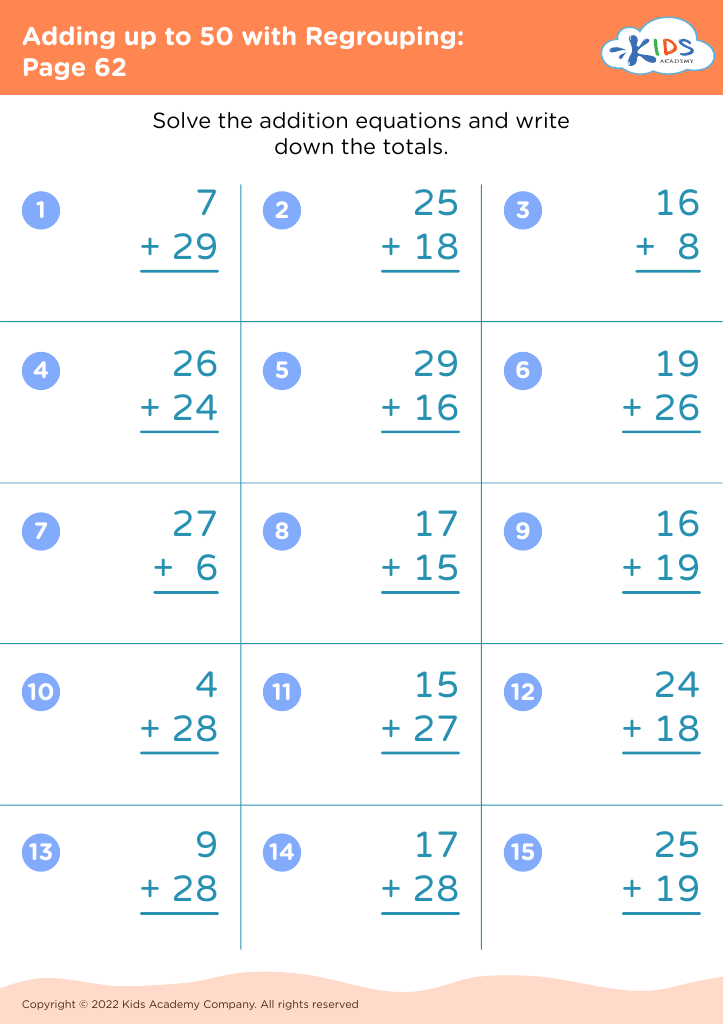
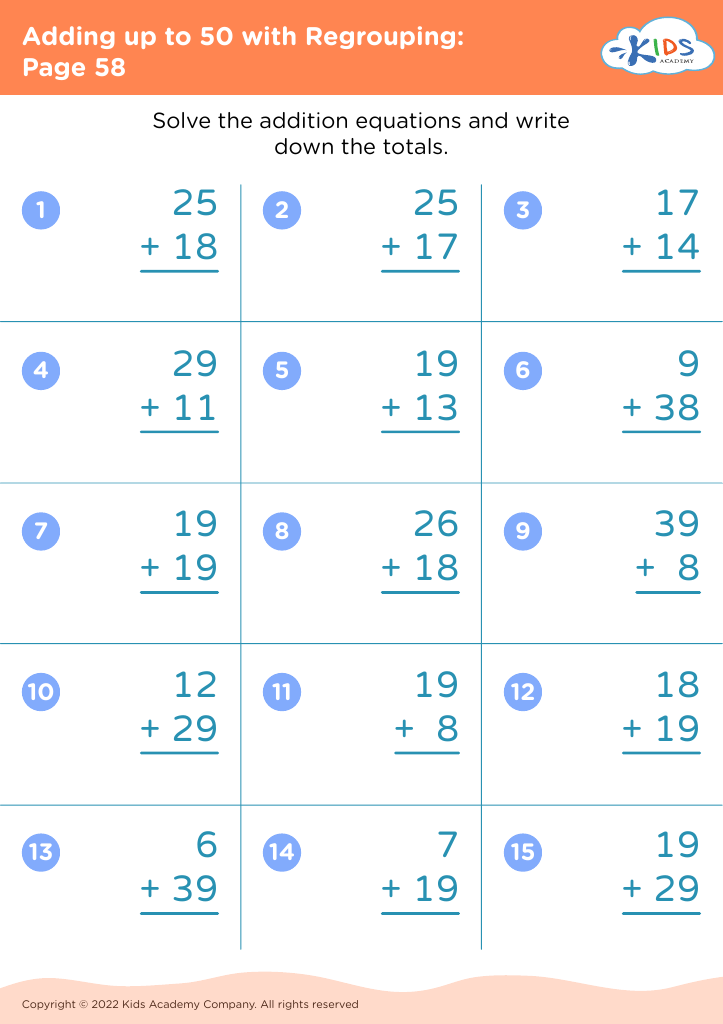
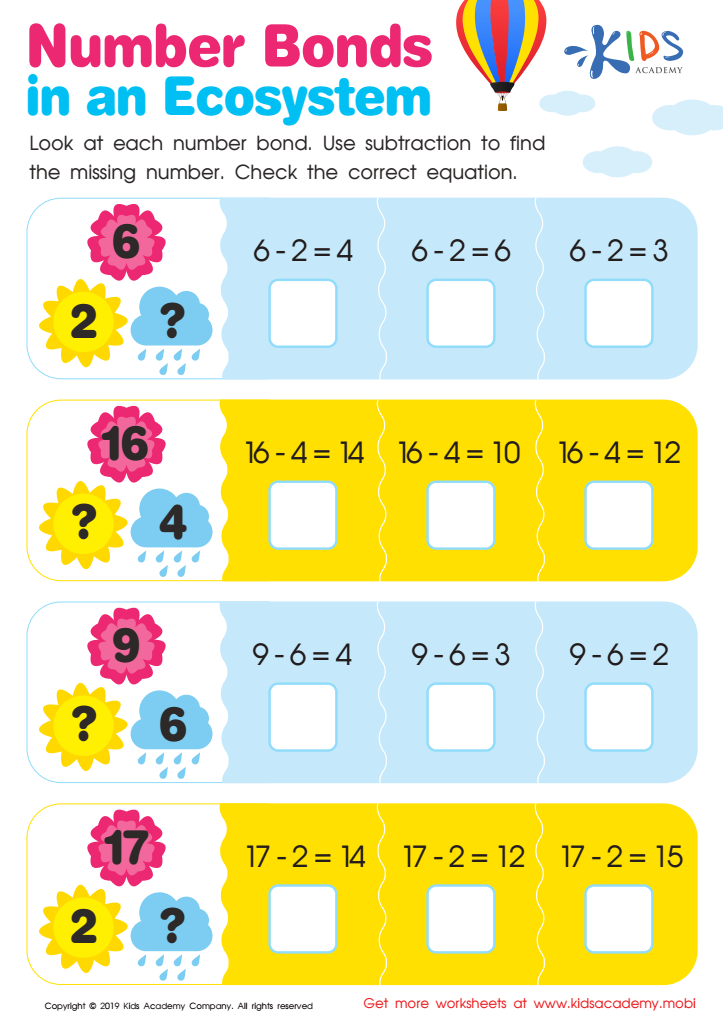
Number Bonds in an Ecosystem Worksheet
This worksheet is a great tool to help your kids sharpen their maths skills. Use the colourful images to teach them how to subtract the missing numbers and check the equation. Show them the four different images and let them try solving each number bond. With your guidance, they'll be able to hone their maths skills in no time!
 Assign to My Students
Number Bonds in an Ecosystem Worksheet
Worksheet
Learning Skills
Improving addition skills
Practicing money calculation
Enhancing problem-solving abilities
Strengthening mathematical reasoning
Enhancing problem-solving skills
Practice following instructions
Understanding number sequencing
Enhancing mathematical thinking
Understanding number bonds
Developing problem-solving abilities
Join Kids Academy for Free
Who is primarily going to use this learning content?






Improving addition skills for children aged 8-9 is crucial for their overall mathematical development and academic success. At this age, children begin to transition from basic arithmetic to more complex mathematical concepts. Mastery of addition lays a solid foundation for future learning, enabling learners to tackle subtraction, multiplication, and division with confidence. It also nurtures critical thinking and problem-solving abilities, as children learn to manipulate numbers and visualize mathematical scenarios.
Moreover, strong addition skills enhance a child’s daily life activities, such as budgeting, shopping, and logical reasoning. As parents and teachers, prioritizing the development of these skills fosters a growth mindset and builds self-esteem. Children who recognize their mathematical competence are more likely to engage actively in their education and pursue STEM-related fields later.
Additionally, well-developed addition skills facilitate smoother transitions in the classroom, where group projects and collaborative problem-solving activities often rely on basic computational proficiency. Hence, nurturing these skills not only supports academic achievement but also cultivates a love for learning and curiosity about numbers, laying the groundwork for lifelong skills that enrich their lives beyond the classroom.








