
Practicing addition Worksheets for Ages 8-9
4 filtered results
Difficulty Level
Grade
Age
-
From - To
Subject
Activity
Standards
Our "Practicing Addition Worksheets for Ages 8-9" are designed to make math fun and engaging. These expertly crafted worksheets help young learners develop their addition skills through a variety of stimulating exercises. Children will solve problems, enhance their computational abilities, and build a strong arithmetic foundation. Perfect for classroom use or at-home practice, these worksheets support different learning styles with colorful visuals and diverse challenges. As students practice, they gain confidence and proficiency in their math abilities. Empower your 8 to 9-year-olds to succeed in math with our dynamic, thorough, and easily accessible addition worksheets.
Favorites
With answer key
Interactive
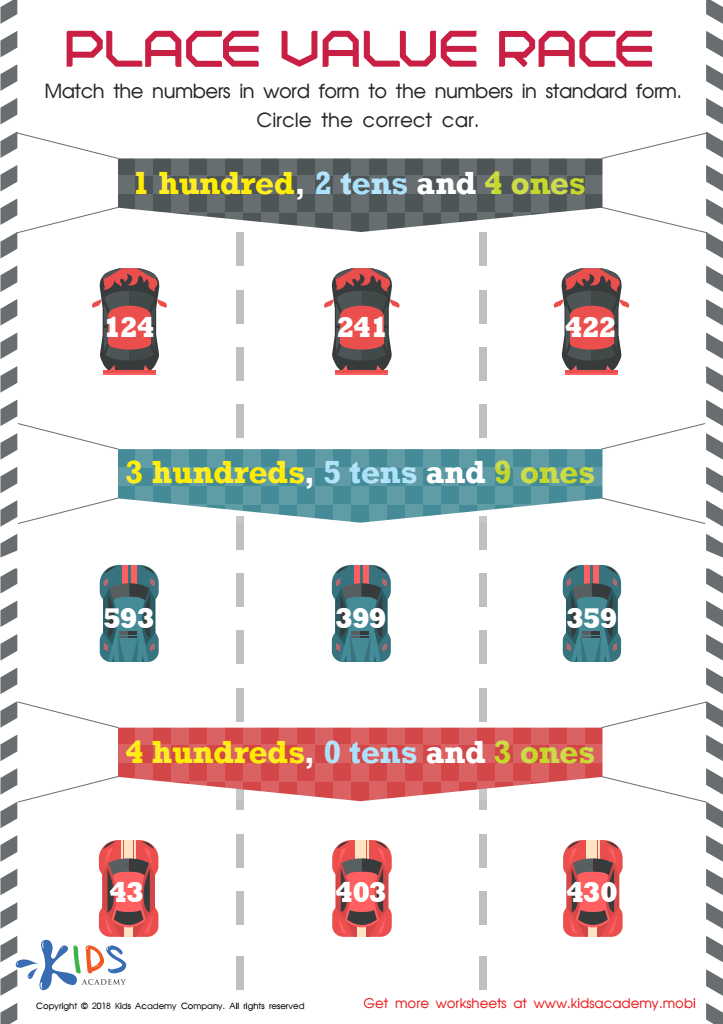
Place Value Race Worksheet
Teach your child to count, then write numbers in word form and back to standard form. In this worksheet, they'll match the numbers written in word form to their standard form and circle the correct car with the correct answer.
 Assign to My Students
Place Value Race Worksheet
Worksheet
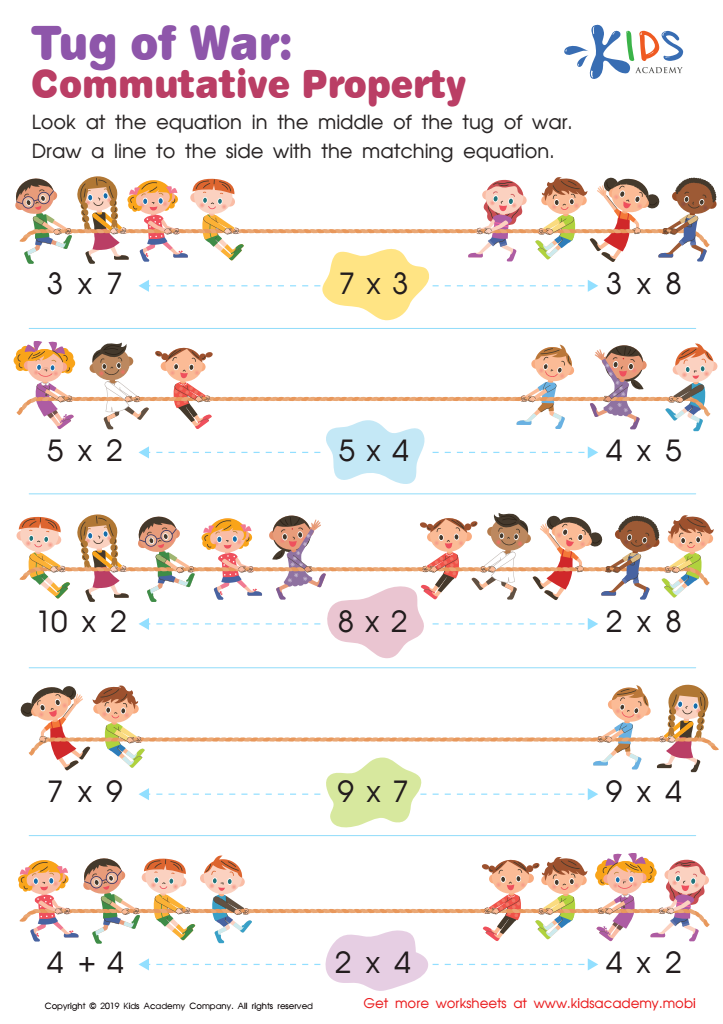
Tug of War: Commutative Property Worksheet
Tug of war is a great game to teach your child simple math. Explain the commutative property--it states that the product remains the same regardless of the order of factors. Use the equations in the middle of the worksheet and have your child draw a line to the corresponding equation. It's a fun and easy way to learn math.
Tug of War: Commutative Property Worksheet
Worksheet
Learning Skills
Join Kids Academy for Free
Who is primarily going to use this learning content?








Practicing addition for children ages 8-9 is critical for their foundational mathematical development. At this juncture, children's brains are exceptionally receptive to learning new concepts, and proficiency in basic arithmetic sets the stage for more advanced math skills. Regular practice in addition helps to solidify a child's understanding of number relationships and builds their ability to perform more complex mathematical tasks with confidence.
Moreover, fluency in addition is closely linked to academic success in other areas. Many everyday activities, such as cooking, shopping, and time management, require the ability to add numbers quickly and accurately. When children practice addition, they enhance their problem-solving skills, logical thinking, and reasoning abilities. This establishes a strong cognitive framework that aids in grasping more sophisticated concepts like multiplication, division, fractions, and algebra down the line.
In the classroom and at home, encouraging regular practice of addition can also boost a child's confidence and reduce math-related anxiety. Confident math learners are more likely to participate in class, ask questions, and show interest in STEM (Science, Technology, Engineering, and Mathematics) subjects. Thus, incorporating addition practice into daily routines fosters a positive attitude towards mathematics, insatiable curiosity, and lifelong learning skills.








