Solve word problems Worksheets for Ages 8-9
3 filtered results
-
From - To
Enhance your child's problem-solving skills with our engaging “Solve Word Problems” worksheets designed specifically for ages 8-9. These worksheets offer a variety of real-life scenarios, encouraging students to apply their math skills in innovative ways. With a focus on critical thinking and analytical reasoning, each activity promotes an interactive learning experience. From addition and subtraction to multiplication and division, our resources build confidence and mastery in tackling word problems. Perfect for home or classroom use, these worksheets make learning fun and accessible. Foster your child's love for math today and watch them thrive in their problem-solving abilities!
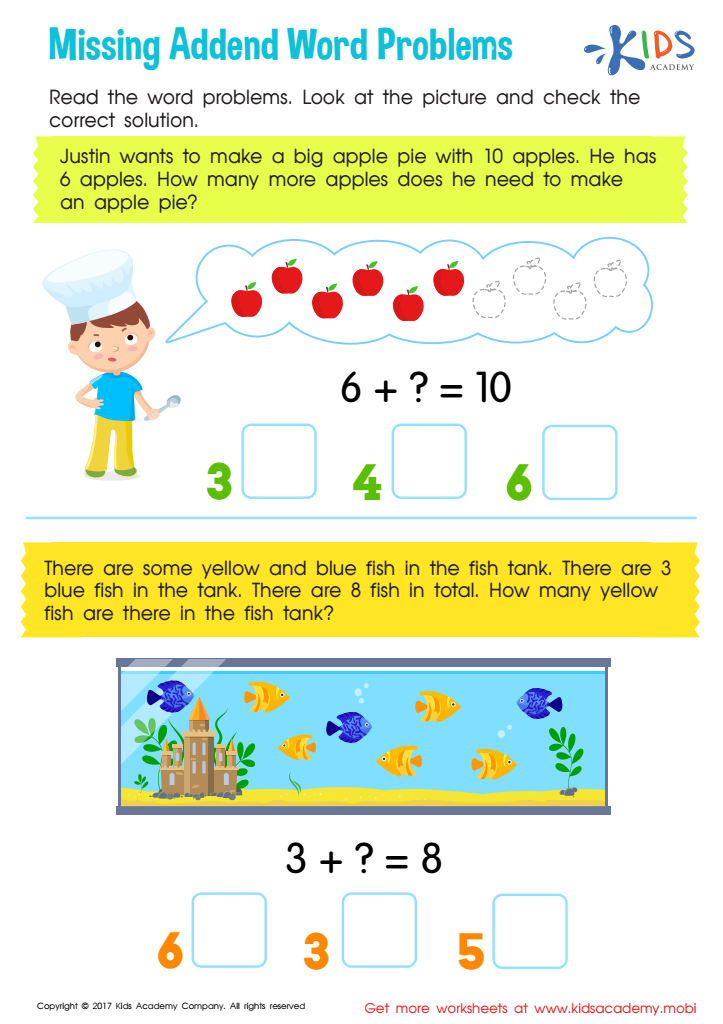
Missing Addend Word Problems Worksheet
 Assign to My Students







Parents and teachers should prioritize solving word problems for children aged 8-9 because it is an essential skill that fosters critical thinking, comprehension, and practical application of mathematics in real-life scenarios. At this age, children are transitioning from basic arithmetic to more complex problem-solving, which reinforces their understanding of mathematical concepts.
Word problems require students to decipher language, identify relevant information, and determine the mathematical operations needed to find a solution. This not only enhances their analytical skills but also improves reading comprehension and vocabulary as they learn to interpret and articulate problems. By practicing word problems, children become adept at applying their knowledge in diverse situations, setting a foundation for more advanced mathematical studies.
Moreover, solving word problems encourages perseverance and resilience, helping children navigate challenges and develop problem-solving strategies. It also fosters a collaborative learning environment, where they can work with peers, discuss approaches, and gain different perspectives. Ultimately, emphasizing word problems cultivates confident, capable learners who can tackle complex issues beyond the classroom, equipping them with essential life skills for their future educational and personal endeavors. Thus, supporting students in this area contributes to their overall intellectual growth and readiness for real-world challenges.








