Understand number relationships Worksheets for Ages 8-9
4 filtered results
-
From - To
Explore our "Understand Number Relationships" worksheets designed specifically for children aged 8-9. These engaging and interactive resources help young learners grasp essential mathematical concepts such as addition, subtraction, and number patterns. Through fun exercises that promote critical thinking, students will enhance their ability to identify relationships between numbers, strengthening their overall math skills. Perfect for classroom use or at-home practice, our worksheets cater to various learning styles and encourage independent problem-solving. Start your child’s journey to becoming a confident math student today with these thoughtfully crafted worksheets that make learning number relationships exciting and enjoyable!
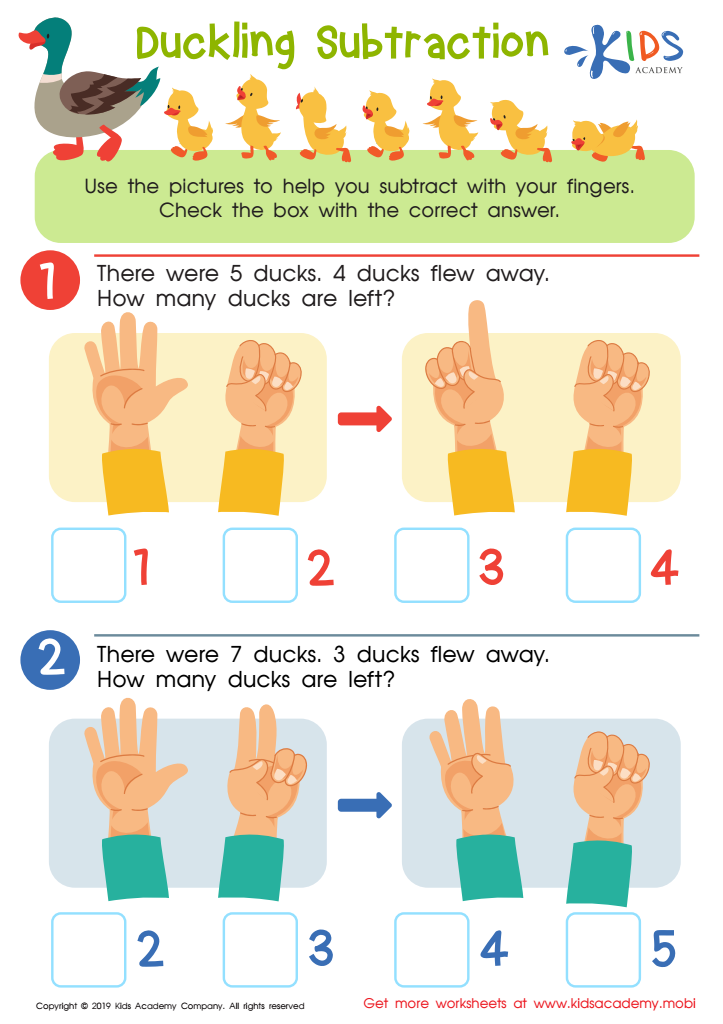
Duckling Subtraction Worksheet
 Assign to My Students







Understanding number relationships is crucial for children aged 8-9 as it forms the foundation for their future mathematical development. At this age, students begin to transition from basic arithmetic to more complex problem-solving that involves the concept of relationships between numbers, such as addition and subtraction, multiplication and division, and fractions and decimals.
When parents and teachers emphasize number relationships, they help children recognize patterns and connections between numbers. This skill enhances their ability to perform calculations, enables them to make predictions, and fosters critical thinking. For instance, knowing how addition and subtraction are related allows students to solve problems more efficiently and understand inverse operations.
Furthermore, a strong grasp of number relationships boosts students' confidence and reduces anxiety toward math, promoting a positive attitude toward the subject. Understanding these concepts also aids in real-world applications, such as budgeting and measuring, thereby making math relevant to daily life.
Ultimately, invested parents and teachers can help nurture a child's mathematical thinking, enabling them to become proficient and enthusiastic learners. Engaging students in discussions about number relationships contributes to a deeper understanding of math, which is essential for academic success and lifelong learning.








