Fine Motor Skills Adding up to 1000 Without Regrouping Worksheets for Ages 8-9
3 filtered results
-
From - To
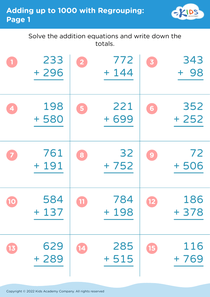
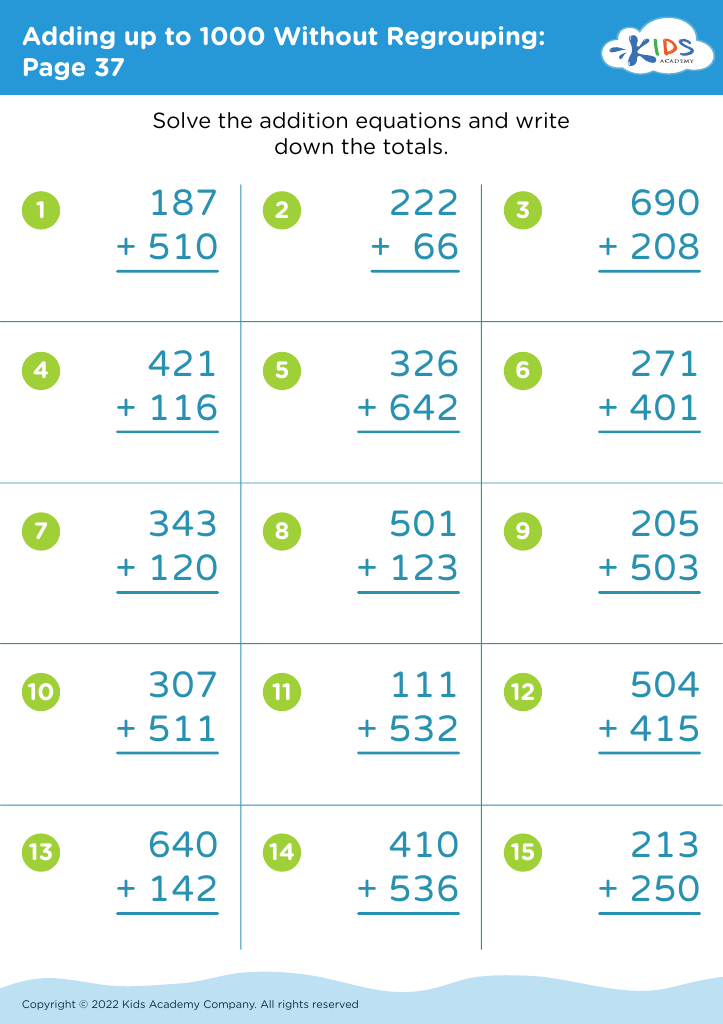
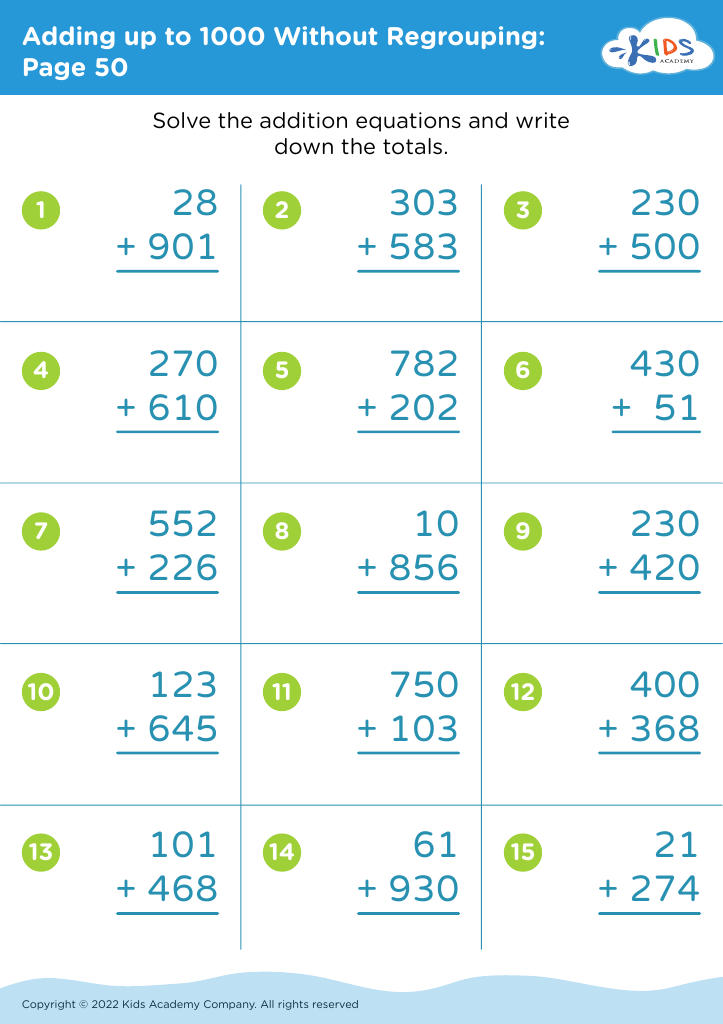
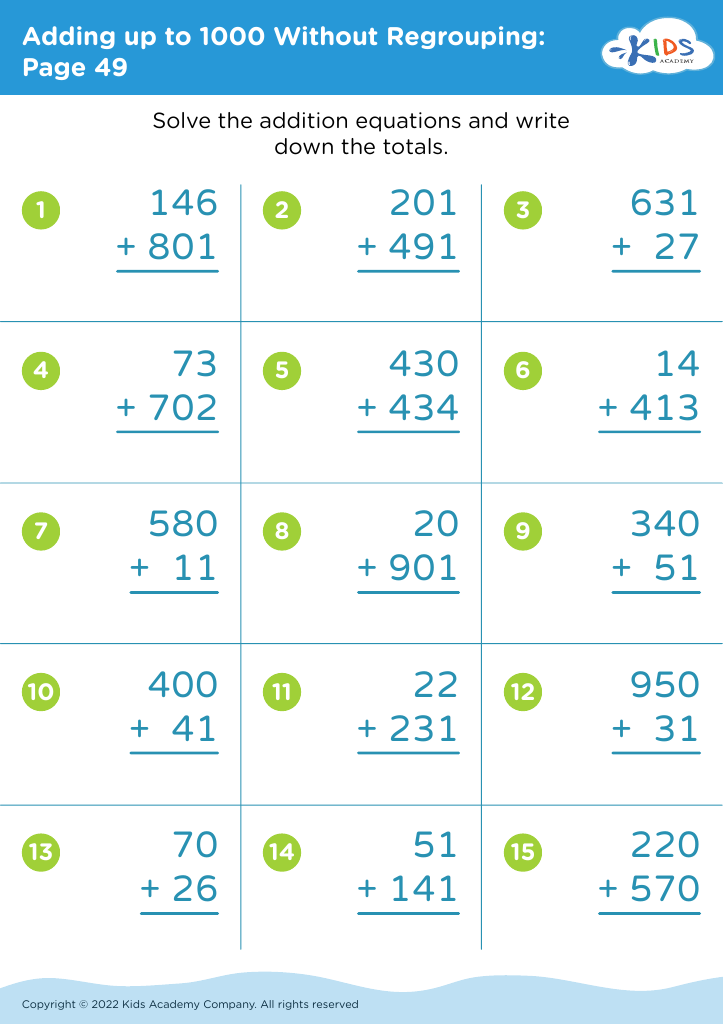
Boost your child's arithmetic and fine motor skills with our "Adding up to 1000 Without Regrouping Worksheets for Ages 8-9." Tailored for young learners, these engaging printables offer a fun way to practice adding large numbers while enhancing pencil control and precision. Perfect for classroom use or at-home enrichment, each worksheet is designed to make math drills enjoyable and skill-building. As children solve addition problems, they'll also develop vital fine motor skills essential for writing and everyday tasks. Turn math practice into a captivating experience and help your child excel in both math and motor skills!


Parents and teachers should prioritize the development of fine motor skills and mastering tasks like adding up to 1000 without regrouping in children ages 8-9 because these skills are foundational for academic and daily life success. Fine motor skills involve the coordination of small muscles, particularly in the hands and fingers, enabling children to perform precise actions. This coordination is crucial for activities such as writing, handling small objects, and using tools.
Proficiency in addition without regrouping reinforces mathematical understanding and problem-solving abilities. By focusing on sums up to 1000, children develop their number sense, computational fluency, and confidence in handling larger numbers, which are stepping stones to more complex math concepts.
The combination of fine motor skill development with arithmetic practice enhances cognitive abilities such as focus, processing speed, and spatial awareness. These skills benefit a range of academic areas beyond math, including reading, science, and art.
Moreover, confidence in their fine motor and arithmetic abilities fosters a positive attitude toward learning. When children achieve these skills, they are better prepared for the academic challenges ahead, and both parents and teachers can play a pivotal role in nurturing their growth, resulting in well-rounded, capable learners.