Numerical reasoning Addition & Subtraction Worksheets for Ages 8-9
3 filtered results
-
From - To
Discover our engaging Numerical Reasoning Addition & Subtraction Worksheets designed specifically for kids aged 8-9! These worksheets offer a wealth of exercises that help young learners strengthen their mathematical skills, boost their problem-solving abilities, and enhance their critical thinking. With a vibrant mix of puzzles, real-life scenarios, and fun illustrations, students will enjoy practicing addition and subtraction in effective and interesting ways. Our user-friendly format allows for easy instruction, making it perfect for both classroom use and home reinforcement. Equip your child with essential math skills while ensuring they have fun with our creatively designed numerical reasoning exercises!
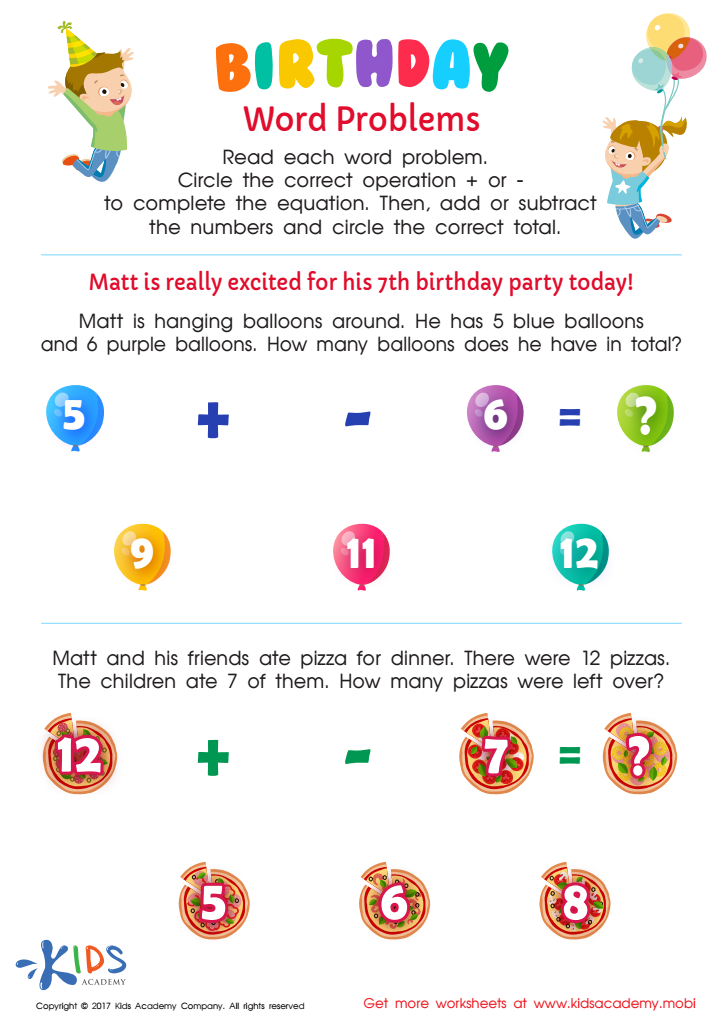
Birthday Word Problems Substraction Worksheet
 Assign to My Students








Numerical reasoning, specifically in addition and subtraction, forms a foundational pillar for children's overall mathematical understanding and problem-solving skills. For children aged 8-9, mastering these concepts is critical as they transition from basic arithmetic to more complex mathematical operations and real-life applications.
Parents and teachers should emphasize the importance of proficient addition and subtraction for several reasons. Firstly, these skills are essential for everyday tasks, such as budgeting, shopping, and cooking, enabling children to make informed decisions. Developing numerical reasoning also enhances logical thinking; students learn to analyze problems, identify operations needed, and arrive at reasonable solutions independently.
Furthermore, strong addition and subtraction skills support later learning in mathematics, influencing success in geometry, fractions, and even algebra. Early hygiene with these concepts builds confidence and encourages a growth mindset, which fosters resilience in tackling challenging subjects.
Additionally, the collaborative aspect of learning together instills a sense of community and support in learning. Engaging with addition and subtraction in fun, interactive ways can truly spark a love for math, cultivating students into lifelong learners. Therefore, it is essential for parents and teachers to prioritize these skills for holistic academic and personal development.








