Number pattern recognition Math Worksheets for Ages 8-9
3 filtered results
-
From - To
Enhance your child's mathematical skills with our engaging and effective Number Pattern Recognition Math Worksheets designed for ages 8-9. These worksheets offer a variety of exercises that help students identify, understand, and extend number patterns, crucial for developing problem-solving and critical thinking abilities. With colorful, age-appropriate activities, children will enjoy practicing sequences, finding missing numbers, and exploring various numerical patterns in a fun and interactive way. Ideal for both classroom use and at-home practice, these worksheets support the advancement of your child's math proficiency and confidence in a progressively challenging manner.
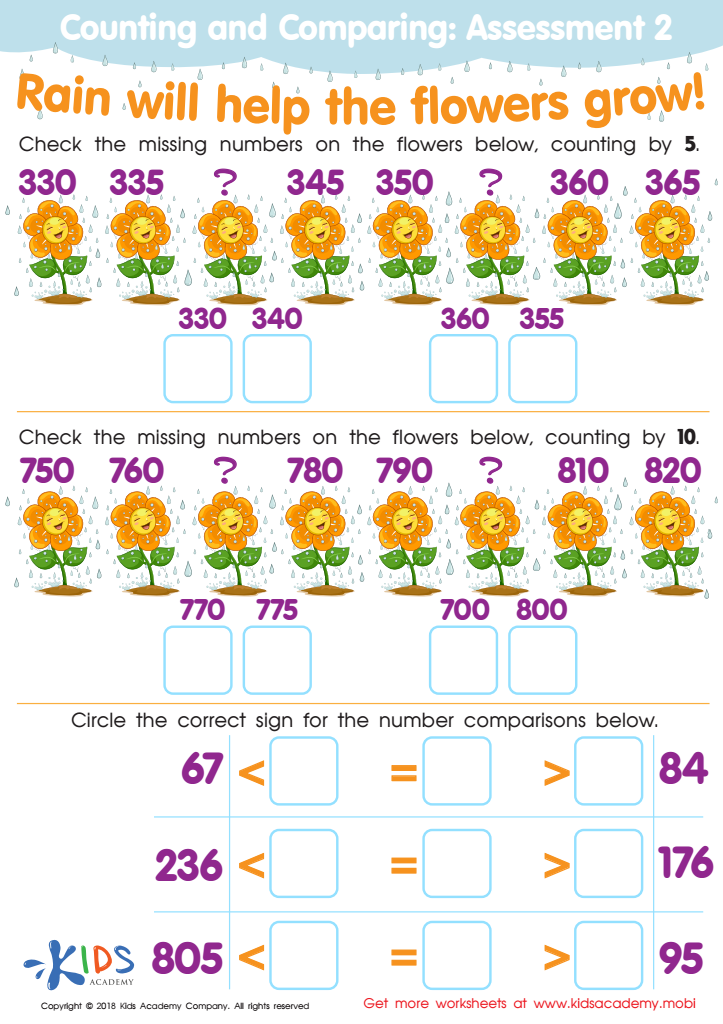
Counting and Comparing: Assessment 2 Worksheet
 Assign to My Students
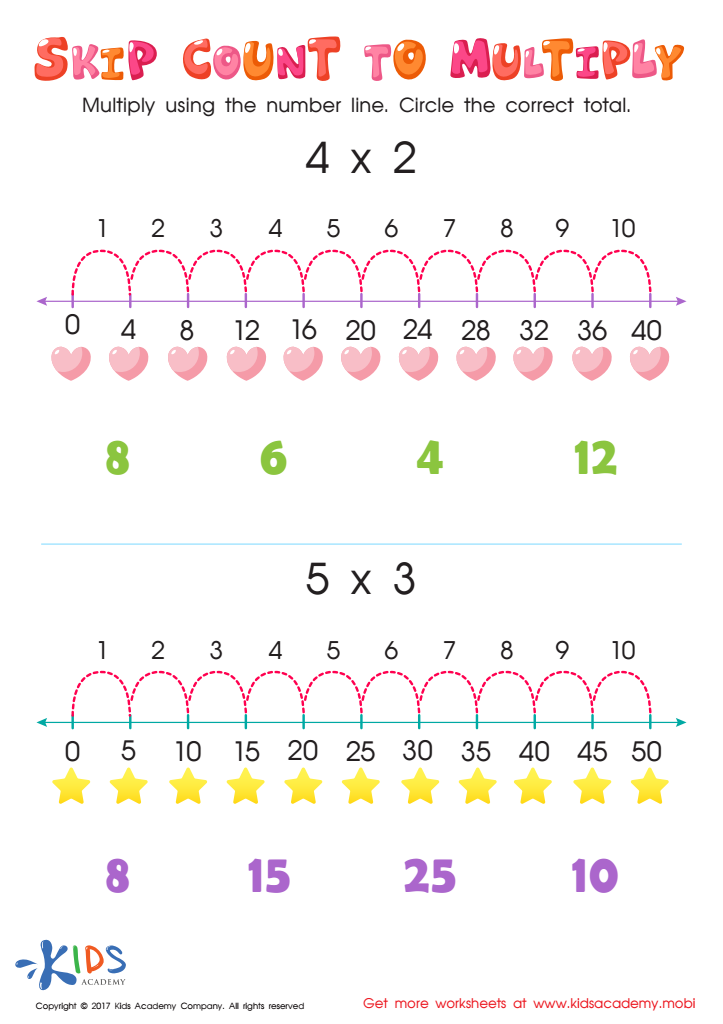
Skip Count Multiplication Worksheet
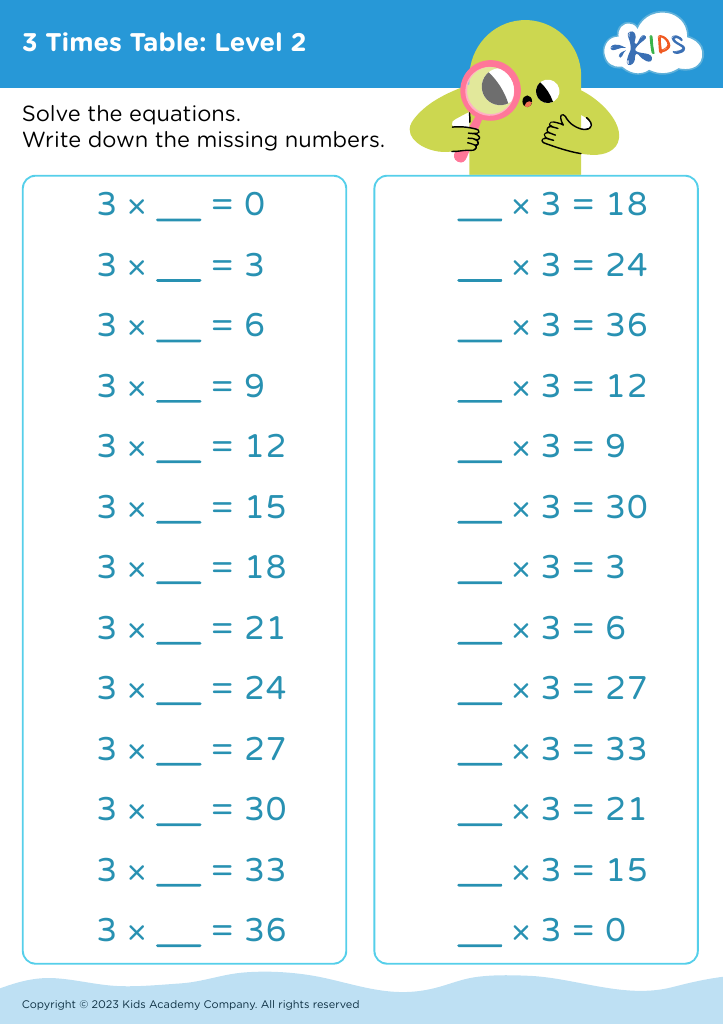







Number pattern recognition is a crucial mathematical skill for children aged 8-9, as it lays a strong foundation for future math learning and problem-solving abilities. Patterns help students recognize relationships between numbers and develop a deeper understanding of fundamental math concepts such as addition, subtraction, multiplication, and division.
Firstly, pattern recognition aids in improving numeracy skills. Knowing how to spot and extend patterns allows children to predict sequences and understand the structure of numbers. This ability directly supports arithmetic proficiency and helps in mastering multiplication tables and divisional patterns effortlessly.
Secondly, it fosters logical thinking and reasoning. Identifying and analyzing patterns require children to think critically and logically. They learn to predict what comes next based on observed rules, sharpen their analytical skills, and apply this logical reasoning to solve a variety of mathematical problems.
Thirdly, recognizing patterns builds confidence in math. When children grasp patterns, they experience moments of insight and success that boost their self-esteem, encouraging a positive attitude toward the subject. They are more likely to view math as a manageable and even enjoyable challenge.
Finally, pattern recognition transcends math, benefiting other academic areas and everyday life. It enhances general cognitive skills, important for tasks such as reading comprehension and scientific inquiry.
In conclusion, number pattern recognition equips children with essential math skills, promotes logical thinking, boosts confidence, and supports overall cognitive development.








