
Practice addition Math Worksheets for Ages 8-9
5 filtered results
Difficulty Level
Grade
Age
-
From - To
Subject
Activity
Standards
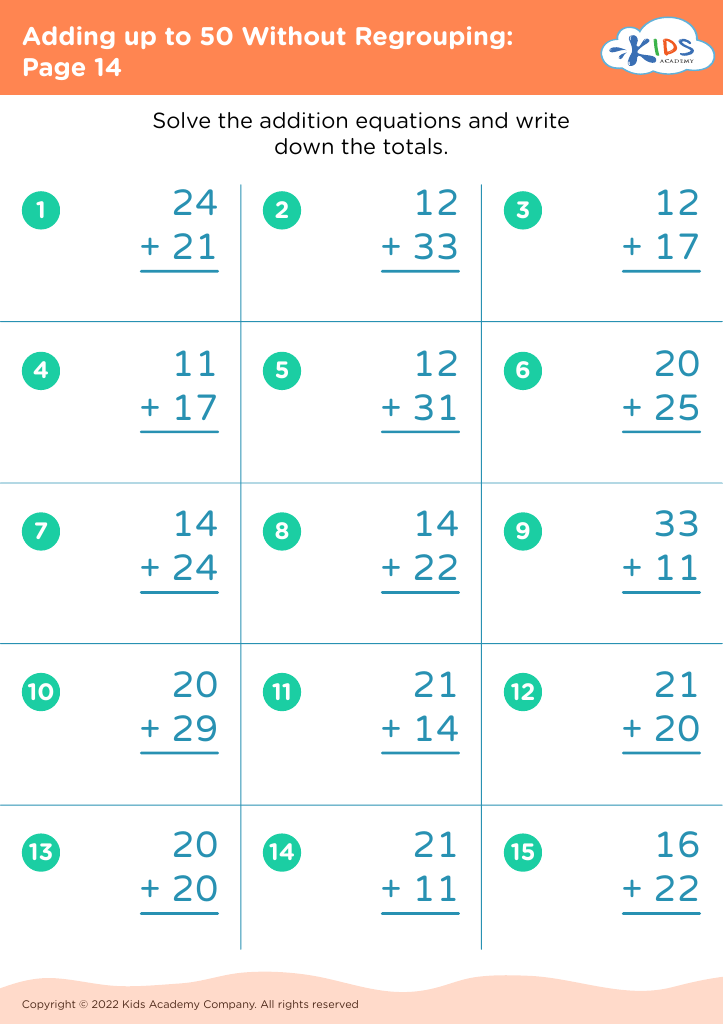
Enhance your child's math skills with our engaging Practice Addition Math Worksheets designed specifically for ages 8-9! Our worksheets make learning addition fun and interactive, featuring a variety of problems that encourage critical thinking and problem-solving. With visually appealing layouts and age-appropriate challenges, these worksheets help reinforce essential math concepts while building confidence. Children can practice addition through a mix of single and multi-digit problems, fostering both accuracy and speed. Perfect for home or in the classroom, our printable worksheets are an excellent resource to support your child’s math journey and ensure they excel in foundational skills.
Favorites
With answer key
Interactive
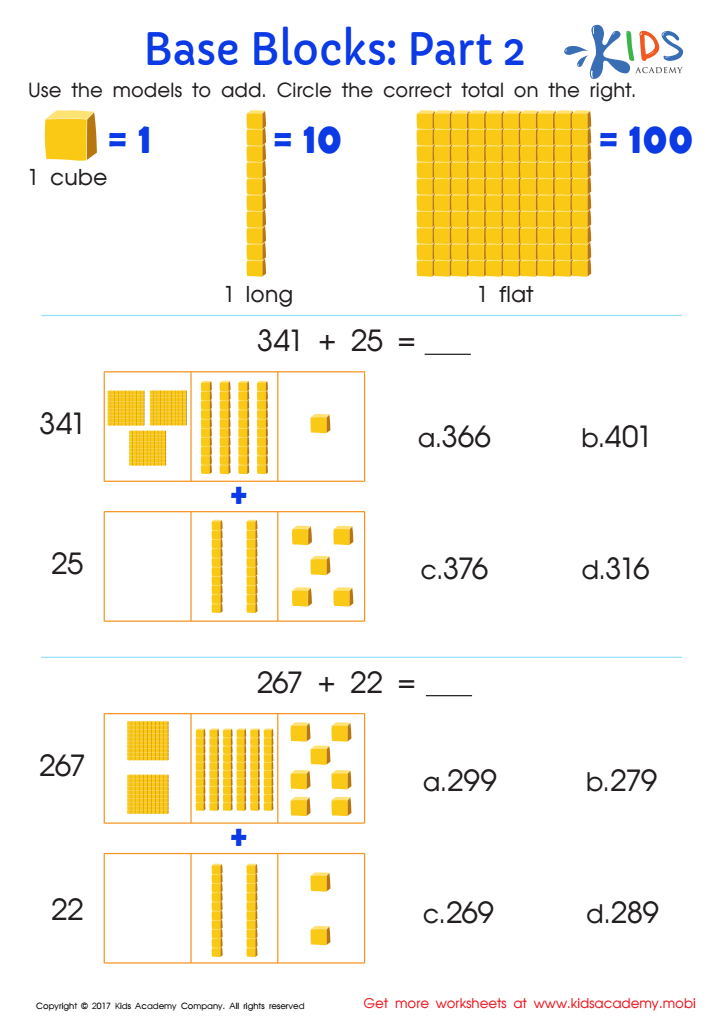
Base Ten Blocks Worksheet: Part 2
It provides kids with the practice needed to get a better grip on numeracy and multi-digit addition. Get the PDF today and give your child the resources they need.
This worksheet uses base blocks to help kids recognize and add multi-digit numbers. It gives kids the practice they need to become more numerate and handle multi-digit addition with confidence. Download the PDF now and give your child the tools they need to succeed.
 Assign to My Students
Base Ten Blocks Worksheet: Part 2
Worksheet
Join Kids Academy for Free
Who is primarily going to use this learning content?







Practicing addition for children aged 8-9 is crucial for their mathematical development and foundational skills. At this age, children transition from mastering basic arithmetic operations to employing them in more complex problem-solving scenarios. Frequent practice ensures that they become fluent in addition, facilitating their confidence in math as they progress to multisyllabic numbers, fractions, and basic algebraic concepts.
Furthermore, a strong grasp of addition cultivates critical thinking and logical reasoning, skills essential not just in mathematics, but throughout all academic subjects and everyday life. Regular practice helps identify and address any learning gaps, ensuring that every child has the tools needed to succeed.
Additionally, engaging parents or teachers in this practice allows for supportive learning environments, where children can feel motivated and encouraged. It promotes teamwork and can lead to positive reinforcement through guided exercises or games, enhancing their learning experience.
Ultimately, prioritizing addition practice at this age lays the groundwork for enduring mathematical capability and success, fostering attitudes of persistence and resilience. Investing time and resources into this primary skill equips children with the essentials they need for higher-level math and prepares them for both academic and practical challenges ahead.








