Identify shapes Worksheets for 8-Year-Olds
12 filtered results
-
From - To
Explore our engaging "Identify Shapes Worksheets for 8-Year-Olds" designed to enhance geometry skills through fun activities! These worksheets incorporate vibrant illustrations and interactive tasks, making the learning experience enjoyable and effective. Your child will identify, compare, and categorize shapes while developing critical thinking and visualization skills. With various levels of difficulty, these resources cater to different learning styles, ensuring every student benefits. Perfect for classroom use or at-home learning, our worksheets help reinforce essential math concepts in an entertaining way. Dive into the world of shapes today and watch your child build confidence in their math abilities!
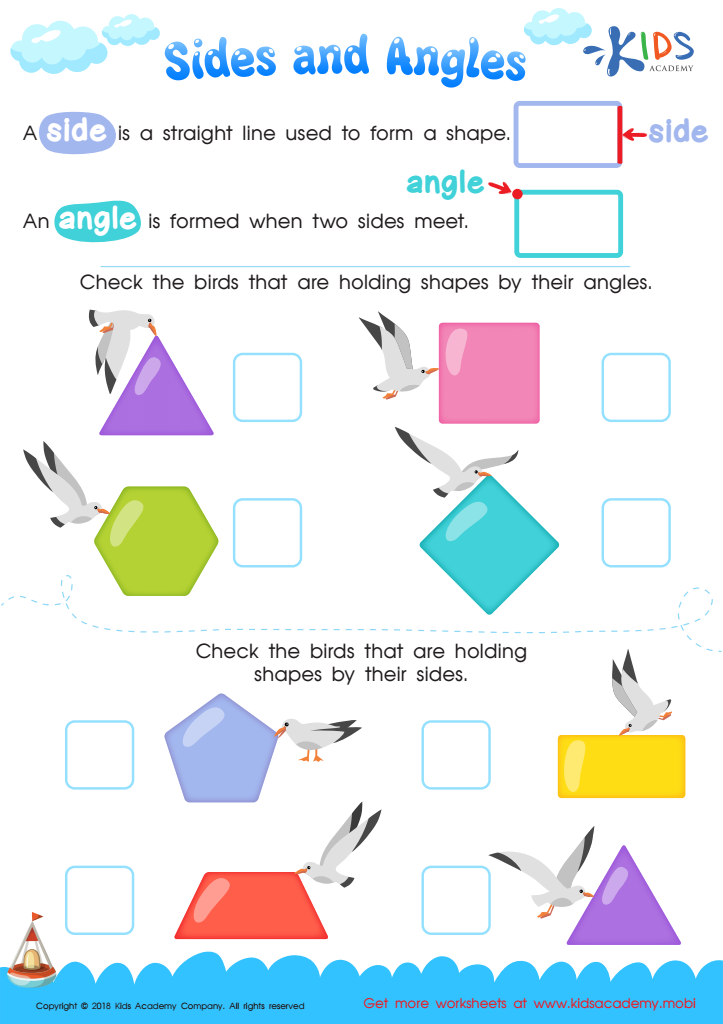
Sides and Angles Worksheet
 Assign to My Students







Identifying shapes is a critical skill for 8-year-olds that lays the foundation for various cognitive and practical abilities. First, it enhances spatial reasoning, which is vital for later learning in mathematics and science. As children learn to recognize and differentiate between shapes, they develop the ability to visualize geometric concepts, a skill crucial in fields like architecture, engineering, and art.
Additionally, recognizing shapes contributes to a child's overall cognitive development. It helps enhance their observation skills and attention to detail, allowing them to make connections in their environment, such as reading maps or understanding patterns in nature. When children become familiar with shapes, they also improve their vocabulary by learning terms like "hexagon," "octagon," or "symmetry," fostering better communication skills.
Moreover, shape recognition is instrumental in building a child's confidence and independence in problem-solving as they apply their understanding to real-world situations, like constructing items or organizing spaces. For parents and teachers, supporting shape identification through activities, games, and hands-on experiences creates joyful learning opportunities that can inspire curiosity and a love for learning. Active engagement in this area of early education significantly impacts children’s future academic achievements and their ability to navigate complex concepts with ease.








