
Visual fraction representation Worksheets for 8-Year-Olds
3 filtered results
Difficulty Level
Grade
Age
-
From - To
Subject
Activity
Standards
Our Visual Fraction Representation Worksheets for 8-Year-Olds make fractions fun and engaging! Designed specifically for young learners, these worksheets utilize colorful images and intuitive visual aids to teach fundamental fraction concepts. Students yearn to explore halves, thirds, quarters, and more through diverse activities that build strong mathematical foundations. Perfect for classroom or homeschooling use, our expertly crafted resources align with educational standards to help children confidently identify, compare, and understand fractions in everyday context. Tailored to stimulate curiosity and enhance comprehension, these worksheets support a seamless blend of learning and play for aspiring mathematicians. Engage, educate, and empower your child today!
Favorites
With answer key
Interactive
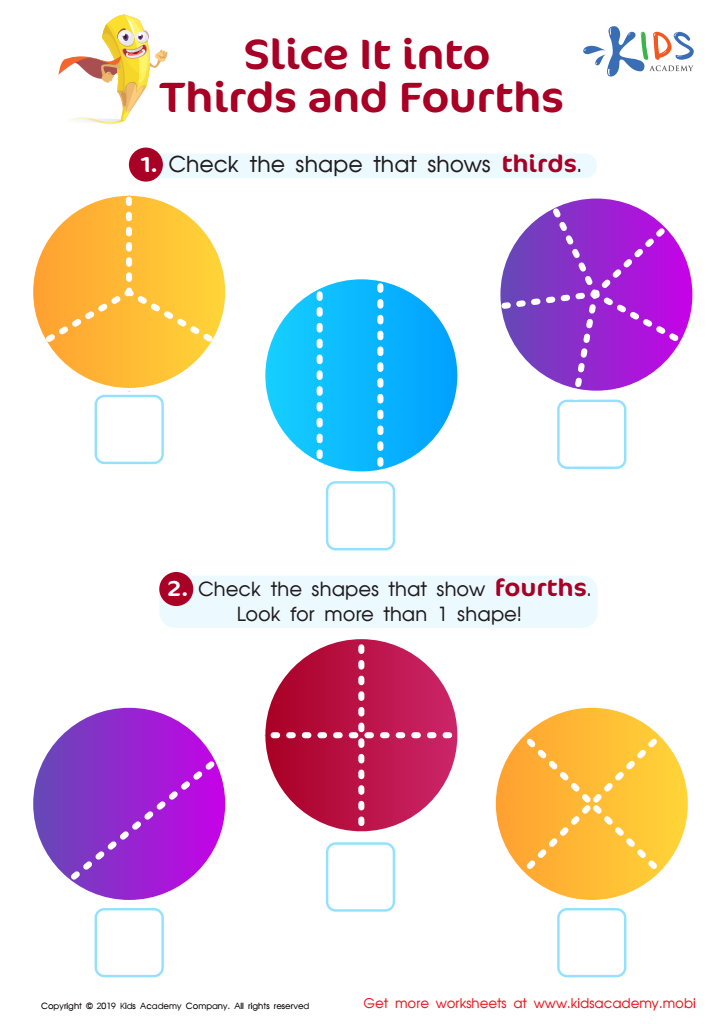
Slice in Thirds Fourths Worksheet
This worksheet helps kids learn fractions visually by dividing circles into thirds and fourths. They will learn that fractions must be equal parts, not just sets, by choosing the right colorful circles. It's an easy way to master fractions and have fun doing it!
 Assign to My Students
Slice in Thirds Fourths Worksheet
Worksheet
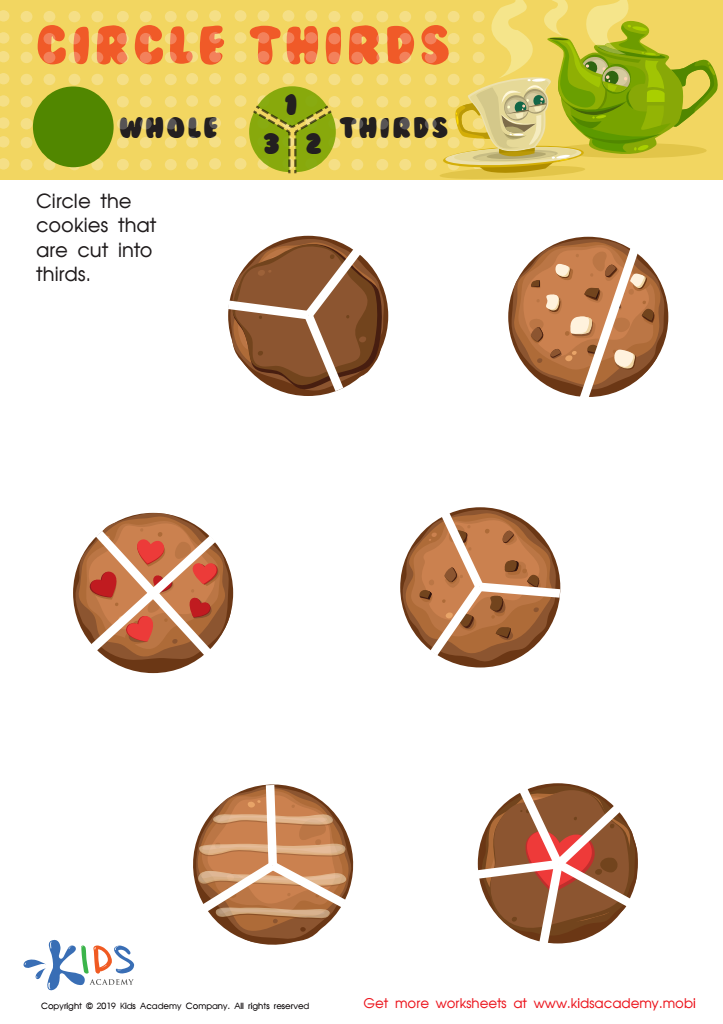
Circle Thirds Worksheet
Remind your kids of the different ways shapes can be divided: wholes, halves, thirds, and fourths. Now, look at the shapes in the worksheet and have them circle the cookies cut into thirds.
Circle Thirds Worksheet
Worksheet
Join Kids Academy for Free
Who is primarily going to use this learning content?


.jpg)


.jpg)

Visual fraction representation is crucial for 8-year-olds because it lays the groundwork for their understanding of fractions and mathematical concepts. At this age, children are concrete learners who benefit immensely from visual aids. Visual fractions allow students to see exactly what fractions represent, making the abstract concept much more tangible.
For parents, encouraging the use of visual representations at home can make math more engaging and less intimidating for children. Simple activities like cutting a pizza into slices or using fraction bars can spark an interest in numbers and provide practical ways to understand fractions.
Teachers can utilize visual tools like pie charts, number lines, and area models to demonstrate fraction concepts in a classroom setting. This approach can help students grasp the idea of parts of a whole, equivalence, and comparison of fractions more easily. Research has shown that children who are exposed to visual fraction methods often perform better in math and develop a more positive attitude towards it.
Overall, establishing a strong foundational understanding of fractions through visual representation can lead to greater success in more advanced math topics. This early investment can build confidence in young learners, encouraging a lifelong comfort with mathematics.








