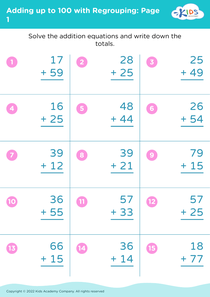
Understanding patterns Adding up to 100 Without Regrouping Worksheets for 8-Year-Olds
3 filtered results
-
From - To
Discover the joy of math with our "Understanding patterns: Adding up to 100 Without Regrouping Worksheets" designed specifically for 8-year-olds! These engaging worksheets are perfect for helping young learners grasp essential math concepts effortlessly. By focusing on adding numbers up to 100 without regrouping, children will gain a solid foundation in arithmetic while recognizing and understanding numerical patterns. Our carefully crafted activities ensure that learning remains fun and motivating, fostering confidence and a love for math. Perfect for both classroom settings and at-home practice, these worksheets are an invaluable resource for parents and teachers striving to support their children's education.
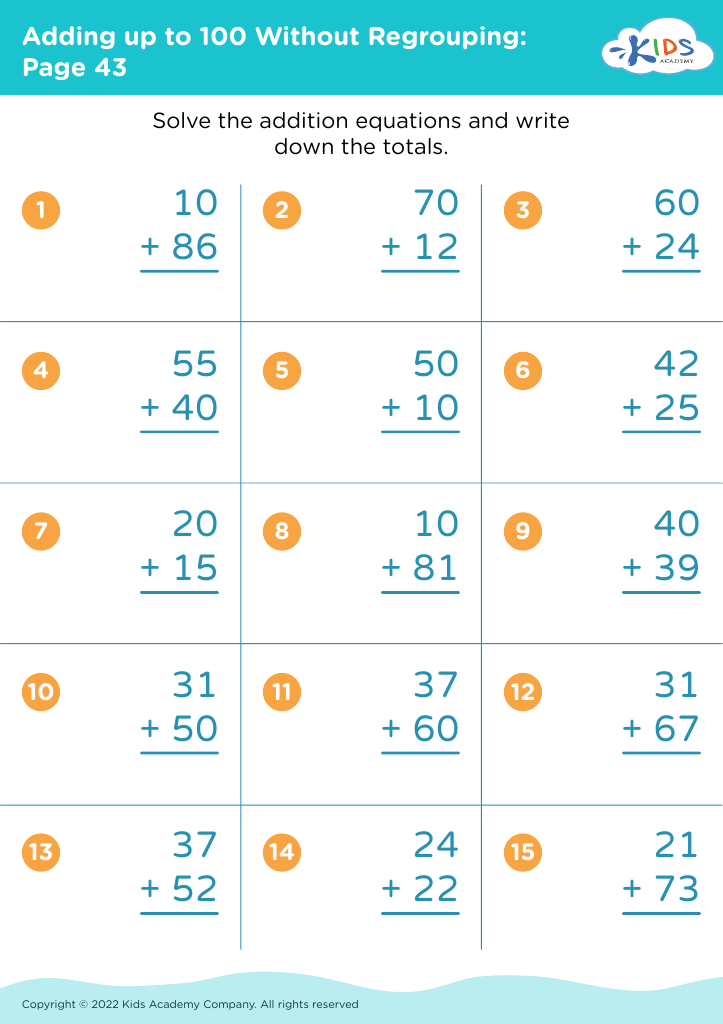
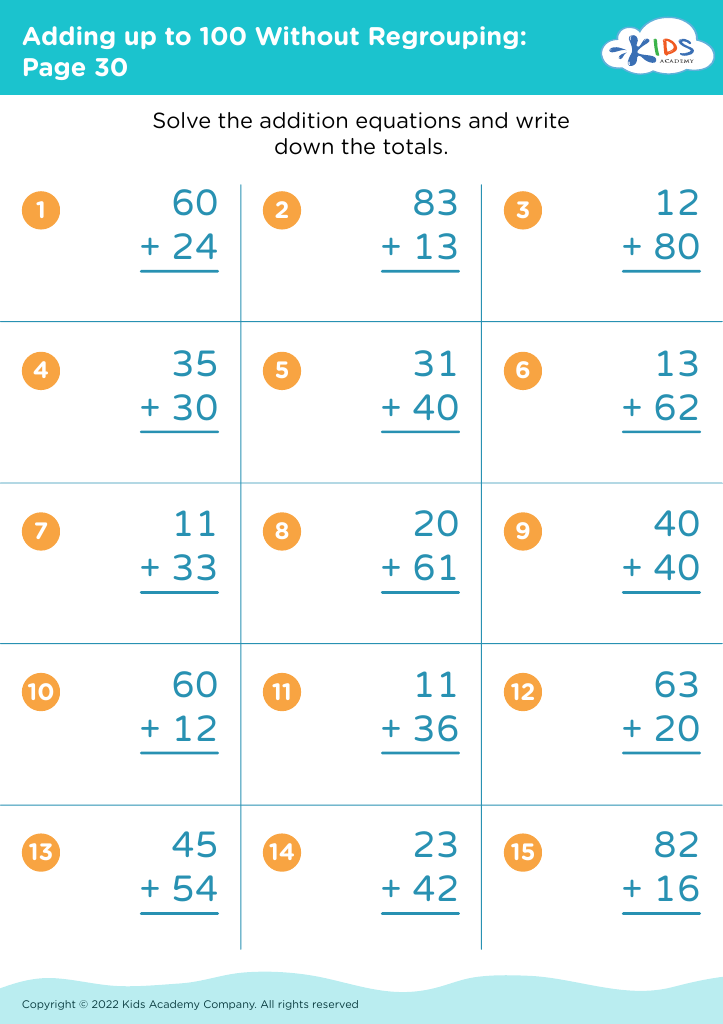
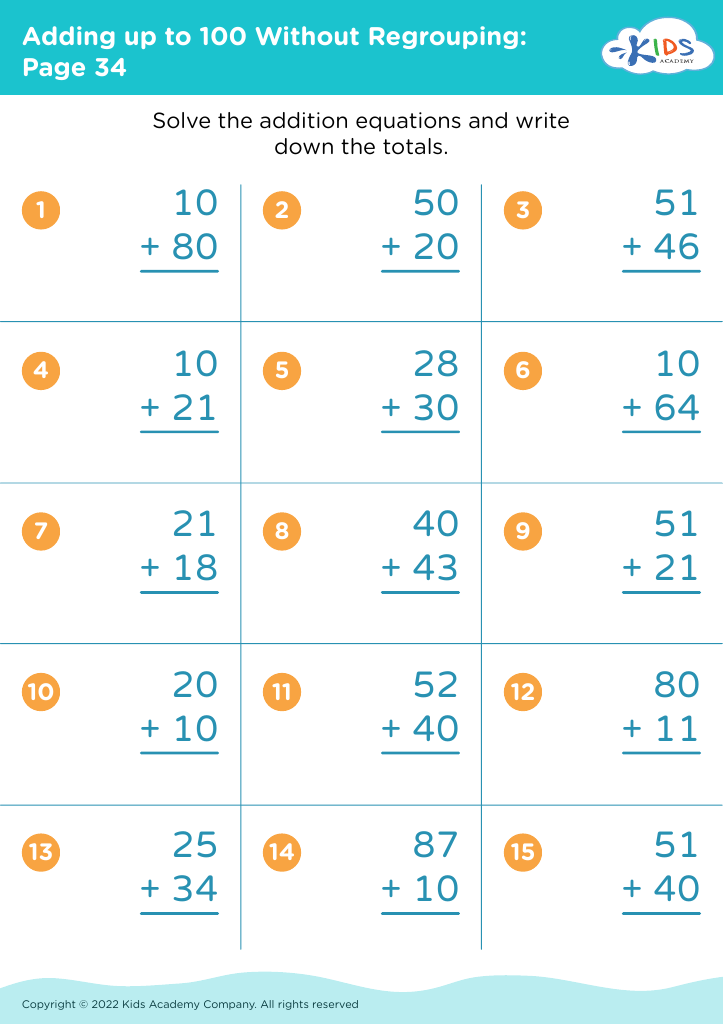




Understanding patterns and mastering addition up to 100 without regrouping is crucial for 8-year-olds as it lays the foundation for more advanced mathematical concepts. Patterns help children recognize relationships between numbers, enhancing their ability to solve problems creatively and logically. Recognizing and interpreting patterns supports cognitive development and boosts a child’s ability to make predictions and reason out answers on their own, fostering independent learning and critical thinking.
Mastery of addition up to 100 without regrouping simplifies the transition to more complex arithmetic operations, including multi-digit addition and subtraction, and mental arithmetic. When children see adding smaller numbers as manageable, they gain confidence in their math skills, promoting a positive attitude towards learning and reducing math anxiety. This skill also directly correlates with everyday tasks such as money management, time calculations, and basic measuring skills, making math a practical and useful tool in daily life.
Furthermore, without the necessity of regrouping, children can focus purely on understanding number relationships and addition processes, which simplifies the learning curve and supports gradual attainment of arithmetic fluency. Parental and teacher support in this area sets students on a trajectory towards mathematical success, providing a strong, supportive base that serves them well in future academic endeavors and real-world scenarios.