
Compare fractions Addition Worksheets for 8-Year-Olds
6 filtered results
Difficulty Level
Grade
Age
-
From - To
Subject
Activity
Standards
Explore our engaging "Compare Fractions Addition Worksheets" designed specifically for 8-year-olds! These worksheets offer a fun and interactive way for children to practice comparing fractions while enhancing their addition skills. With a variety of colorful and appealing exercises, children will develop critical thinking and problem-solving abilities. Our worksheets are perfect for reinforcing classroom learning or for use at home. Watch your child gain confidence as they master the concept of comparing fractions. Ideal for teachers and parents alike, our resources encourage independent learning and comprehension. Start your journey to fraction mastery today and make math exciting for your little learner!
Favorites
With answer key
Interactive
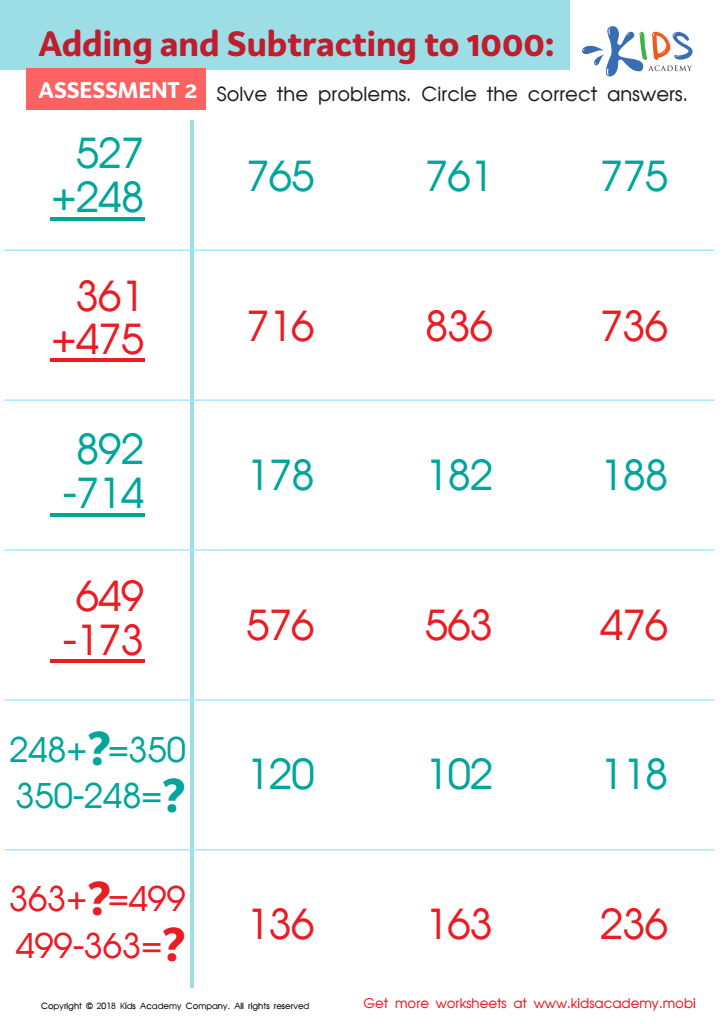
Adding and Subtracting to 1 Worksheet: Assessment 2
Test your child's addition and subtraction of 3-digit numbers with this assessment worksheet! They'll practice regrouping and pre-algebra skills to show their expertise. Have them work through the page and circle their answers, then see how many they got right to check their understanding and progress.
 Assign to My Students
Adding and Subtracting to 1 Worksheet: Assessment 2
Worksheet
Join Kids Academy for Free
Who is primarily going to use this learning content?








Understanding how to compare fractions and perform fraction addition is essential for 8-year-olds as they develop foundational math skills. At this age, children transition from concrete mathematical concepts to more abstract reasoning, and mastering fractions supports this development.
First, comparing fractions equips children with critical analytical skills. They learn to recognize relationships between numbers, enabling them to make informed decisions about quantities in real-life situations, such as cooking or measuring ingredients. This skill fosters logical thinking and problem-solving abilities.
Moreover, addition involving fractions builds on students' previous knowledge, reinforcing their understanding of basic mathematical operations. It encourages them to visualize fractions as part of a whole, encouraging a deeper grasp of numerical relationships.
From an educational perspective, being proficient in fraction comparison and addition lays the groundwork for more advanced math topics, such as decimals and ratios, which they will encounter in higher grades.
Finally, engaging parents and teachers in this learning process strengthens support systems around the child, creating a collaborative environment conducive to math learning. By emphasizing the importance of these skills, parents and teachers can inspire confidence and motivation in children as they navigate their mathematical journey.








