
Visual perception Addition Worksheets for 8-Year-Olds
4 filtered results
Difficulty Level
Grade
Age
-
From - To
Subject
Activity
Standards
Welcome to our Visual Perception Addition Worksheets for 8-Year-Olds! These engaging worksheets are designed to enhance your child's visual perception skills while reinforcing essential addition concepts. With a variety of colorful activities, your child will develop the ability to quickly identify numbers, patterns, and relationships. Our resources are ideal for classroom use or at-home practice, ensuring that your child builds confidence in their math abilities. Each worksheet is crafted to make learning fun and interactive, empowering learners with the tools they need to succeed in math. Explore our collection today and watch your child thrive in their learning journey!
Favorites
With answer key
Interactive
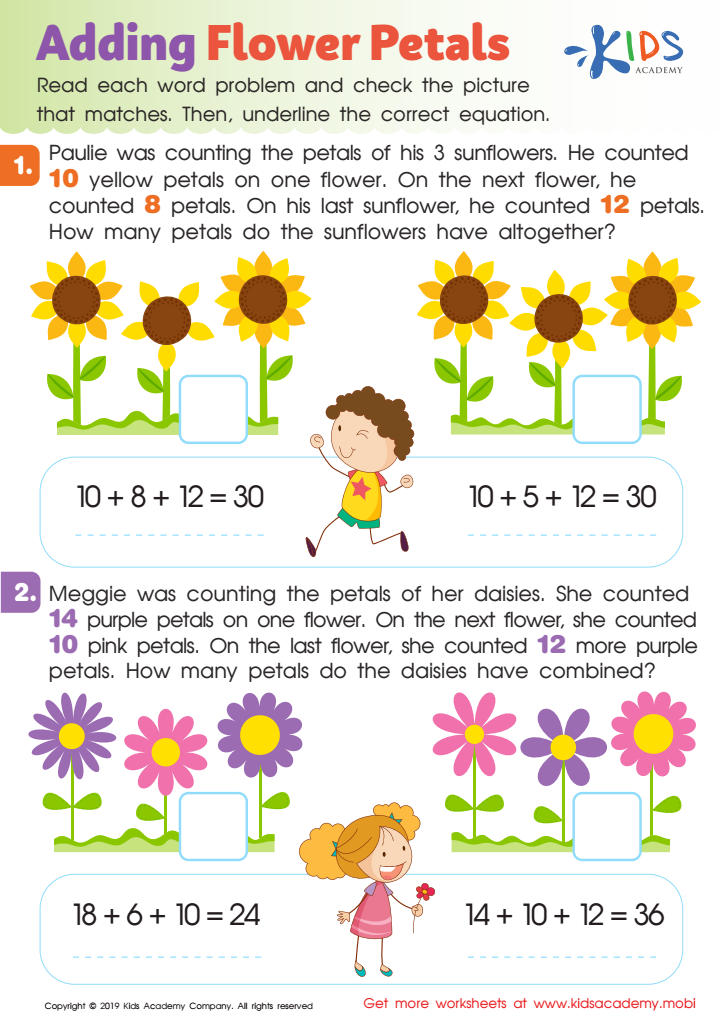
Adding Flower Petals Worksheet
This free worksheet helps little mathematicians learn to understand word problems. They'll read each one and match it to the corresponding picture. Important info is highlighted, teaching kids to look for key info when solving problems. Then they'll underline the correct number equation that matches the picture. A great way to practice problem-solving skills!
 Assign to My Students
Adding Flower Petals Worksheet
Worksheet
Join Kids Academy for Free
Who is primarily going to use this learning content?








Parents and teachers should care about visual perception addition for 8-year-olds because it plays a crucial role in a child's overall mathematical development and academic success. At this age, children are transitioning from basic arithmetic to more complex problem-solving, and strong visual perception skills enhance their ability to interpret and visualize numerical information effectively.
Visual perception addition helps children recognize patterns, shapes, and spatial relationships, which are foundational skills in mathematics. Improved visual processing can lead to quicker and more accurate calculations, fostering confidence in their abilities. It also supports problem-solving in real-world contexts; for instance, when helping with measurements in cooking or understanding charts and graphs.
Moreover, developing visual perception addition can mitigate math-related anxiety, allowing children to approach tasks with a positive mindset. Engaging in activities that strengthen these skills, like puzzles and visual games, promotes not only mathematical proficiency but also cognitive abilities such as critical thinking and memory retention.
In summary, visual perception addition is key to enhancing an 8-year-old's math readiness and overall learning experience, paving the way for future success in higher-level mathematics and everyday situations. Thus, supporting the development of these skills is essential for parents and educators alike.








