
Analog clock reading Math Worksheets for 8-Year-Olds
3 filtered results
Difficulty Level
Grade
Age
-
From - To
Subject
Activity
Standards
Introduce your 8-year-old to the world of timekeeping with our engaging Analog Clock Reading Math Worksheets! Designed to make learning to read an analog clock both fun and educational, these worksheets help kids grasp the concepts of hours, minutes, and time-telling with ease. Perfect for reinforcing classroom lessons or practicing at home, each activity builds essential math and reading skills. With colorful graphics and simplified instructions tailored for young learners, our worksheets offer a practical yet enjoyable way to foster time-telling confidence. Turn every tick-tock into a learning opportunity with our expertly crafted analog clock exercises!
Favorites
With answer key
Interactive
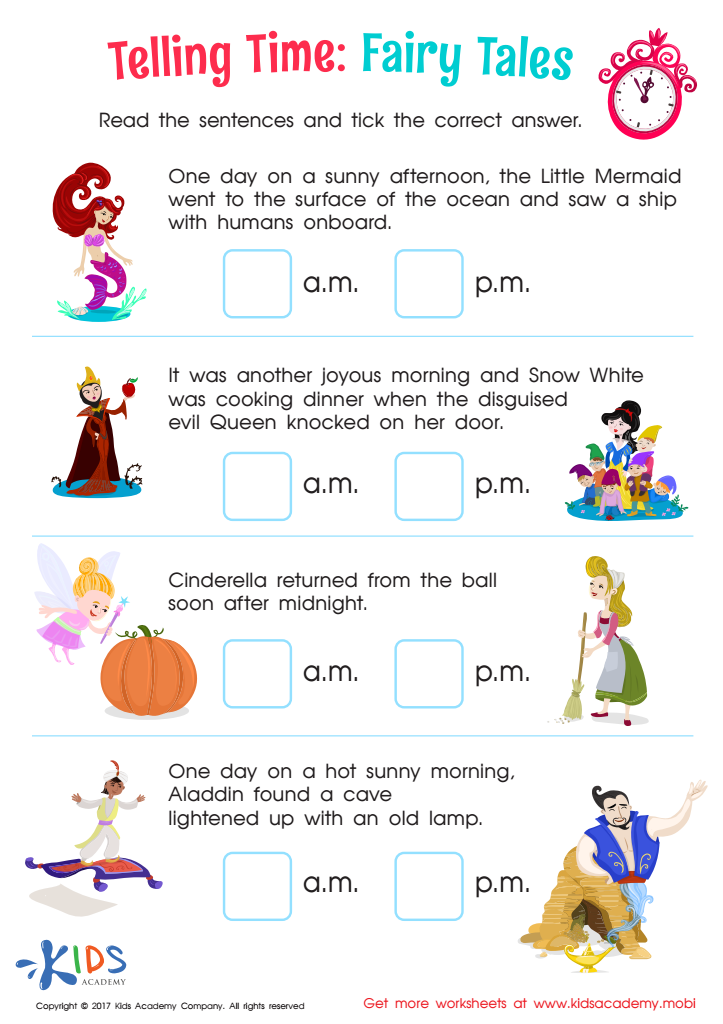
Telling Time: Fairy Tales Worksheet
Bring your child's imagination to life with classic fairy tales! This colorful telling time worksheet has it all: The Little Mermaid, Cinderella, and more! Plus, your child will have fun learning to distinguish a.m. from p.m. with this charming worksheet.
 Assign to My Students
Telling Time: Fairy Tales Worksheet
Worksheet
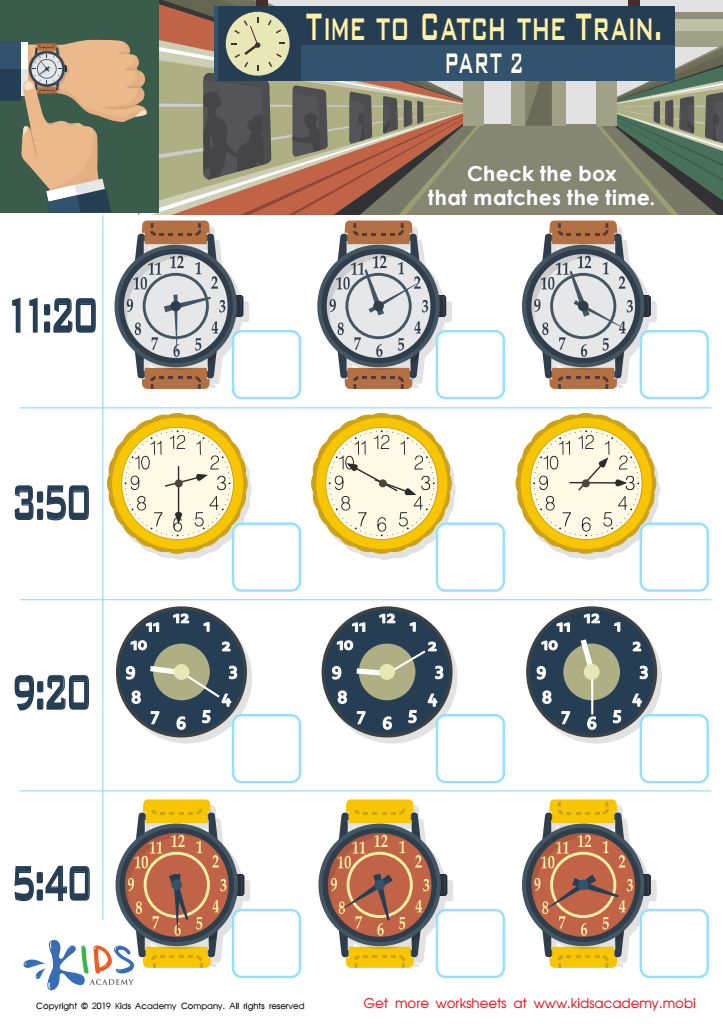
Time to Catch the Train Part 2 Worksheet
Teach your kids the importance of telling time and how to do it. Explain that there are multiple ways to show the time, such as written on the left side or watches in the picture. Guide them to check the box that matches the time. Knowing the time is essential to get things done and create order. Ensure your kids understand this and they will reap the benefits.
Time to Catch the Train Part 2 Worksheet
Worksheet
Join Kids Academy for Free
Who is primarily going to use this learning content?







Understanding how to read an analog clock is essential for 8-year-olds for several significant reasons that parents and teachers should recognize. Firstly, it helps children develop a sense of time management and organization. Knowing how to tell time allows kids to understand schedules, differentiate between various parts of the day, and allocate appropriate time for tasks and activities, which is instrumental in fostering independence and responsibility.
Secondly, reading an analog clock enhances mathematical skills. It involves counting, addition, subtraction, multiplication (by 5s for the minutes), and an awareness of fractions (e.g., understanding that the hour hand halfway between numbers is 30 minutes). This reinforces number sense and mental math abilities, fundamental components of a strong mathematical foundation.
Moreover, analog clock reading connects children to a real-world skill that is still prevalent in their environments. Many public places, homes, and even standardized tests use analog clocks. Therefore, proficiency in reading analog clocks ensures children are not disadvantaged in their daily lives.
Lastly, it broadens their cognitive development. Telling time with an analog clock requires interpreting spatial information within a circular layout, a contrast to the linear progression seen in digital formats. This spatial reasoning is crucial for problem-solving and is beneficial across various academic disciplines.
In essence, mastering analog clock reading supports life skills, math fundamentals, and cognitive growth—critical aspects of an 8-year-old’s educational journey.








