
Comparing sizes Math Worksheets for 8-Year-Olds
3 filtered results
Difficulty Level
Grade
Age
-
From - To
Subject
Activity
Standards
Discover engaging and educational Comparing Sizes Math Worksheets designed for 8-year-olds! Our printable worksheets help children enhance their mathematical skills while making learning fun. Through various interactive activities, kids will practice comparing and contrasting different sizes, lengths, and dimensions. These worksheets are perfect for developing critical thinking and problem-solving abilities, laying a strong foundation for future math success. Each activity is tailored to match the learning pace of young minds, ensuring they grasp key concepts with ease. Ideal for use at home or in the classroom, our Comparing Sizes Math Worksheets make learning enjoyable and effective for all students.
Favorites
With answer key
Interactive
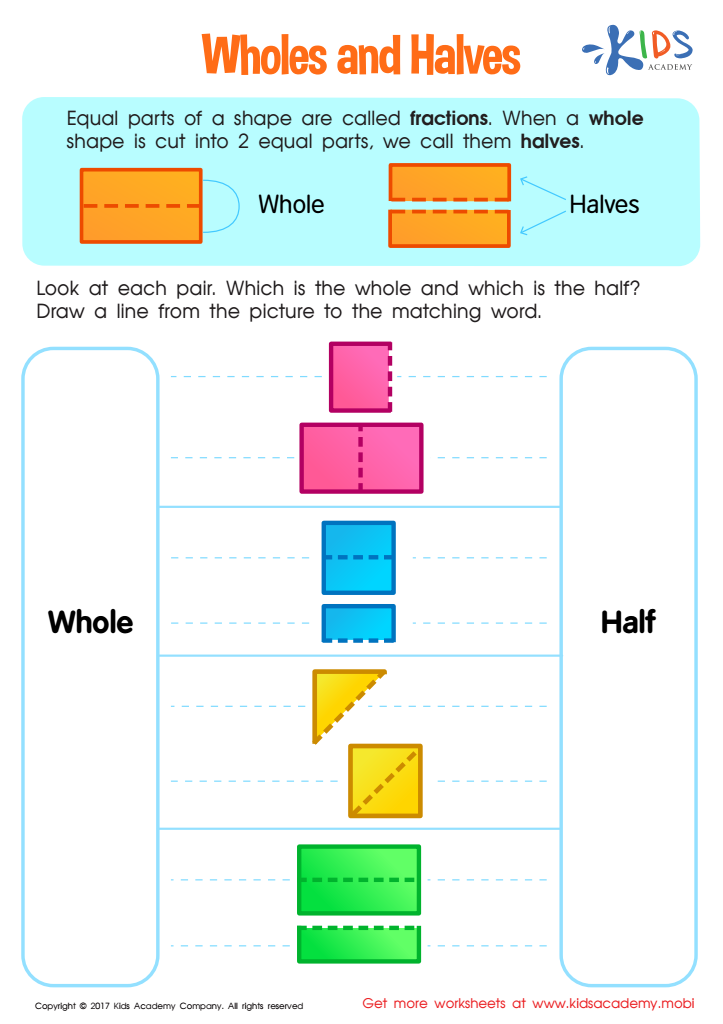
Wholes and Halves Worksheet
Students can feel overwhelmed with fractions. Help take the stress off by using a colorful worksheet to explain whole shapes and how to find halves. Ask them to identify the whole and point to the matching word for the half. A free printout can help guide them.
 Assign to My Students
Wholes and Halves Worksheet
Worksheet
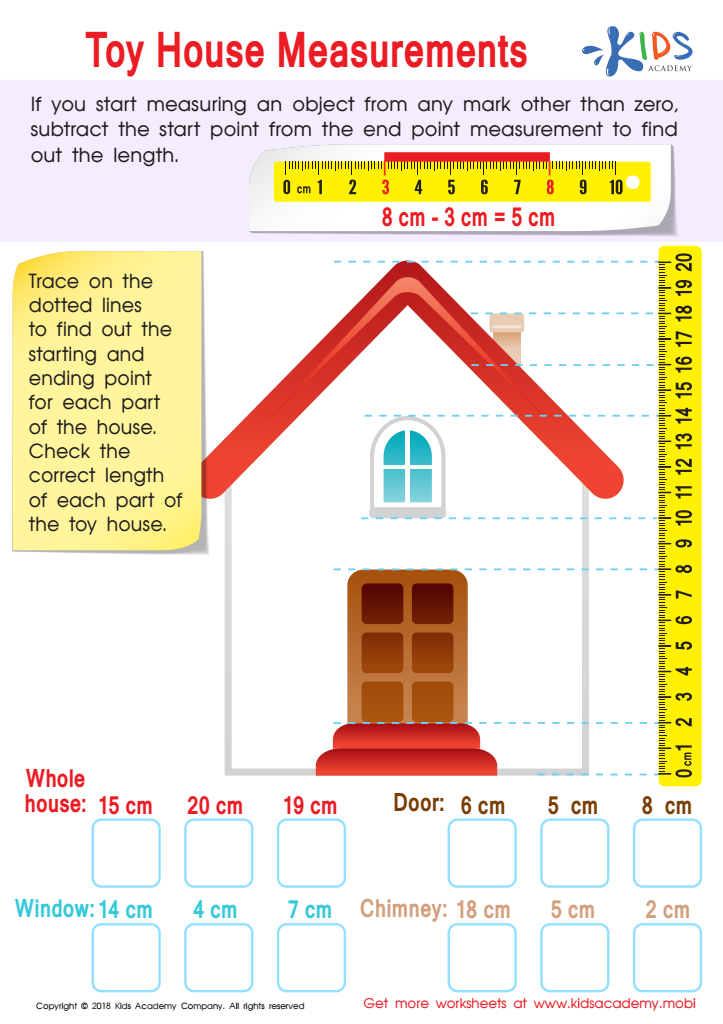
Toy House Measurements Worksheet
This worksheet requires math and measuring skills. When measuring an object from a non-zero starting point, subtract the start point from the end point to get the correct length. Kids must trace the dotted lines to get the right length for each part of the house.
Toy House Measurements Worksheet
Worksheet
Join Kids Academy for Free
Who is primarily going to use this learning content?






%20(1).jpg)
Comparing sizes in math is a fundamental concept that significantly influences a child's cognitive development and practical life skills. For 8-year-olds, mastering this concept enhances their ability to understand and interpret the world around them. When parents and teachers prioritize teaching size comparison, they actually foster critical thinking and problem-solving abilities.
Firstly, comparing sizes helps children grasp basic math concepts such as greater than, less than, and equal to, which are foundational to more advanced topics they'll encounter later on. Understanding size comparisons paves the way for grasping measurements, geometry, fractions, and even algebraic thinking.
Secondly, it aids in developing spatial awareness. Kids learn to judge distances and recognize shapes and patterns, supporting their abilities in everyday tasks like assessing quantities, sorting objects, and following directions. Good spatial awareness is crucial not just in math, but also in physical activities, arts, and sciences.
Moreover, comparing sizes enriches vocabulary and language skills. As they describe objects in terms of "bigger", "smaller", "taller", or "shorter", children enhance their descriptive language abilities.
Lastly, fostering these skills early has psychological benefits. Success in understanding logical and tangible concepts builds confidence, encourages curiosity, and promotes a positive attitude toward learning. Ultimately, focusing on comparing sizes equips children with a robust foundation for both academic success and practical life skills.








