
Counting money Math Worksheets for 8-Year-Olds
3 filtered results
Difficulty Level
Grade
Age
-
From - To
Subject
Activity
Standards
Boost your 8-year-old's financial literacy with our engaging counting money math worksheets! Tailored to help kids master essential money-handling skills, these worksheets feature various activities that involve counting coins, bills, and making change. Our fun and interactive exercises are designed to make learning enjoyable while building real-world math expertise. Perfect for classroom use or at-home practice, these worksheets enhance your child's confidence in everyday calculations. Start today and ensure your child grasitates a solid foundation in money management. Visit Kids Academy for free, printable resources that make learning both fun and effective!
Favorites
With answer key
Interactive
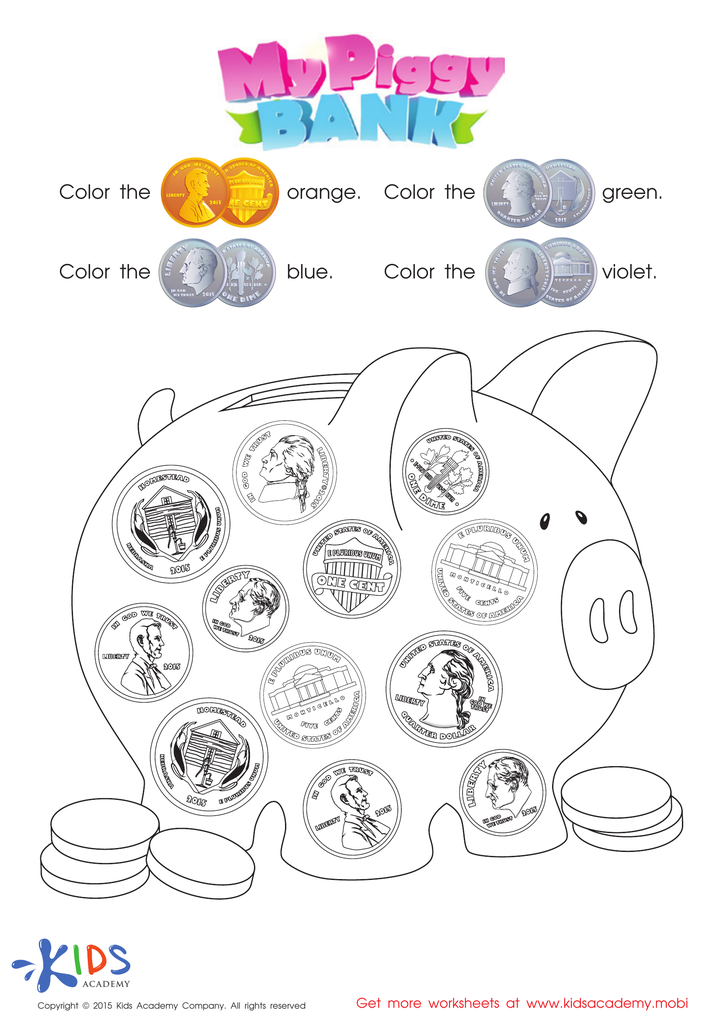
Recognizing Money Money Worksheet
Help the piggy bank by coloring its coins with Kids Academy's free money worksheets! Learn the different coins and their values with your kids. Printable worksheets are available to continue the lesson. Let's learn and have fun!
Recognizing Money Money Worksheet
Worksheet
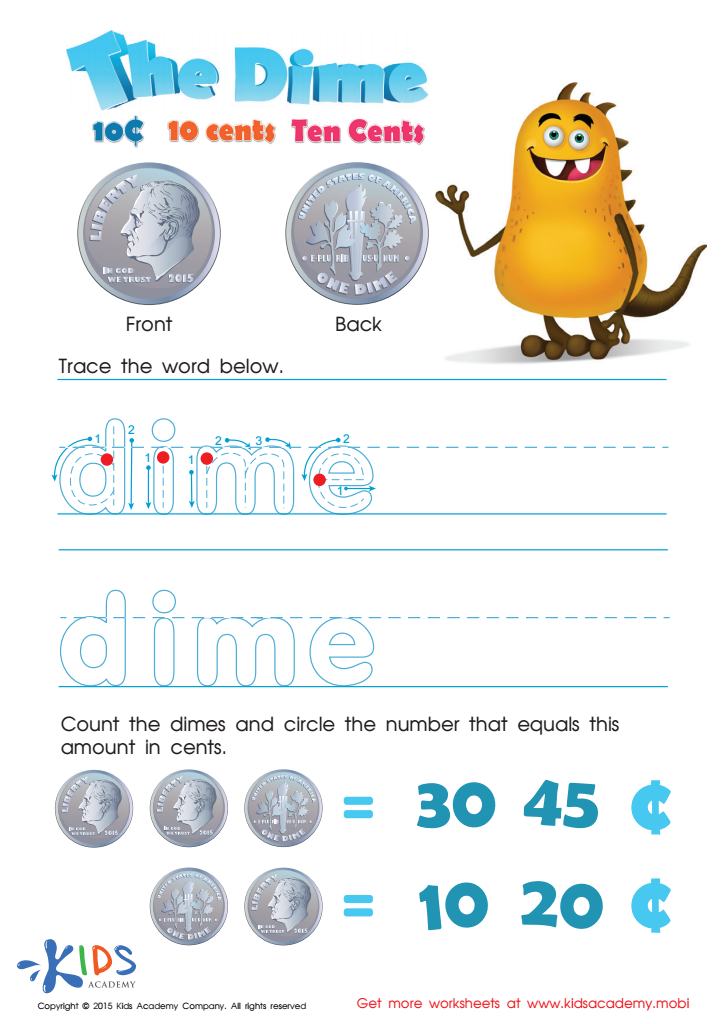
Ten Cents or the Dime Money Worksheet
Introduce your kids to coin games! Start with a dime: trace the word on both sides and count the dimes. Kids Academy has printable worksheets to help your kids learn how to count money.
 Assign to My Students
Ten Cents or the Dime Money Worksheet
Worksheet
Join Kids Academy for Free
Who is primarily going to use this learning content?








Counting money is an essential skill for 8-year-olds as it lays the foundation for financial literacy and practical math application in everyday life. At this age, children are developing numeracy skills, and learning to count money enhances their understanding of basic arithmetic, including addition, subtraction, multiplication, and division.
For parents and teachers, encouraging proficiency in counting money can lead to better cognitive development. It not only strengthens a child's number sense but also introduces real-world application of mathematics, making learning relatable and interesting. For instance, when children handle coins and notes, they learn to perform accurate calculations, thereby improving their problem-solving skills and attention to detail.
Moreover, learning to count money teaches children the value of different denominations, aiding in the comprehension of money management and budgeting—an indispensable life skill. This early exposure can foment responsible spending habits and an appreciation for saving, concepts that are crucial as they grow older.
In essence, by prioritizing counting money, parents and teachers help equip their children with essential mathematical tools and life skills that are vital for both academic success and everyday living. It’s an investment in their future, fostering confidence, independence, and informed financial decision-making.








