
Identifying shapes Math Worksheets for 8-Year-Olds
26 filtered results
Difficulty Level
Grade
Age
-
From - To
Subject
Activity
Standards
Welcome to our “Identifying Shapes Math Worksheets” tailored for 8-year-olds! These interactive and engaging worksheets are designed to bolster your child’s understanding of various shapes, including circles, triangles, squares, and more. As students learn to recognize and classify shapes, they develop essential geometry skills critical for their academic journey. Our resources include fun activities and real-life applications, making math enjoyable and relatable. Each worksheet is crafted to enhance cognitive skills while promoting creativity and problem-solving. Explore our extensive collection of printable worksheets, perfect for reinforcing learning at home or in the classroom. Start shaping your child’s math skills today!
Favorites
With answer key
Interactive
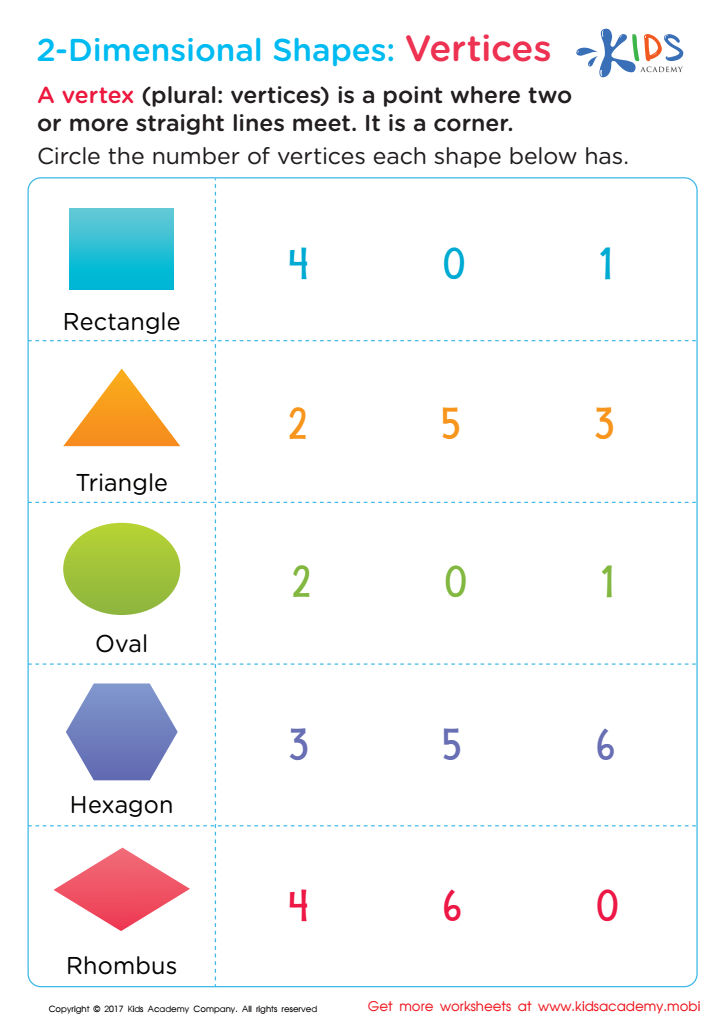
Two–Dimensional Shapes: Vertices Printable
This colorful worksheet teaches kids geometry by introducing them to two-dimensional shapes and vertices. Kids can practice counting vertices and learn an important new math term in an easy to understand way. Boost your child's knowledge of geometry today!
Two–Dimensional Shapes: Vertices Printable
Worksheet
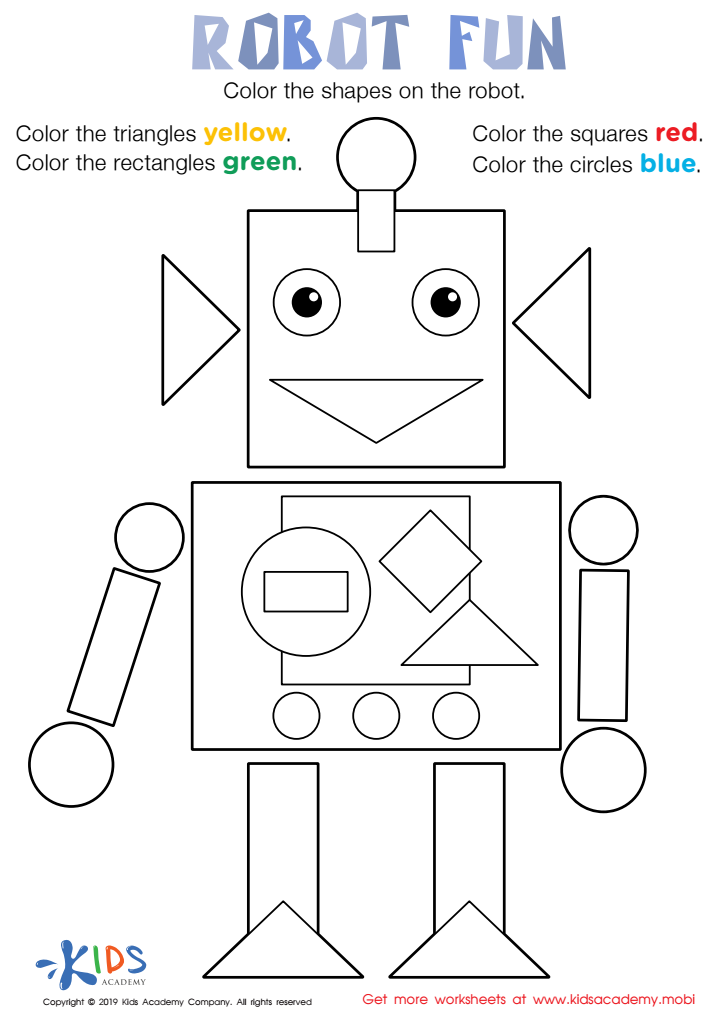
Robot Fun Worksheet
Help your child learn about basic shapes with this fun robot worksheet! Kids practice identifying circles, squares, rectangles and triangles, then color each shape according to directions. Make math practice enjoyable with this coloring page that teaches all four basic shapes - it's an important math skill!
Download (PDF)
 Assign to My Students
Assign to My Students
Robot Fun Worksheet
Worksheet
Join Kids Academy for Free
Who is primarily going to use this learning content?








Identifying shapes is a fundamental mathematical skill that significantly impacts a child’s cognitive development and understanding of the world. For 8-year-olds, this skill goes beyond mere recognition; it lays the groundwork for more advanced concepts in geometry and spatial reasoning. Teachers and parents should prioritize this skill because it enhances critical thinking, problem-solving, and analytical skills.
Shapes are an integral part of everyday life, seen in architecture, nature, and the objects around us. When children learn to identify and differentiate shapes, they sharpen their observational skills and connect mathematical concepts to real-life situations. This knowledge fosters creativity and helps children express thoughts visually, supporting subjects such as art and design.
Furthermore, identifying shapes contributes to developing mathematical vocabulary, introducing terms like "triangle," "rectangle," and "sphere." This vocabulary is crucial as children progress in math and science. Mastery of shapes also forms the foundation for understanding more complex mathematical relationships and equations in higher grades.
By prioritizing shape identification, parents and teachers empower children with essential skills that promote confidence in math and encourage lifelong learning. A solid foundation in geometry certainly leads to greater academic and problem-solving success later in life.








