
Understanding number relationships Math Worksheets for 8-Year-Olds
3 filtered results
Difficulty Level
Grade
Age
-
From - To
Subject
Activity
Standards
Explore our "Understanding Number Relationships" math worksheets designed specifically for 8-year-olds! These engaging resources help young learners grasp essential concepts like addition, subtraction, and the relationship between numbers. With a variety of exercises, students will enhance their problem-solving skills and develop a strong numerical foundation. Our worksheets promote critical thinking as children explore patterns, comparisons, and sequencing. Perfect for classroom learning or at-home practice, these worksheets support different learning styles and provide instant feedback to boost confidence. Download and integrate these worksheets into your teaching toolkit to foster a love for math while building foundational skills in young mathematicians!
Favorites
With answer key
Interactive
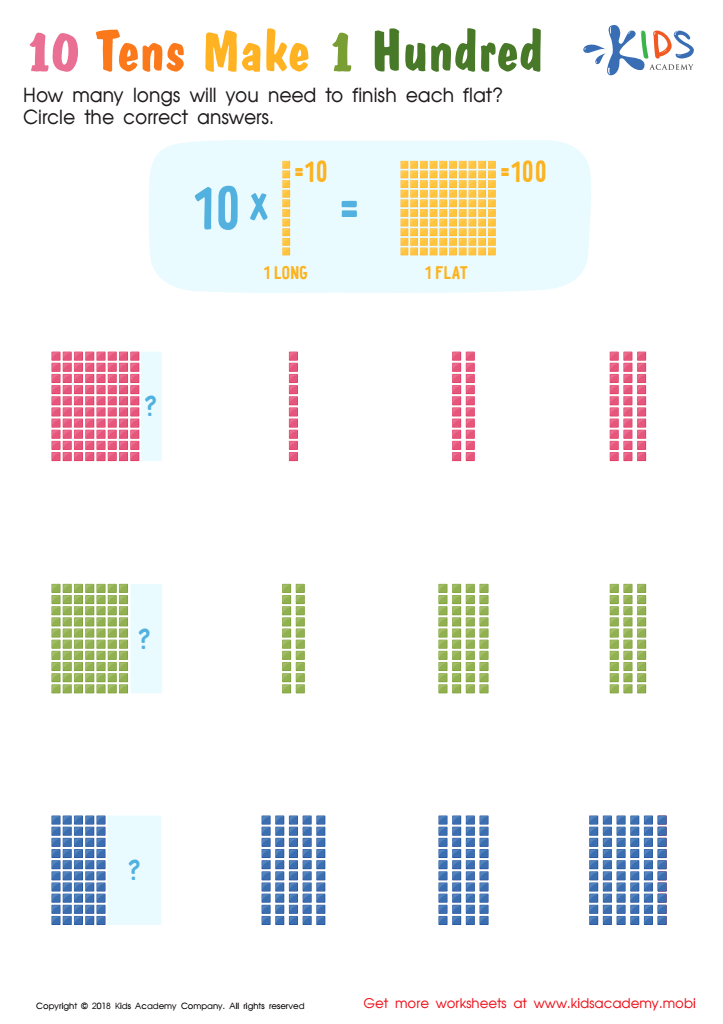
10 Tens Make 1 Hundred Worksheet
Help your child understand multiplication with this worksheet. Ask them how many 'longs' will be needed to complete each flat, then have them circle the correct answer from the options. With this exercise, your child will learn that 10 'tens' make 1 'hundred'!
 Assign to My Students
10 Tens Make 1 Hundred Worksheet
Worksheet
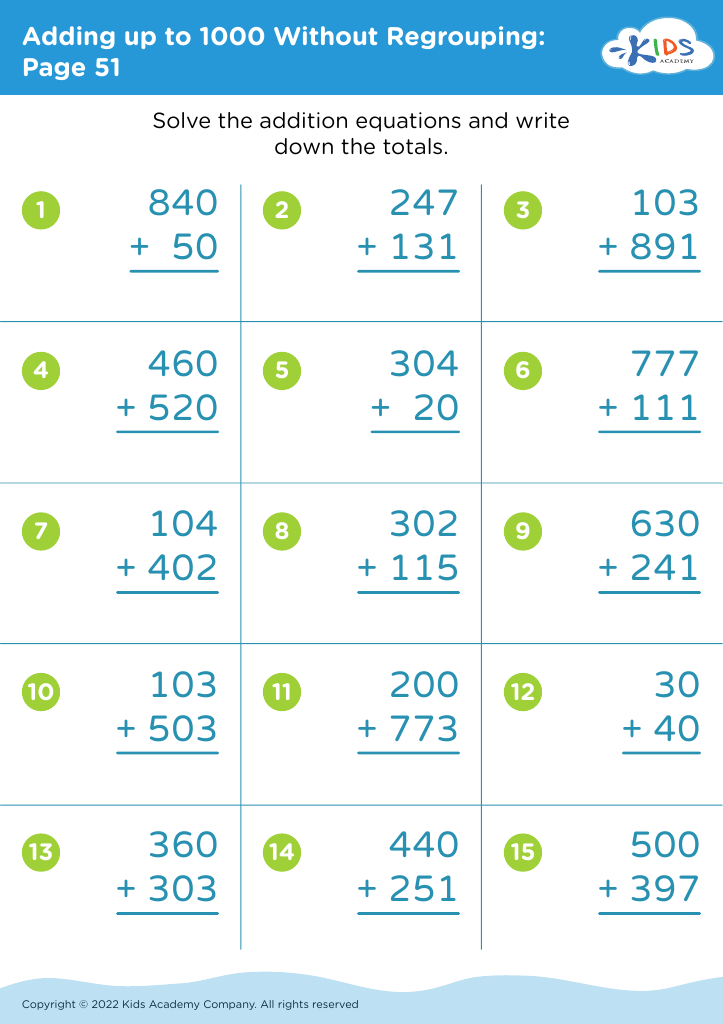
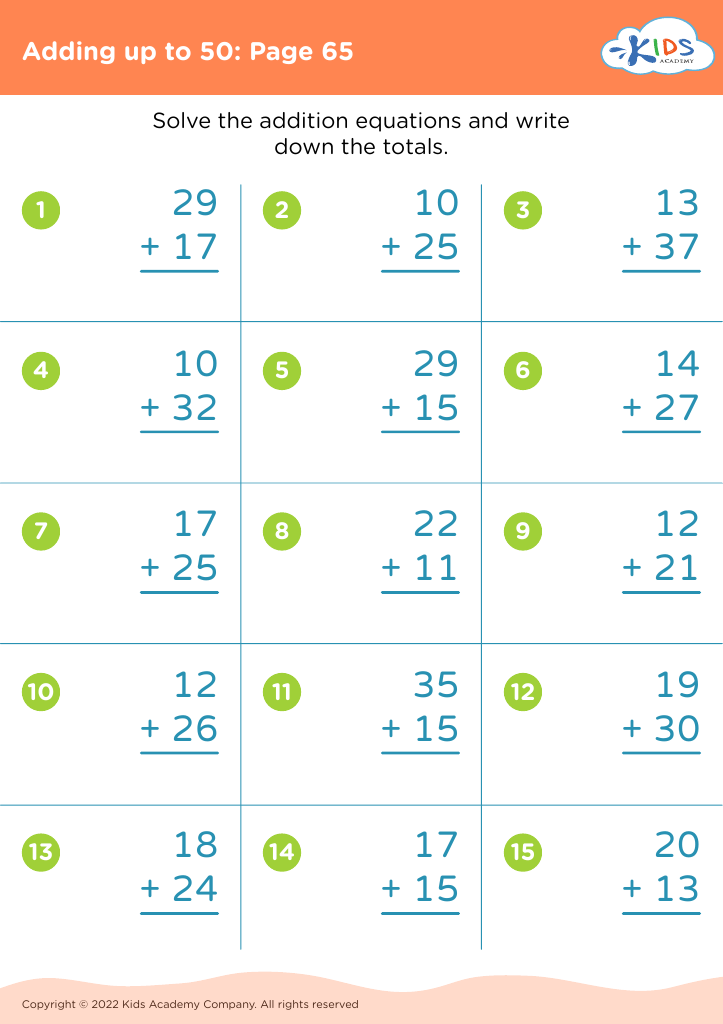
Join Kids Academy for Free
Who is primarily going to use this learning content?





Understanding number relationships is essential for 8-year-olds because it forms the foundation for their future mathematical skills. At this age, children begin to move from basic arithmetic to a deeper understanding of how numbers interact, which is critical for problem-solving and logical thinking. When students comprehend concepts such as place value, addition and subtraction relationships, and the connections between different operations, they gain confidence in their abilities, turning math anxiety into enthusiasm.
Parents and teachers play a crucial role in nurturing this understanding. By fostering an environment where kids can explore number relationships, they help develop critical thinking skills that extend beyond math. Engaging activities, real-life applications, and discussions around numbers allow children to see patterns and develop strategies to tackle more complex problems.
Moreover, a firm grasp of number relationships supports success in later academic pursuits, including algebra and geometry. It also enhances overall cognitive development, improving reasoning and analytical skills. Ultimately, encouraging an understanding of number relationships not only equips children with essential math skills but also prepares them for lifelong learning and practical problem-solving in everyday situations. Thus, clarity and support from parents and teachers are vital in this critical stage of development.








