Understanding symmetry Math Worksheets for 8-Year-Olds - Page 2
27 filtered results
-
From - To
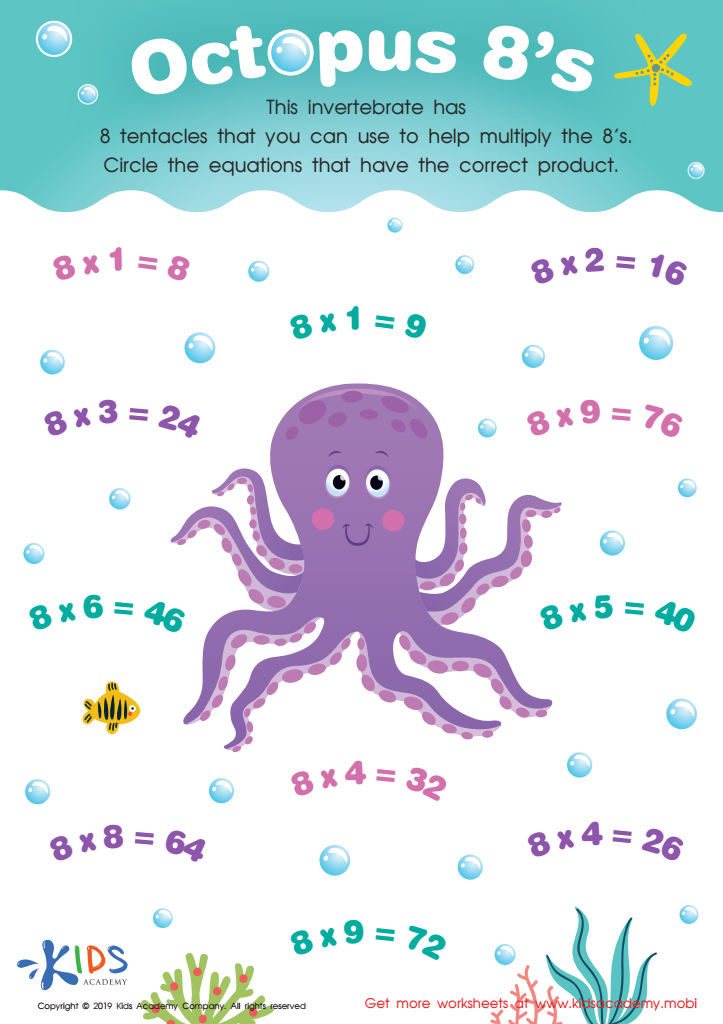
Octopus 8’s Worksheet
 Assign to My Students







Understanding symmetry is crucial for 8-year-olds as it lays a foundation for their overall math comprehension and problem-solving abilities. At this age, children begin to grasp more complex mathematical concepts, and symmetry introduces them to important ideas in geometry. It enhances spatial awareness, allowing kids to recognize patterns, shapes, and angles, which are essential skills not just in math but in many real-world applications, such as art, architecture, and nature.
For parents and teachers, fostering an understanding of symmetry helps cultivate critical thinking. As children explore symmetry, they engage in activities that require reasoning and logical thinking – skills they will use throughout their education and lives. Additionally, symmetry reinforces creativity as children learn to appreciate balance and beauty in design, helping them to express themselves through art and other subjects.
Moreover, symmetry is a bridge to advanced concepts in mathematics, such as algebra and calculus. By instilling an appreciation for symmetry early on, adults can help children build confidence in their mathematical abilities, making future lessons less intimidating. Overall, prioritizing symmetry in education contributes not only to stronger math skills but also to well-rounded cognitive development.








