
Visual interpretation Math Worksheets for 8-Year-Olds
5 filtered results
Difficulty Level
Grade
Age
-
From - To
Subject
Activity
Standards
Dive into the fun world of visual interpretation with our specially designed math worksheets for 8-year-olds! These engaging worksheets from Kids Academy enhance math skills through visual learning, aiding in the comprehension of complex concepts. Young learners will enjoy solving puzzles, decoding graphs, and analyzing images that help develop critical thinking and problem-solving abilities. Each worksheet is crafted to keep children entertained while reinforcing essential math standards. Whether your child is learning at home or needs extra practice, our visual interpretation worksheets are the perfect tool to make math exciting and accessible. Explore and watch their math confidence grow!
Favorites
With answer key
Interactive
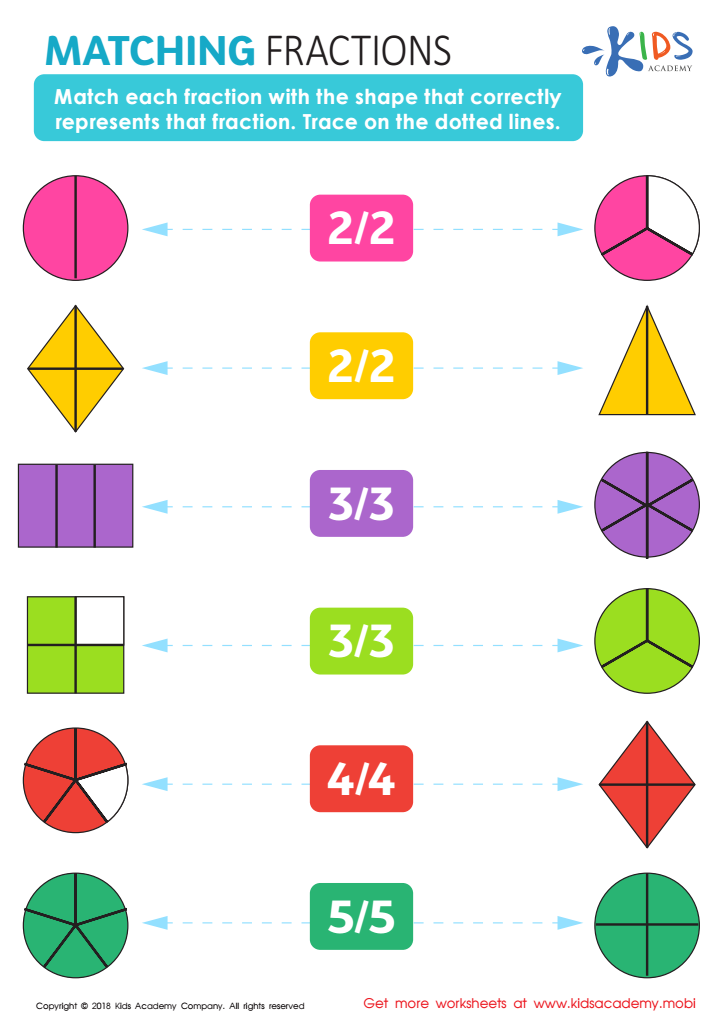
Matching Fractions Worksheet
This worksheet uses colorful images to engage students. On the left are six shapes, mirrored on the right, with fractions in the middle. Students must match up the fraction with the right shape. It's a fun way to sharpen fractions skills!
 Assign to My Students
Matching Fractions Worksheet
Worksheet
Join Kids Academy for Free
Who is primarily going to use this learning content?








Visual interpretation in math is crucial for 8-year-olds as it enhances their understanding and retention of mathematical concepts. At this age, children are often concrete thinkers who benefit from seeing abstract ideas represented visually. Visual tools, such as pictures, diagrams, and manipulatives, help bridge the gap between concrete objects and abstract thinking. When children can see math, they can better grasp concepts like addition, subtraction, fractions, and geometry.
Furthermore, visual interpretation caters to different learning styles. Not all children learn effectively through verbal or written instructions alone; some excel when information is presented visually. By incorporating visual tools, teachers and parents support these diverse learners, promoting inclusive education.
Using visual methods also makes math more engaging and less intimidating. Many children associate numbers with anxiety, but visual aids turn math into an interactive and enjoyable activity. This positive experience is crucial, as early attitudes toward math can influence a child's confidence and performance in the subject for years to come.
Lastly, visual interpretation encourages problem-solving and critical thinking skills. Children learn to approach problems from multiple angles and find creative solutions. This foundational skill set not only applies to math but also enhances general cognitive development, preparing them for future academic challenges.








