Improve your child’s cursive writing skills with Alphabet Recognition Cursive Writing Worksheets tailored for 8-year-olds. These engaging worksheets help children master cursive letter formations while reinforcing alphabet recognition. Each worksheet offers step-by-step guides to enhance writing fluency and build muscle memory for each letter. Perfect for classroom or at-home practice, our well-designed activities make learning cursive fun and effective. Compact lessons ensure kids stay motivated and progress confidently. Empower your child’s handwriting skills today with our expert-designed cursive worksheets and watch their abilities shine. Ideal for second and third graders to boost their writing prowess!

Check out this FREE Trial Lesson on Cursive Writing for age 8!

Sorting Objects into 3 Categories

Favorites
With answer key
Interactive
  • 8
  • Alphabet Recognition
  • Cursive Writing
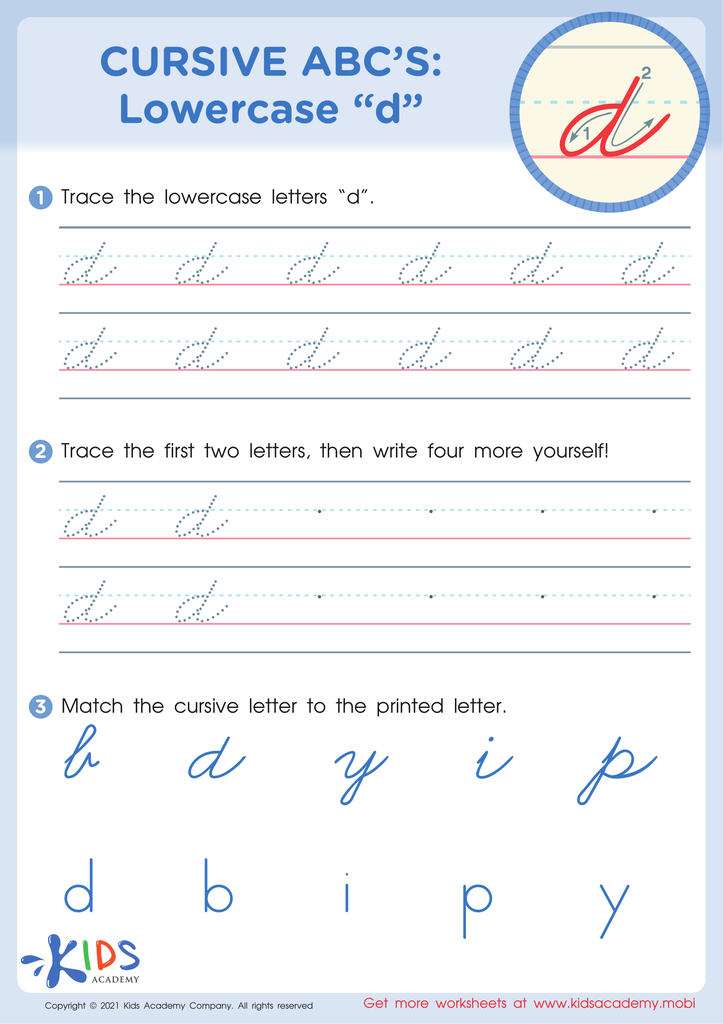
Cursive ABCs: Lowercase d

Cursive ABCs: Lowercase d

To make learning fun, introduce colorful worksheets! These help young learners perfect their cursive lowercase 'd'. By the end, they'll be better at writing and identifying the letter. It's an easy and enjoyable exercise for kids!
Cursive ABCs: Lowercase d
Worksheet
Cursive ABCs: Uppercase E

Cursive ABCs: Uppercase E

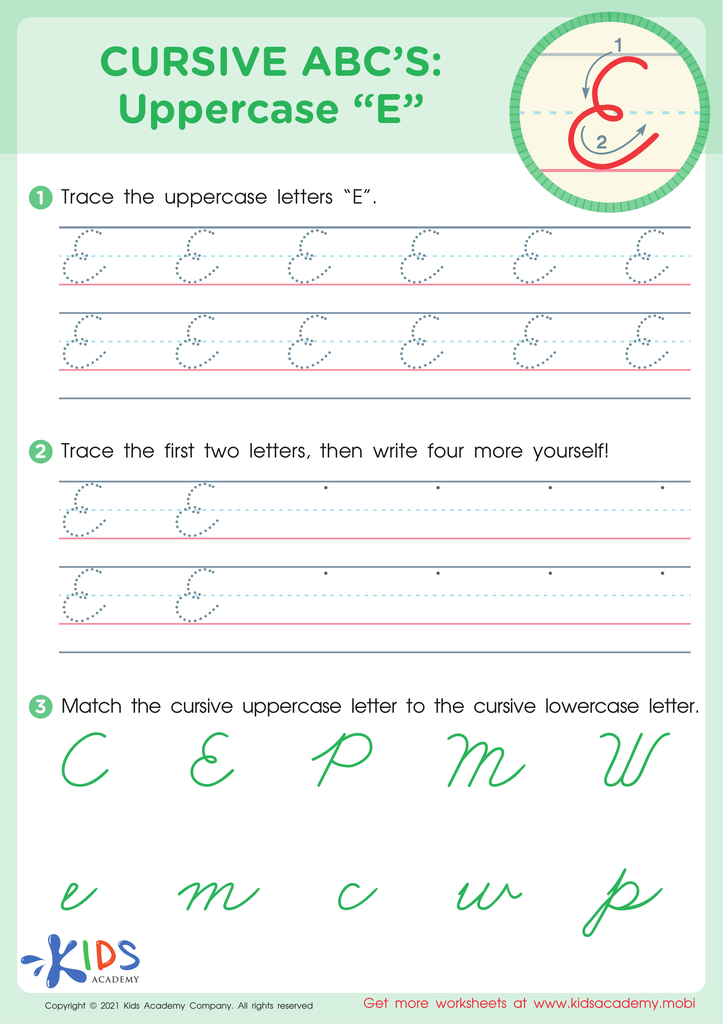
Ask your child if they can identify the letter 'E' and give examples. Each letter is unique, so provide coaching. Have them trace cursive 'E' to become familiar and boost confidence. Then, ask them to write it on their own.
Cursive ABCs: Uppercase E
Worksheet
Cursive ABCs: Uppercase G

Cursive ABCs: Uppercase G

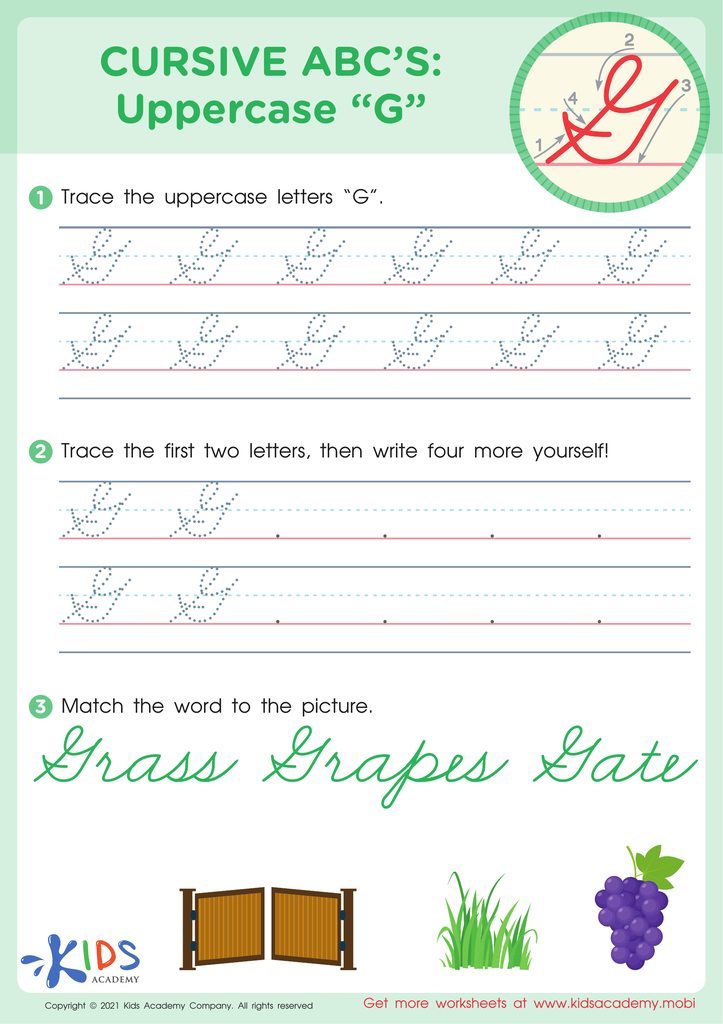
Remind your kids of words beginning with 'G' like 'girl' and 'goat'. Ask them to give examples too. Use this tracing worksheet to help your kids practice writing the cursive uppercase 'G'. It'll help them perfect their motor skills and get better at cursive letters.
Cursive ABCs: Uppercase G
Worksheet
Cursive ABCs: Lowercase c

Cursive ABCs: Lowercase c

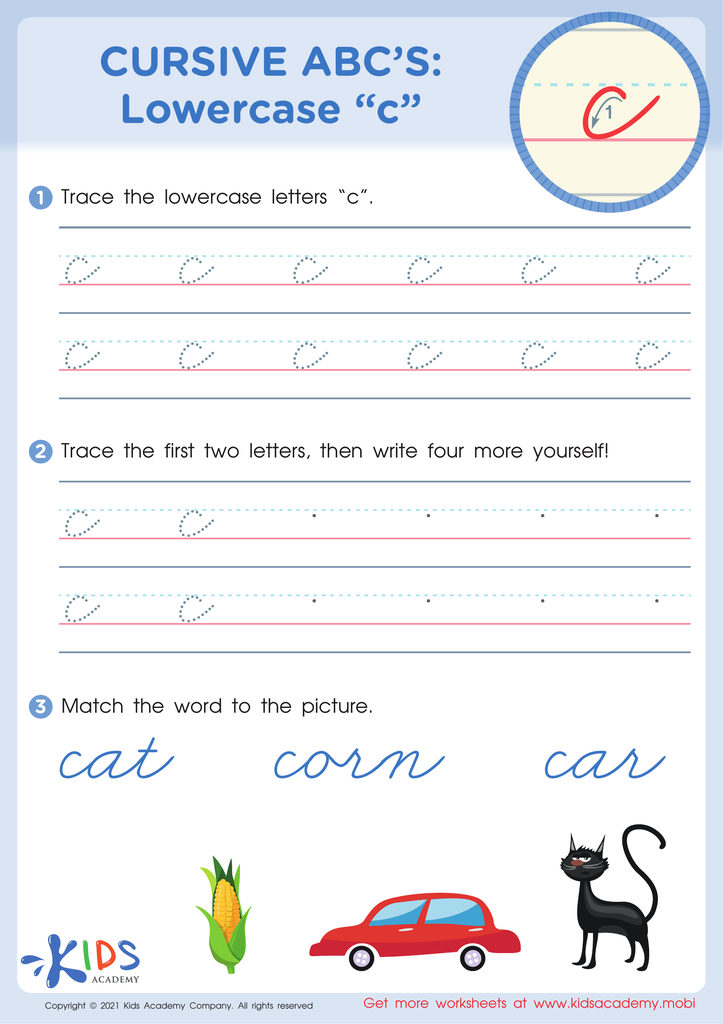
Once your child has successfully printed their letters, help them learn to recognize and write the alphabet in cursive. Struggling? This worksheet is perfect to assist them. Writing is an essential skill for kids to learn, so do all you can to help them. Use these tracing worksheets and guide them as they write the lowercase letter 'c' in cursive.
Cursive ABCs: Lowercase c
Worksheet
Cursive ABCs: Lowercase b

Cursive ABCs: Lowercase b

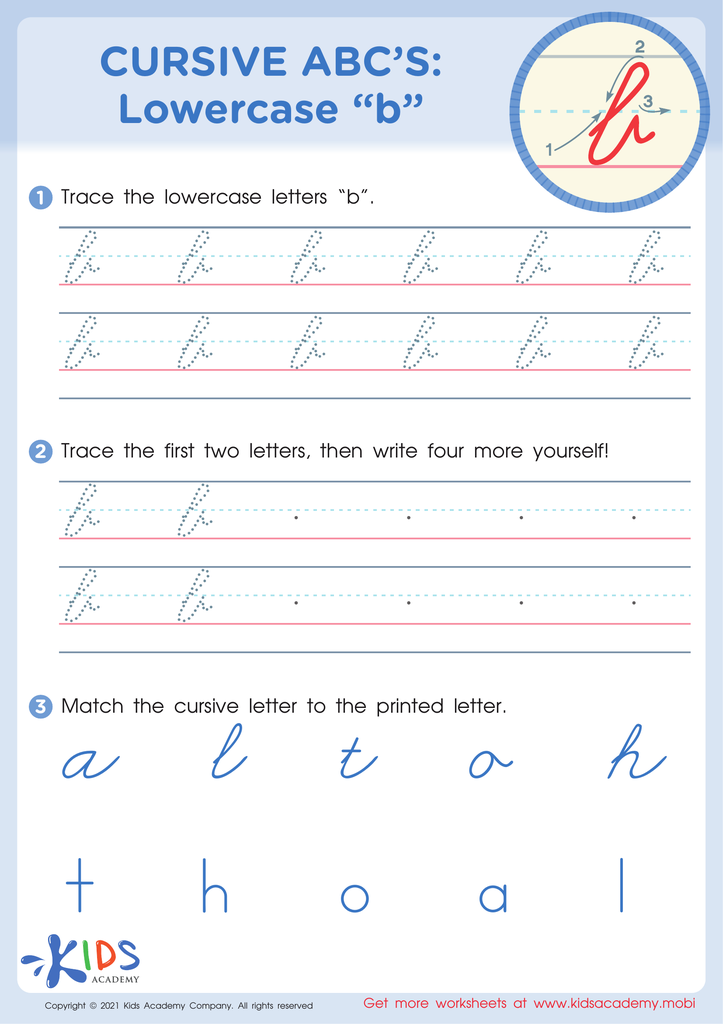
Trace two lines of lowercase b's with your kids. Guide them through the loops and swirls to help them learn cursive handwriting. Then let them practice writing the letter b themselves in the last two lines. With this exercise, your kids should become better at writing and recognizing the lowercase cursive b.
Cursive ABCs: Lowercase b
Worksheet
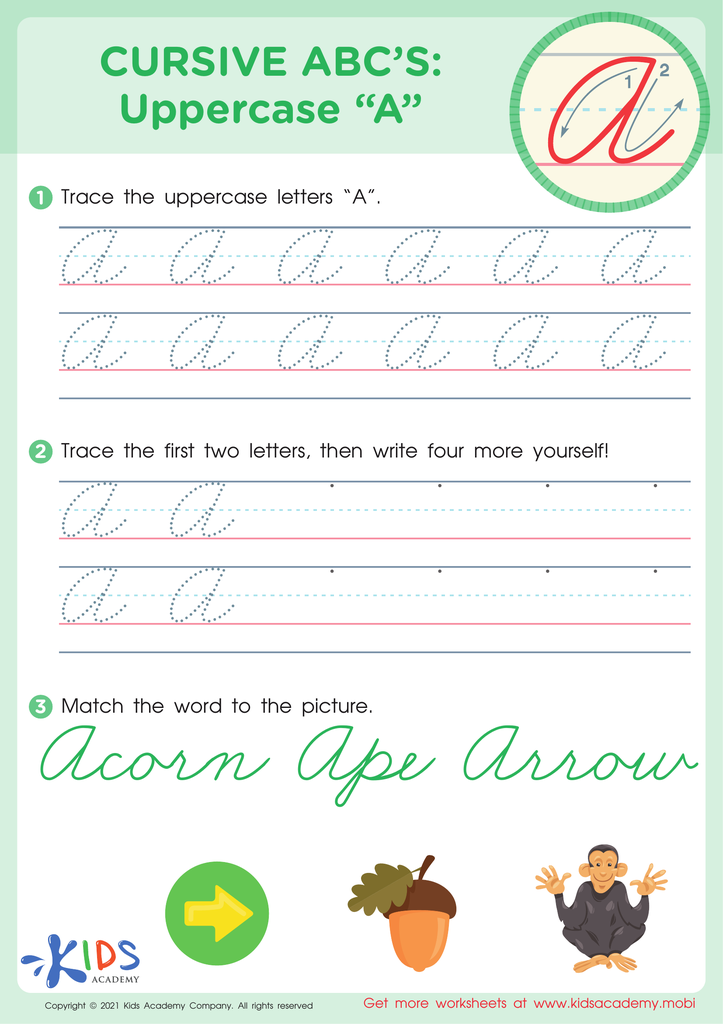
Cursive ABCs: Uppercase A

Cursive ABCs: Uppercase A

Help your kids develop their writing skills with our great tracing sheets. Improve their motor skills, as well as their vocabulary, by guiding them through tracing the dotted lines for the uppercase letters of the alphabet. When they are ready, let them practice writing the letters on their own for improved confidence.
Cursive ABCs: Uppercase A
Worksheet
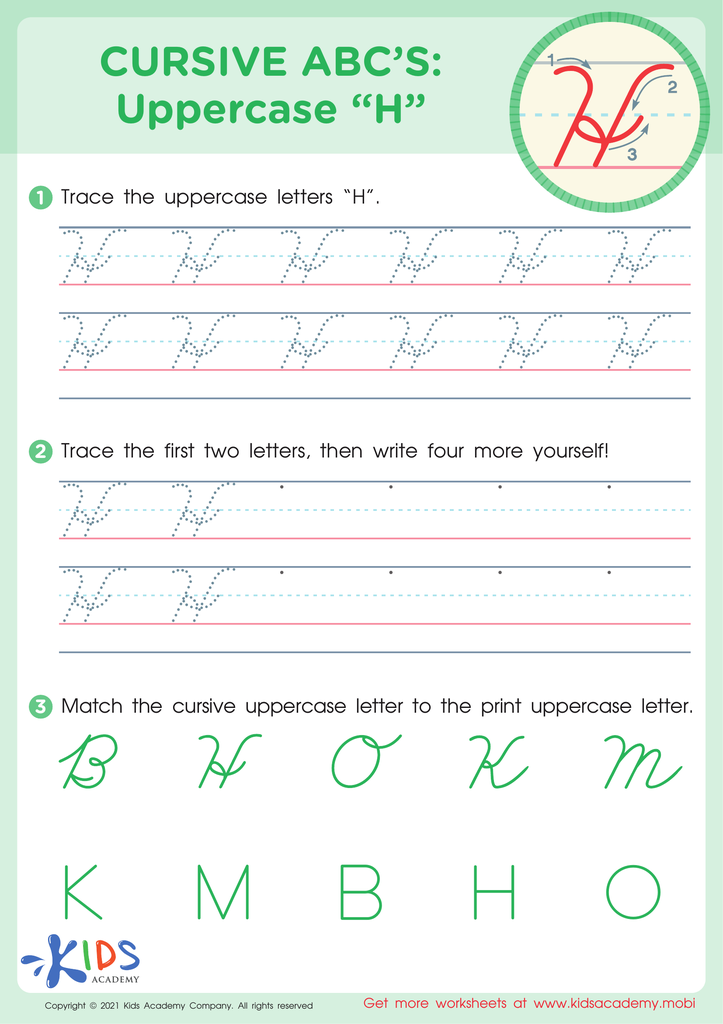
Cursive ABCs: Uppercase H

Cursive ABCs: Uppercase H

Have your child recite the alphabet and give you words beginning with H. This tracing sheet is perfect to help them improve their handwriting. Guide their hands as they trace the uppercase H, then have them practise writing it alone. At the bottom is an exercise to check their letter recognition.
Cursive ABCs: Uppercase H
Worksheet


Alphabet recognition in cursive writing is vital for 8-year-olds as it significantly bolsters several facets of early childhood development that contribute to long-term educational success. Firstly, it enhances fine motor skills. Learning to write cursive involves a specific sequence of pen movements that help children develop better hand-eye coordination and dexterity, which are essential for everyday tasks and other academic activities.

Additionally, cursive writing aids memory retention and cognitive growth. The connected, flowing nature of cursive writing can activate different parts of the brain compared to print writing, enhancing learning connections and improving memory recall. Studies have shown that writing by hand, especially in cursive, can stimulate brain synapses and synchronicity between the right and left hemispheres.

Moreover, alphabet recognition in cursive prepares students for situations where they might encounter longhand writing in historical documents or older printed materials. It prepares them to read diverse forms of text, promoting literacy and cultural continuity.

Furthermore, the pride and accomplishment felt by mastering a sophisticated skill like cursive writing can foster self-esteem and a greater interest in learning. Engaging with cursive writing can thus build a strong foundation for an array of social, academic, and personal skills that serves children throughout their lives. So, investing in alphabet recognition in cursive practice is a holistic approach to a child’s educational enrichment.